Get Full Government Meeting Transcripts, Videos, & Alerts Forever!
Get email alerts on the Horse Racing Reform topic
No spam. Unsubscribe anytime.
Committee hears bill to modernize horse racing law, alter parimutuel thresholds and license rules
Summary
Senate Bill 5,563 would update multiple RCWs governing horse racing, change parimutuel withholding thresholds, remove a per-day race cap and alter licensing provisions; the Horse Racing Commission and industry representatives said changes reflect modern practices and address financial strains.
Senate Bill 5,563, an agency-request bill from the Washington State Horse Racing Commission, received a public hearing before the Senate Business, Financial Services, Gaming & Trade Committee. The proposal updates numerous statutes governing pari-mutuel wagering, licensing, and commission governance.
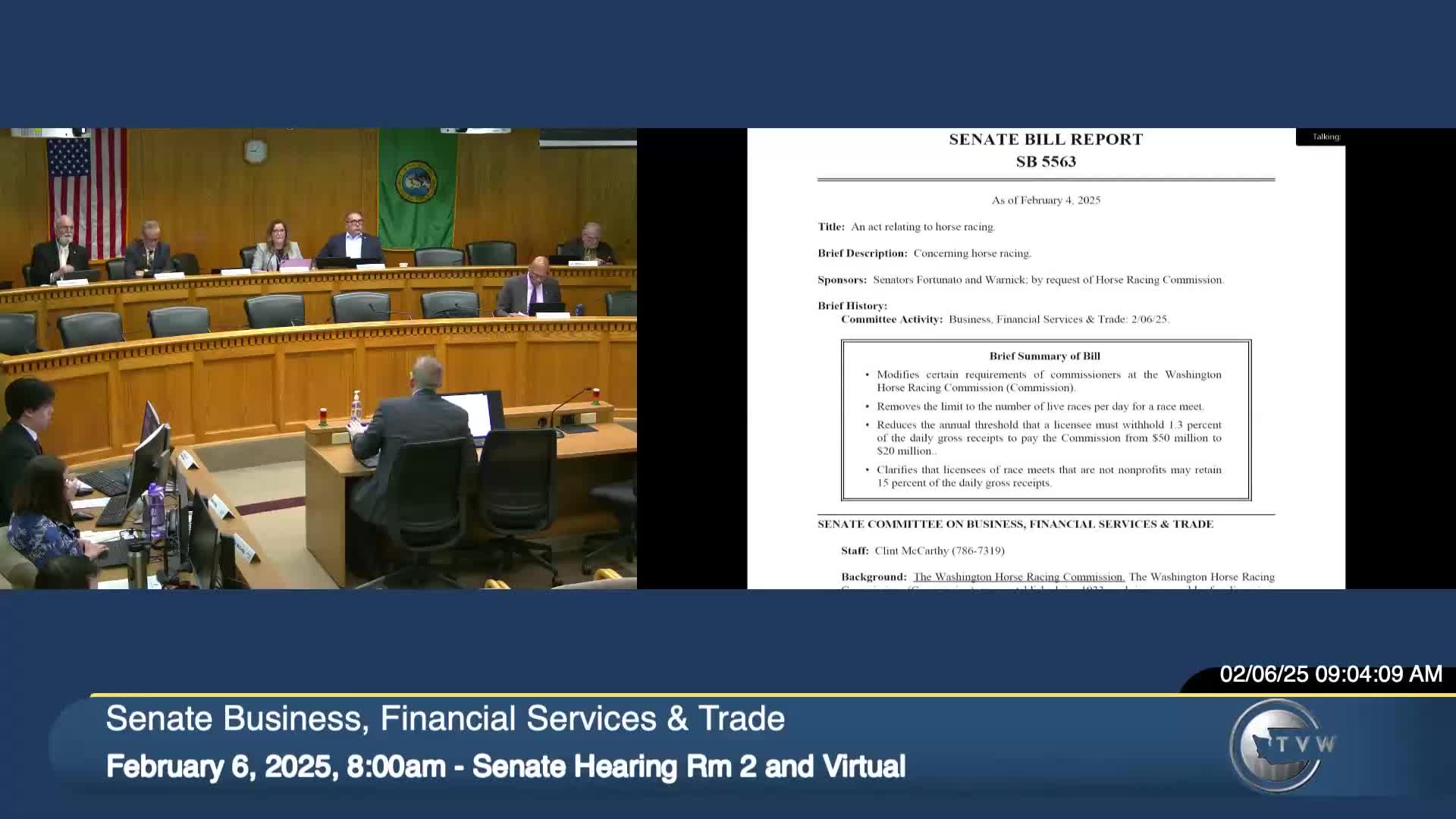
Clem McCarthy, committee staff, summarized the bill’s major provisions: it would remove the requirement that one of three commissioners be a racehorse breeder, prevent commission employees from working simultaneously at tracks they oversee, permit out-of-state simulcast wagering on tracks not under the commission’s jurisdiction, and remove the statutory maximum number of live races per day. Parimutuel withholding thresholds would change: the current $50 million gross-receipts threshold would be reduced to $20 million and licensee retained percentages would be standardized at 15 percent; race-day per-race fees would be set at $500 regardless of annual gross receipts. The bill would also expand the commission’s ability to spend for equine industry development, increasing an authorization from $300,000 to $500,000 per fiscal year.
Amanda Benton, executive secretary of the Washington Horse Racing Commission, described the bill as a regulatory "clean up" to modernize statutes that have not been substantially updated in 15–20 years. Benton and industry witnesses said declining wagering handle and rising costs have strained the industry and commission budgets.
Senator Joe Fain Stanford (Sen. Stanford) asked about declining handle and the commission’s fiscal outlook, noting the federal Horse Racing Integrity and Safety Authority (HISA) assessment has raised concerns. Benton told the committee the commission projects a negative fund balance within 15–18 months without supplemental support; she said adjustments to source market fees provide limited flexibility but are not sufficient to cover potential federal assessments.
Sponsor Senator John Fortunato said the bill is intended to streamline regulatory requirements and lower operating costs to make the industry more viable. Industry witnesses including Emerald Downs executives and representatives of horsemen’s associations described the track’s local economic impact and urged legislative action to avoid closures and preserve jobs.
The hearing was informational and included testimony from Emerald Downs leadership, jockeys, kitchen staff who said the racetrack supports local employment, and the Horsemen’s Benevolent and Protective Association. No committee vote occurred at the hearing.