Get Full Government Meeting Transcripts, Videos, & Alerts Forever!
Get email alerts on the Life Insurance Suicide Exclusion topic
No spam. Unsubscribe anytime.
Senate committee hears bill to shorten life insurance suicide exclusion from two years to one
Summary
Senate Bill 5,495 would reduce the statutory suicide exclusion in individual life policies from two years to one year; sponsor and advocates framed change as reducing stigma and easing access for families, while industry groups warned of public-safety and actuarial consequences.
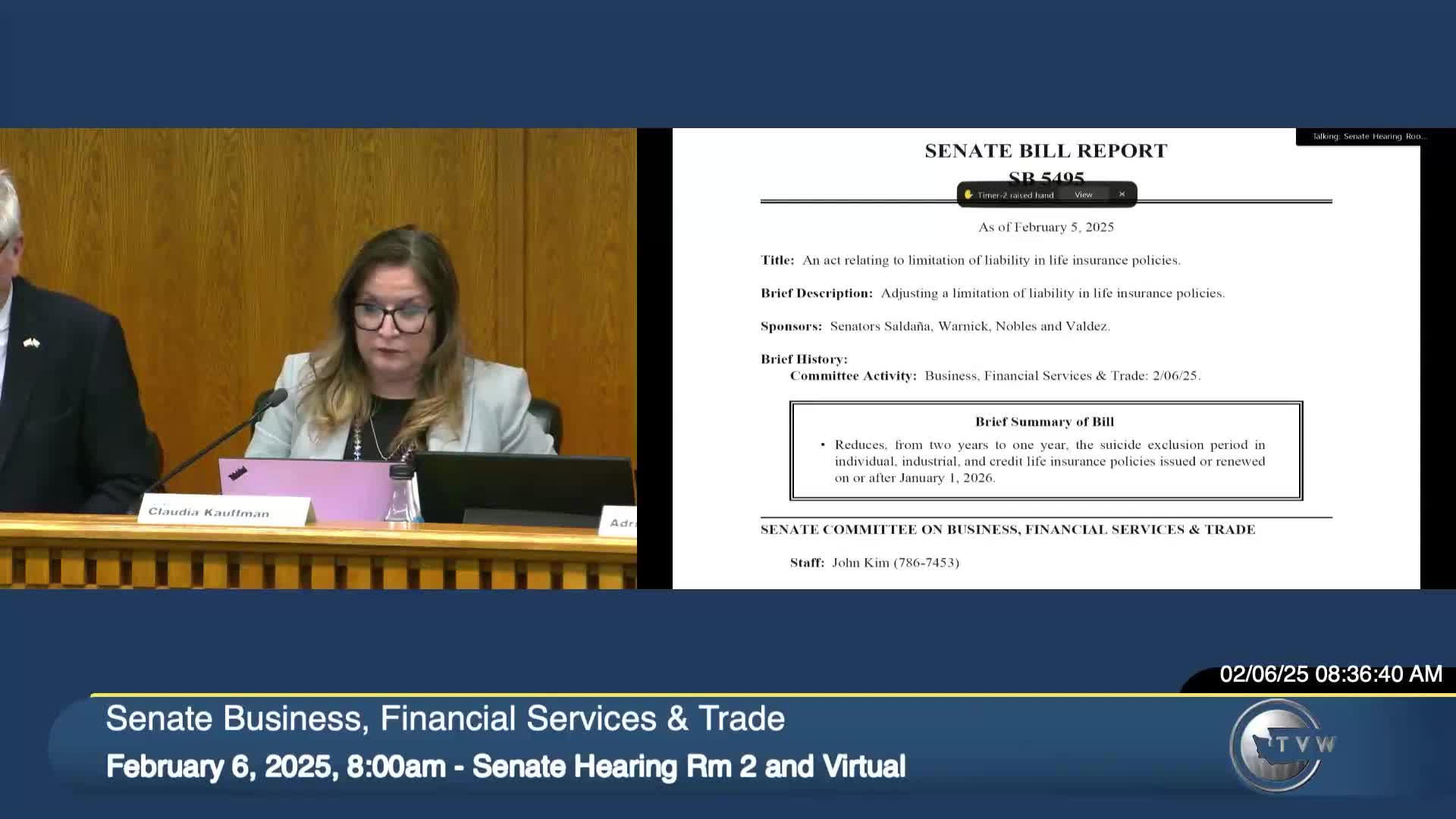
Senate Bill 5,495, which would reduce the statutory suicide exclusion for individual life insurance policies from two years to one year for policies issued or renewed on or after Jan. 1, 2026, received public hearing testimony before the Senate Business, Financial Services, Gaming & Trade Committee.
Senator Manka Dhingra Saldana (Sen. Saldana), sponsor of SB 5,495, told the committee she proposed the change after work on an agriculture mental-health task force that documented suicide risks in farming communities. She said the bill aims to reduce a perception that families cannot collect life insurance benefits after a suicide, and to encourage people to seek help instead of remaining silent. "I want people to know that suicide is not a sin...their families should not then have to feel that stigma," Saldana said.
Supporters included the Washington Farm Bureau, which noted high farm stress and cited statistics showing farms and farm families face elevated suicide risk. Bree Elzey of the Farm Bureau told the committee that farmers confront high labor costs, loss of farms and other stressors, and that access to life insurance for grieving families can reduce stigma and financial hardship.
The life insurance industry opposed shortening the exclusion. Chris Teft, representing the American Council of Life Insurers (ACLI), said ACLI supports the existing two-year exclusion and noted 46 states currently use a two-year period; four states have more recently moved to a one-year clause. Teft said ACLI’s concerns include the risk that shortening the exclusion could increase demand for life policies by people contemplating suicide and could unintentionally lead to higher suicide rates. "We are concerned that the 2 year exclusion does 2 things. It reduces the likelihood that people will buy life insurance coverage with the intent to commit suicide and it helps maintain more affordable premiums for all applicants," Teft said.
Testimony was primarily advocacy and informational; committee staff and members discussed possible technical fixes and the potential unintended consequences of changing the statutory waiting period. No committee vote occurred at the hearing. If enacted, the bill would apply to policies issued or renewed on or after Jan. 1, 2026.