Get Full Government Meeting Transcripts, Videos, & Alerts Forever!
Get email alerts on the State Health Plan topic
No spam. Unsubscribe anytime.
Senate committee hears bill to update Washington State Health Plan; OFM to lead drafting and reporting
Summary
Senate Bill 5,568 would direct the Office of Financial Management to develop an updated statewide health resource strategy, require stakeholder coordination, and set reporting deadlines for a preliminary report by July 1, 2026 and a completed plan by Dec. 31, 2027.
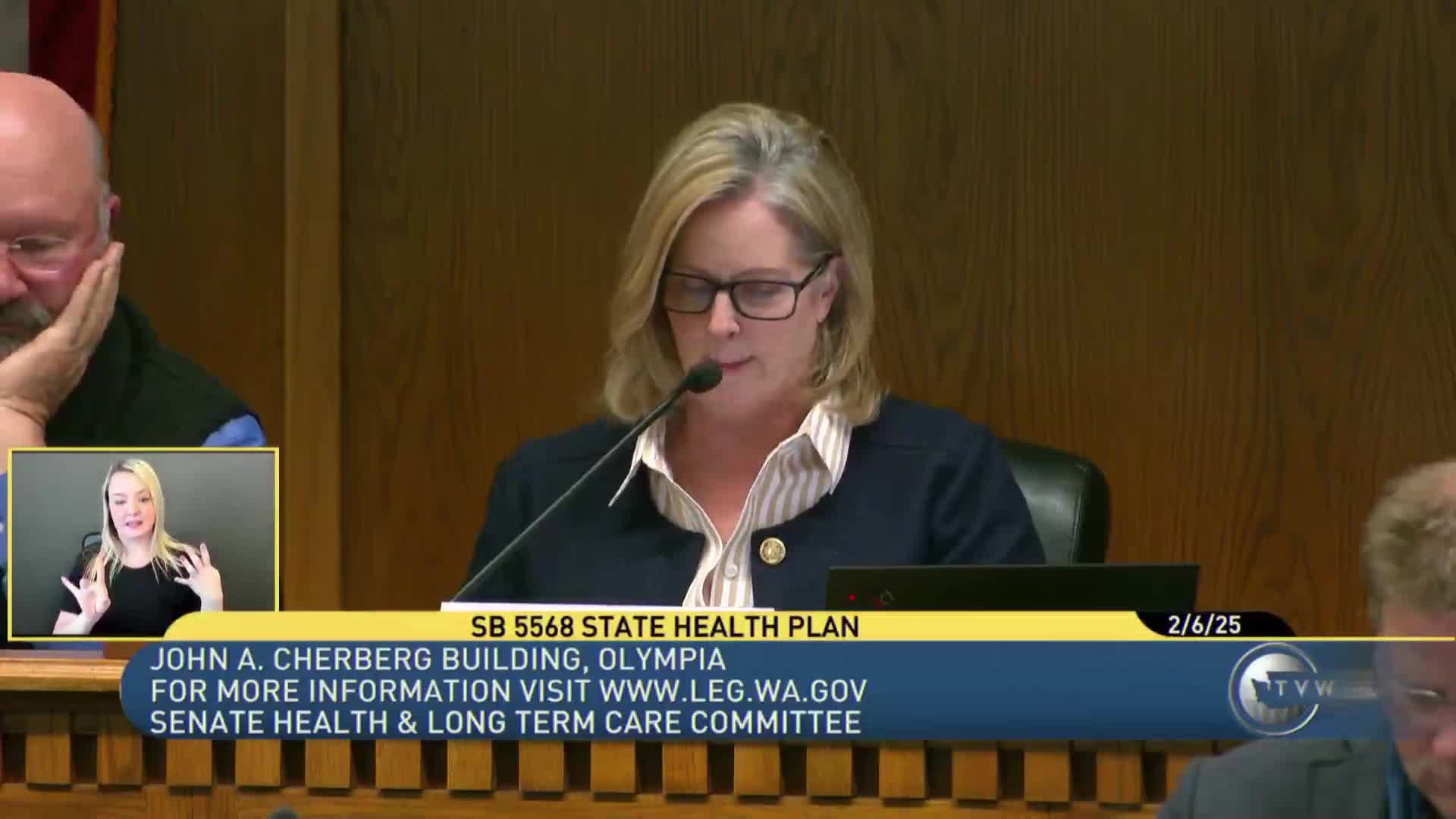
The Senate Health & Long Term Care Committee held a hearing on Senate Bill 5,568, a proposed substitute that would update Washington’s State Health Plan and direct the Office of Financial Management (OFM) to develop a statewide health resource strategy.
Committee staff laid out the bill’s purpose and background, referencing the original State Health Plan from 1987 and subsequent guidance assigned to OFM by the legislature. The proposed substitute would require OFM to coordinate with public and private stakeholders, consider health equity principles in developing the plan, and obtain access to relevant health system data collected by the Health Care Authority in addition to Department of Health licensing data. The bill sets a schedule: OFM must submit a preliminary report by July 1, 2026 and a completed plan by Dec. 31, 2027; it also requires biennial updates thereafter.
Annie Panucci, Director of Forecasting and Research at OFM, testified that OFM supports provisions that codify work the agency is already doing, appreciates the bill’s data‑access provisions, and can meet the reporting and public‑hearing requirements within existing capacity; OFM’s updated fiscal note continues to reflect zero impact. Health care provider groups and insurers voiced general support for updating the plan. Amy Brackenberry of the Washington State Medical Association said the state should use the update to address certificate‑of‑need issues, administrative simplification, and access gaps (for example, maternity care availability). Jennifer Ziegler of the Association of Washington Health Plans also supported an objective analysis and administrative simplification.
Why it matters: Supporters say a modernized, routinely updated state health plan and resource strategy could help policymakers identify gaps in access, target investments, and inform reforms to cost, capacity, and quality across the state’s health system.
Meeting context: The committee heard from a mix of health‑system stakeholders, OFM staff and industry groups. OFM indicated the work can be conducted within current capacity but will require continued stakeholder engagement.