Get Full Government Meeting Transcripts, Videos, & Alerts Forever!
Get email alerts on the Insurance Credit History Study topic
No spam. Unsubscribe anytime.
Senate committee advances public hearing on bill directing study of credit history and other insurance rating factors
Summary
Lawmakers heard extended testimony on SB 5589, which would require the Office of the Insurance Commissioner to study insurers’ use of credit history and other rate factors and produce reports in 2025 and 2026; insurers and consumer groups urged different approaches to study design.
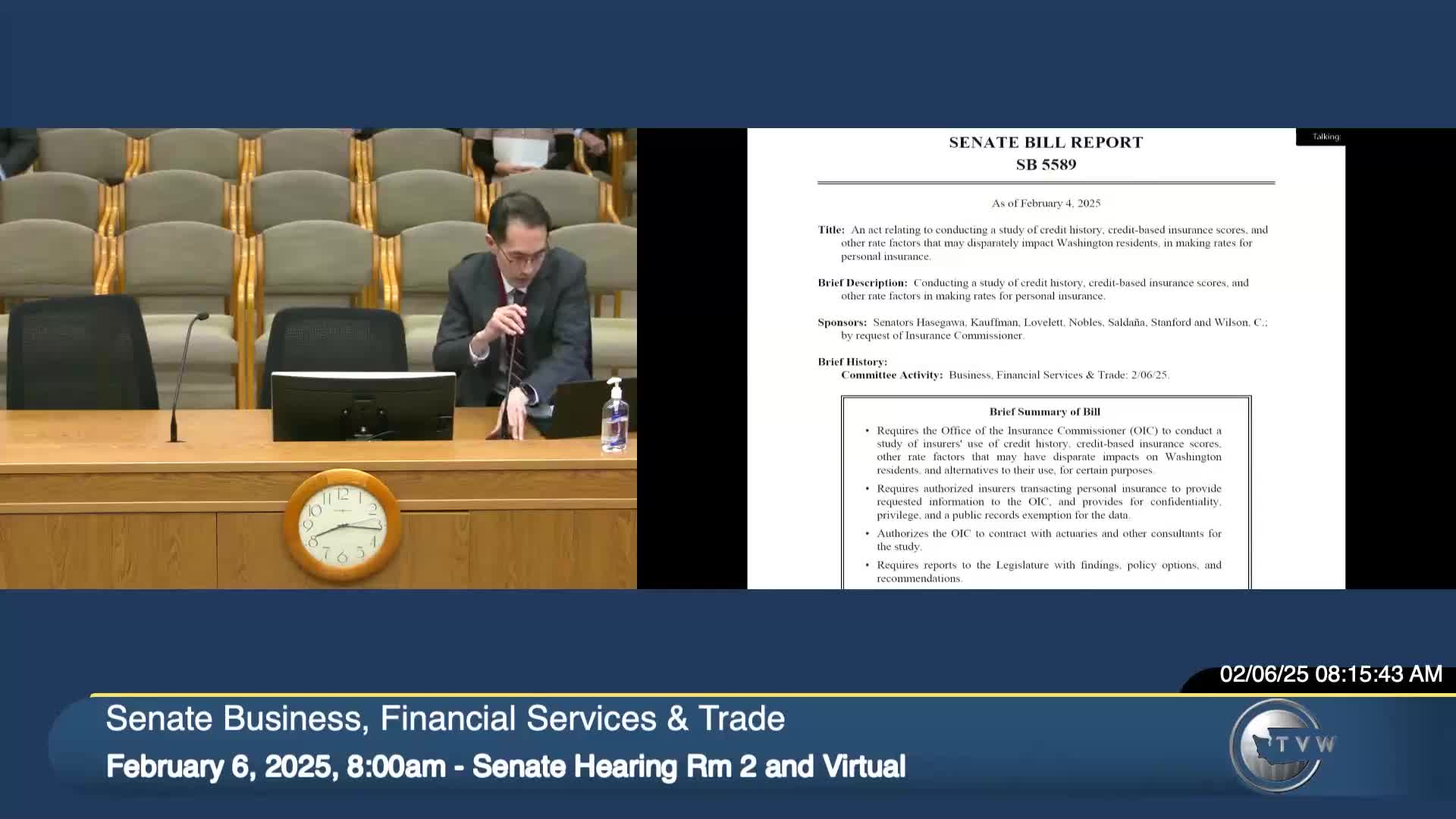
A Senate Business, Financial Services, Gaming & Trade Committee public hearing examined Senate Bill 5,589, which would require the Washington State Office of the Insurance Commissioner (OIC) to study insurers’ use of credit history, credit-based insurance scores and other rate factors used in determining personal insurance premiums and eligibility.
Senator Bob Hasegawa, prime sponsor of SB 5,589, told the committee the study is intended to determine whether the use of surrogate factors such as ZIP code, education or credit history produces unjust disparities in insurance pricing. "We want the information...to be able to ascertain whether or not there is disparities, within the insurance rating systems that are used," Hasegawa said.
The bill would require insurers to provide requested information to the OIC, allow OIC to contract with actuaries and consultants, and set report deadlines: a preliminary report by December 31, 2025, and a final report by September 15, 2026. Committee staff noted the bill creates confidentiality protections and a public-records exemption for certain submitted data; fiscal impacts were not available at the hearing.
Representatives of the OIC described the technical scope. Rory Payne Donovan, legislative director for OIC, said the study aims to provide policymakers with Washington-specific data and policy options. David Ford, senior policy advisor for property and casualty at OIC, outlined common rate factors in homeowners and auto insurance and explained that credit-based components can include non-public items such as length of credit or debt level.
Consumer advocates and researchers urged the study. Michael De long of Consumer Federation of America urged passage, citing research that credit-related surcharges can substantially increase premiums and that other socioeconomic factors also shift prices. Charles Bell of Consumer Reports cited studies showing large premium increases for drivers with lower credit scores and recommended the study address data quality and proprietary scoring methods.
Insurer trade groups warned of costs and urged carefully designed study parameters. Brandon Vick of the National Association of Mutual Insurance Companies and Chris Taft of the American Property Casualty Insurance Association said similar research exists nationally and argued the committee should limit the study’s scope, consider an independent third-party researcher, and provide realistic timelines to avoid onerous data calls and compliance costs. Kenton Bridal of the Northwest Insurance Council recommended a transparent stakeholder process to design the study.
Committee members repeatedly asked OIC staff for historical data about a prior emergency rule that limited use of credit in rates. OIC officials said they would follow up with more detailed information; the earlier emergency action prompted public complaints and reports of premium changes when credit-based factors were temporarily removed.
The hearing was informational and included three panels of public testimony. No vote was taken at the committee hearing. If enacted, SB 5,589 would require OIC to collect insurer data, produce the two reports, and propose policy options for the Legislature to consider.