Get Full Government Meeting Transcripts, Videos, & Alerts Forever!
Get email alerts on the Zoning Ordinance Rewrite topic
No spam. Unsubscribe anytime.
Planning commission reviews Part 1 of zoning rewrite, discusses mixed‑use rules, ADUs, home businesses and short‑term rentals
Summary
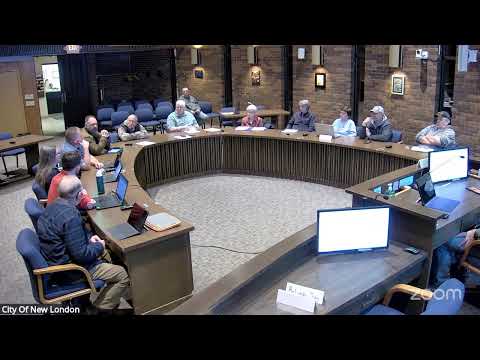
Ben, planner for Fanda Wall and Associates, presented Part 1 of a proposed rewrite of New London's zoning ordinance and asked the Planning Commission for direction on several policy choices.
Ben, planner for Fanda Wall and Associates, presented Part 1 of a proposed rewrite of New London's zoning ordinance and asked the Planning Commission for direction on several policy choices.
The draft consolidates land‑use permissions into a single land‑use table, establishes new zoning districts and bulk (dimensional) standards, and proposes a sequence of implementation steps. "We're trying to modernize this code," Ben said, describing the goal of making the code easier to use and aligning it with state and federal requirements and the comprehensive plan.
Why it matters: the rewrite will change how projects are reviewed and where particular uses are allowed across New London. Commissioners said they want to balance flexibility for development with protections for neighborhood character.
Major proposals discussed
- Mixed‑use buildings: The draft would allow mixed‑use buildings (residential plus nonresidential uses in one structure) in multiple districts and would require that at least 33% of the ground floor be nonresidential. Ben said the 33% rule is modeled on other communities and is intended to preserve downtown storefronts while allowing housing above or behind streetfront commercial space.
- Accessory dwelling units (ADUs): The draft would permit a single ADU on most residential lots and treat ADUs as accessory to the primary dwelling. The consultant described standards including principal‑structure setbacks for detached ADUs, no creation of a separate parcel, and staff‑level review. "The landowner either lives in the accessory dwelling unit or they live in the regular house," Ben said; the draft requires owner occupancy of one unit at the time of permit issuance.
Commissioners pressed staff on parking and long‑term effects. Several commissioners said on‑street parking in winter reduces available spaces and asked whether ADU parking should require an additional off‑street space. Ben said communities typically require two off‑street spaces for single‑family homes and suggested matching the ADU parking requirement to the underlying dwelling type. Commissioners also asked whether a future owner could convert both units to rentals; Ben said the draft requires the new owner to occupy one of the two units to rent the other, but acknowledged that the city does not track ownership changes and enforcement would rely on code language and complaint investigations.
- Home occupations: The draft proposes clearer definitions and standards for small businesses run from homes. Staff asked whether to require an administrative license/permit to create a record of home occupations. Commissioners split: some argued a license would help enforce nuisance cases and allow revocation for abuses; others said licensing would be burdensome and likely not capture all existing informal home businesses. Ben said both approaches are possible and that the code can be amended later if the city wants to add a licensing program.
- Short‑term rentals: State law requires municipalities to permit short‑term residential rentals but allows local regulation. The draft adds short‑term rentals to the land‑use table and proposes neighborhood protections, such as limits on exterior changes, on‑site parking and property management requirements. Staff noted the state requires registration with online platforms; commissioners generally opposed imposing a local license at this time.
- Nonconforming structures and uses: The draft separates nonconforming structures (physical features) from nonconforming land uses (the activity on a site). Ben said the rewrite would generally allow owners to repair and reinvest in existing structures without the old numerical cap (the historical 50% rule), while nonconforming land uses would be discouraged from continuing if they cease operation. He also said state law permits rebuilding after fire or act of God in the original footprint if the owner can document the prior location.
- Small wind systems: A commissioner asked whether small wind energy systems (drafted as 3 kW to 100 kW in the packet) could be prohibited because of technical interconnection and nuisance concerns. Ben said state and utility rules limit local authority in some areas but that the code could try to limit small wind systems to specific districts; staff will review statutory and utility constraints before drafting final language.
Next steps and timing
Ben and staff said they are working on the draft zoning map that implements the text changes and expect to return in the coming months with map and text for further review. "Our goal is still to get this done in the summer of this year," Ben said. Commissioners asked for additional review of parking ratios and owner‑occupancy language for ADUs before formal recommendation to City Council.
Ending
Staff said they would circulate revised drafts and that the commission will have additional review rounds. The commission did not take any formal votes on the draft during the meeting.