Get Full Government Meeting Transcripts, Videos, & Alerts Forever!
Get email alerts on the Law Justice Committee Exec topic
No spam. Unsubscribe anytime.
Law & Justice Committee advances bipartisan package on law‑enforcement oversight, victim funding, consumer protections and other bills
Summary
The Washington Senate Law & Justice Committee on Feb. 6 advanced a slate of bills on law‑enforcement accountability, victim services funding, medical‑debt reporting and other topics after staff briefings, amendments and debate. Several measures drew extended debate over oversight authority and prosecutorial structure.
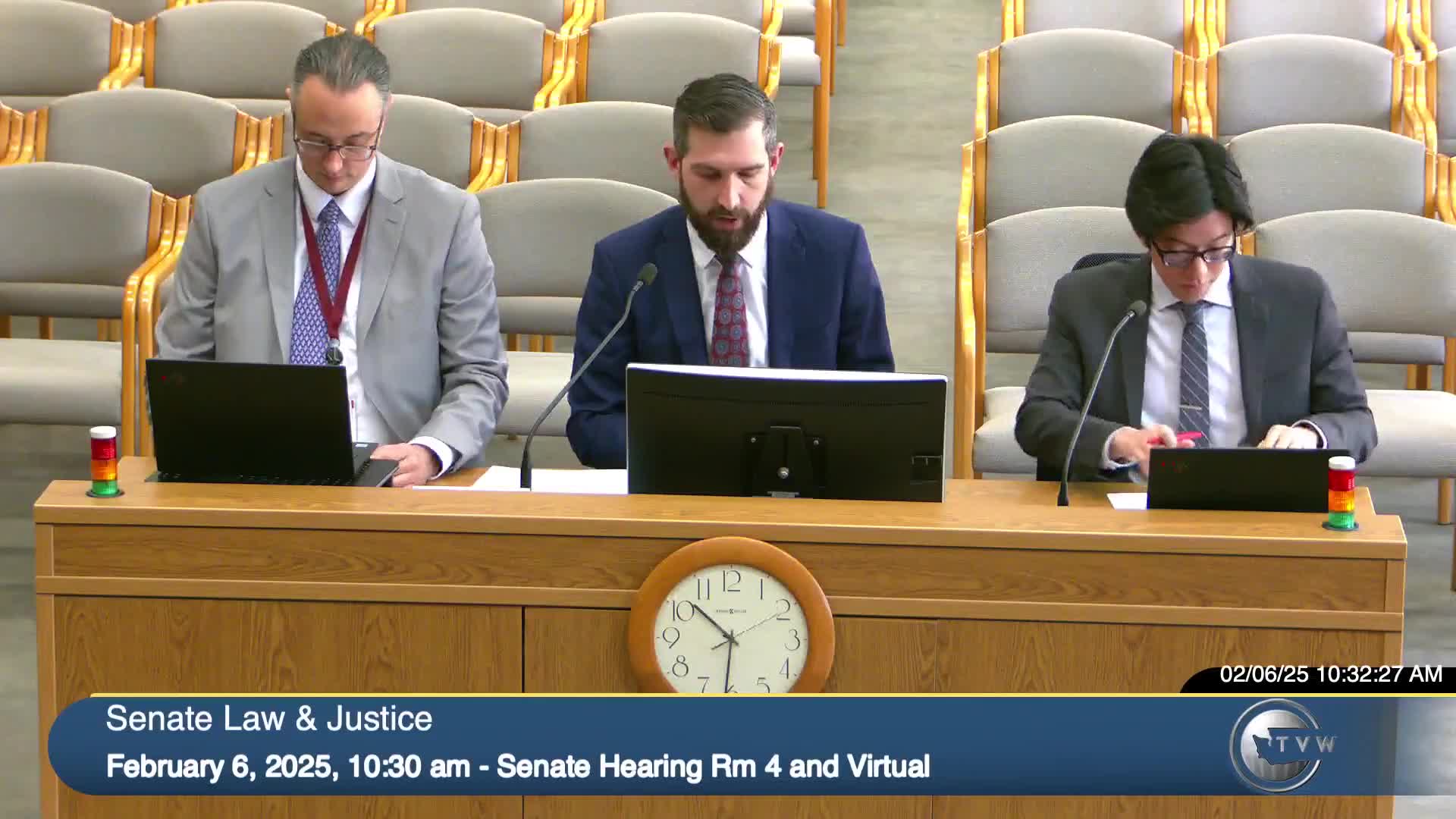
The Law & Justice Committee met Feb. 6 and voted to forward a series of bills to rulemaking and budget committees, including proposals on law‑enforcement oversight, victims’ funding, medical‑debt reporting and the structure of independent investigations and prosecutions.
Staff counsel opened the meeting with bill briefings. "The proposed substitute would create crimes prohibiting trafficking, manufacturing, sending and bringing it into the state, or possession of a child *** doll," said Ryan Giannini, staff counsel, summarizing Senate Bill 5,227. Later in the meeting, Joe McKittrick, staff counsel, described Senate Bill 5,066 as a measure to "strengthen and clarify the authority of the Attorney General to address local law enforcement and local correction agency misconduct through investigations and legal actions."
Why it matters: The items advanced affect criminal statutes, how state and local authorities investigate and prosecute alleged misconduct, funding for victim services and consumer protections for individuals with medical debt. Several bills attracted policy debate about the balance between centralized oversight and local prosecutorial authority.
Key outcomes and highlights
- Law‑enforcement oversight (Senate Bill 5,066): Staff described proposed substitute Charlie as granting the Attorney General authority to investigate local law enforcement and corrections agencies for constitutional or statutory violations, and to bring actions against them. Committee discussion included objections from members who said additional oversight could chill recruitment and duplicate local prosecutorial authority; proponents said the change responds to stakeholder requests for clearer accountability. The committee moved and approved the proposed substitute Charlie and sent it to the Ways and Means Committee with a "due pass" recommendation, subject to signatures.
- Independent investigations and prosecutions (Senate Bill 5,584): The bill would expand the Office of Independent Investigations to include prosecution authority, renaming it the Office of Independent Investigations and Prosecutions and creating an independent prosecutor position. A proposed substitute (Papa) would instead place the independent prosecutor as a position in the governor's office while keeping similar powers; the committee approved the proposed substitute and forwarded it to the Rules Committee with a due‑pass recommendation. Several senators spoke at length opposing further layers of oversight and expressing concern about separating investigation and prosecution and about local prosecutorial authority.
- Medical‑debt reporting (Senate Bill 5,480): The bill would declare certain medical debt void and unenforceable if reported to consumer reporting agencies and prohibit specific entities from reporting medical debts. Multiple amendments were adopted to align definitions with California standards and to adjust contract and notice provisions. Senator Torres said the alignment was intended "to align with the definition that was made in California." The committee approved the amended bill and sent it to the Rules Committee with a due‑pass recommendation.
- Victims funding and dedicated account (Senate Bill 5,362): A proposed substitute would create a Victims of Crime Act account in the state treasury and direct transfers based on a formula described in committee, counting OCVA administrative costs at 5%. The committee adopted a technical amendment and forwarded the bill to Ways and Means with a due‑pass recommendation.
- Motion picture captioning (Senate Bill 5,486): Two proposed substitutes set different thresholds and timing for required open‑caption screenings. The committee adopted a proposed substitute (Mike) that sets a lower screening threshold and other adjustments, then forwarded the bill to Ways and Means.
Other bills advanced with technical amendments or as presented: Senate Bills 5,453 (public defense recruitment and retention), 5,367 (community engagement grants through law enforcement partnerships), 5,356 (Criminal Justice Training Commission training clarifications), 5,436 (interfering with access to places of worship—proposed substitute November), and 5,322? (others briefed). Each received a committee recommendation to advance to the next committee listed in the motions and was recorded as "received a due pass recommendation and sent to [committee] subject to signatures." The committee adjourned after rolling adopted amendments into proposed substitutes and voting.
Discussion vs. formal action
The meeting combined staff bill briefings, sponsor‑offered proposed substitutes and floor‑level amendment debate with final committee votes that generated "due pass" recommendations and referrals to Ways and Means or Rules. Where the committee adopted amendments, the action was to roll them into a proposed substitute and move that substitute forward; several members urged further work in subsequent committees.
What members emphasized
- Supporters argued many changes reflect stakeholder requests or technical fixes and urged timely legislative action to address victims’ funding, consumer protection and training requirements. - Opponents repeatedly raised recruitment and local control concerns, arguing additional oversight layers or prosecutorial structures could chill hiring and duplicate functions of elected county prosecutors. Several senators asked for fiscal and operational details before final passage to the full Senate.
Votes at a glance (committee motions and outcomes)
- SB 5,227 (proposed substitute Bravo): committee moved to give a due pass recommendation; sent to Rules Committee (subject to signatures). - SB 5,066 (proposed substitute Charlie): moved and approved; sent to Ways and Means Committee (due pass). - SB 5,453: due pass recommendation to Ways and Means Committee. - SB 5,367 (amendment Delta rolled into a proposed substitute): adopted and sent to Ways and Means Committee (due pass). - SB 5,356 (proposed substitute Echo, with Echo‑1 amendment rolled in): adopted and sent to Ways and Means Committee (due pass). - SB 5,362 (proposed substitute Foxtrot): adopted and sent to Ways and Means Committee (due pass). - SB 5,480 (multiple amendments; hotel/India/Juliet adopted, Kilo withdrawn): proposed substitute with adopted amendments sent to Rules Committee (due pass). - SB 5,486 (proposed substitute Lima/Mike adopted): adopted and sent to Ways and Means Committee (due pass). - SB 5,436 (proposed substitute November): described by staff; committee considered amendments; proposed substitute includes civil remedies and up to $5,000 per day damages for aggrieved places of worship as drafted in committee discussion. - SB 5,584 (proposed substitute Papa): committee moved and approved Papa; sent to Rules Committee (due pass).
Notes: The committee record shows each measure was voted on by voice; the transcript records "Aye"/"Nay" calls but not a roll‑call tally for individual members. Where motions and movers were recorded on the transcript, they were entered into the committee minutes. Several amendments were withdrawn by their sponsors during debate; in one case a sponsor withdrew an amendment after stakeholder input (SB 5,480 Kilo). Where the transcript did not name a motion mover or seconder explicitly, the committee minutes reflect the motion language and referral destination.
Next steps
Bills with due‑pass recommendations proceed to the committee named in each motion (Ways and Means or Rules) for further consideration, fiscal review, and possible floor action. Several sponsors and committee members said they expect additional technical changes in subsequent committee stops.
Ending
The chair closed the Feb. 6 session after the committee finished its executive calendar and adopted the final set of proposed substitutes and amendments. The committee recessed for caucus during the meeting and resumed to complete votes before adjourning.