Get Full Government Meeting Transcripts, Videos, & Alerts Forever!
Get email alerts on the Early Learning Facilities topic
No spam. Unsubscribe anytime.
Witnesses back SB 5297 to ease matching rules, add emergency grants for early learning facilities
Summary
Stakeholders, including Start Early Washington and childcare developers, told the Senate committee that Senate Bill 5297 would reduce barriers to facility projects by waiving match requirements for applicants in financial hardship and by establishing emergency grants; Commerce staff described likely startup costs in a fiscal note.
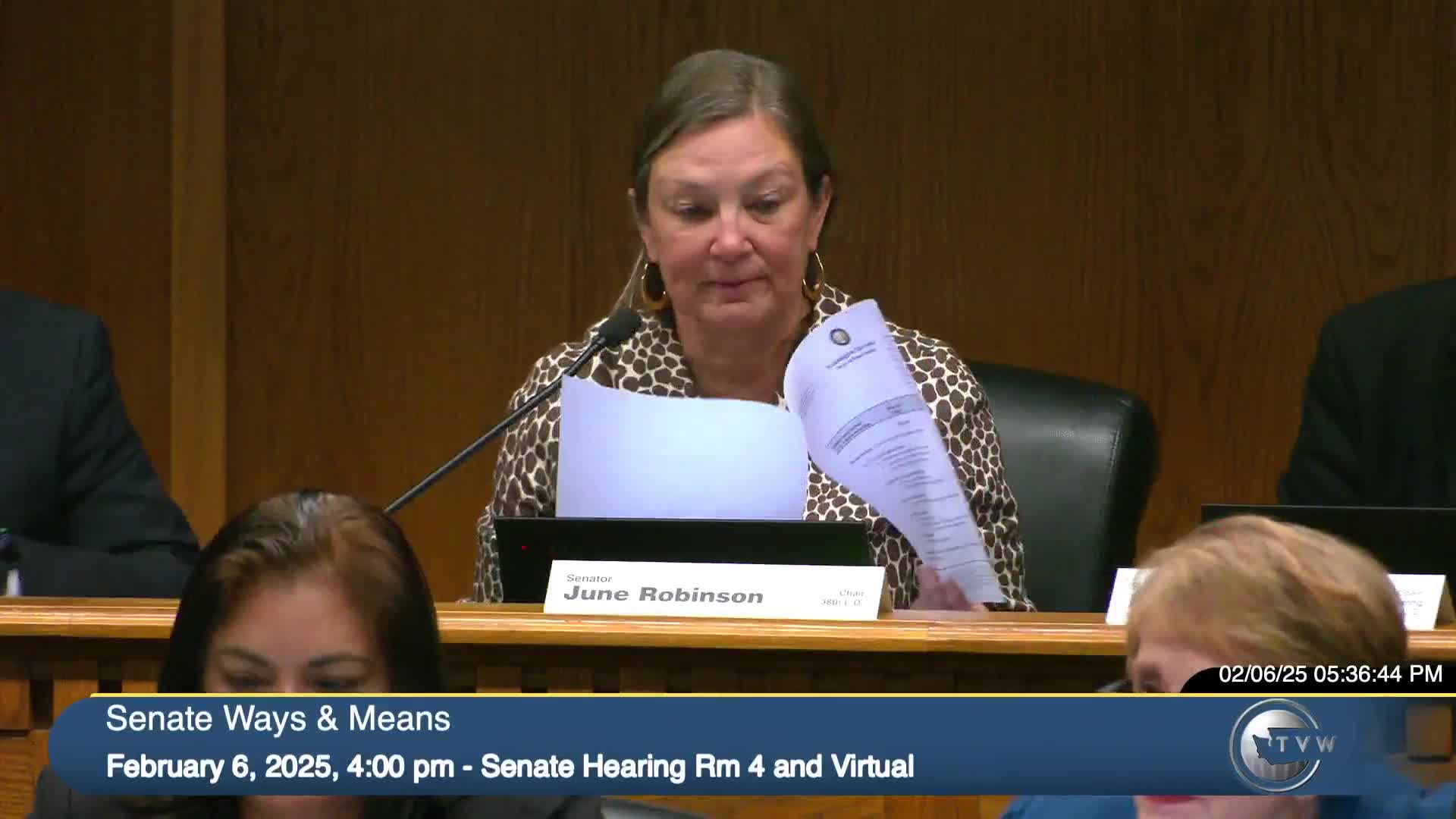
Wendy Brown, staff to the Senate committee, opened the public hearing with a staff report on Senate Bill 5297, which would change the Early Learning Facilities (ELF) Grant and Loan Program administered by the Department of Commerce.
"The Department of Commerce administers the Early Learning Facilities Program, which provides grants and loans to eligible organizations and school districts to plan, renovate, purchase and construct early learning facilities," Brown said. She summarized the bill's main changes: removing match requirements for applicants experiencing financial hardship, encouraging Commerce to leverage private and public matching funds when feasible, prohibiting Commerce from considering the level of project match when selecting projects for funding, expanding project eligibility for slot conversions, adding tribal compact schools as eligible recipients, and establishing an emergency grant program funded from the early learning facilities revolving account, subject to appropriation.
Witnesses supporting the bill described practical barriers created by current match rules and emergency needs that can take learning spaces offline. Bridal Hallock of Start Early Washington and the Early Learning Facilities Coalition told the committee the coalition informed provisions in the bill and highlighted facility emergencies such as flooding: one Spokane center reported approximately $120,000 in flood-related expenses, of which insurance covered about $90,000, leaving a $30,000 shortfall.
"The top need that they found was flooding from broken pipes," Hallock said, giving examples of centers that faced long closures and large uninsured gaps.
Dave Pringle of the Department of Commerce described Commerce's experience administering the program. He said Commerce and its contracted public–private partnership have administered roughly $200,000,000 in grants over the last seven years and leveraged more than $350,000,000 in nonstate funds, and that Commerce administers a $20,000,000 loan pool through a CDFI collaboration that supported 13 new childcare facilities. Commerce's fiscal note estimated an impact to the general fund of $278,000 in the 2025–27 biennium and $434,000 over four years to set up the emergency grant program, run a solicitation for a contractor and complete an environmental justice assessment.
Julie Jerman Murray, founder and executive director of the Rosalie Murray Memorial Foundation, said her nonprofit is developing Birdie's Nest, a therapeutic childcare center in Spokane that would serve 48 children ages 3 to 6 with disabilities. She said construction costs are estimated at $2,500,000 and that current ELF matching requirements forced her to pledge personal savings via a promissory note during the predevelopment phase.
"This project simply can't be completed on a reasonable timeline without investment from the ELF Fund," Jerman Murray said, adding that the bill's moderation of matching requirements would ease the burden on financially constrained providers.
Why it matters: Testimony emphasized both the capital scarcity facing childcare providers and the acute, sometimes-uninsurable shocks (flooding, system failures) that can close facilities for months. Proponents urged legislative changes to prioritize emergency grants and provide hardship-based match waivers so providers can keep facilities open or bring new capacity online.
Committee members asked Commerce staff and advocates about how match waivers would work in practice; Commerce said it uses match as a readiness tool but will work with stakeholders on implementation. No formal committee vote on SB 5297 occurred during the hearing.