Get Full Government Meeting Transcripts, Videos, & Alerts Forever!
Get email alerts on the Library Budget topic
No spam. Unsubscribe anytime.
Buchanan Library asks New Canaan for $222,000 increase to reset baseline after surge in use
Summary
Library leaders told town liaisons that unprecedented visitor numbers and heavier building use require a one-time budget realignment to add custodial and AV staff, shore up staff compensation and boost digital collections, while the library continues to rely heavily on fundraising for programs and capital.
Ellen Corvado, CEO of the Buchanan Library, told New Canaan town liaisons and members of the Board of Finance on Feb. 6 that the library is seeking a $222,000 increase in town funding for the fiscal year 2026 operating budget to “reset our baseline” after a surge in visitorship since the new building opened. Corvado said the request is largely to fund a full-time custodial position, a part-time audio-visual technician and inflation-adjusted salary increases for existing staff.
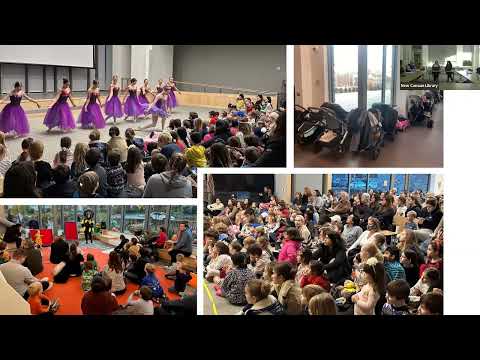
The change matters because the library has seen far higher usage than planners expected in the new building, Corvado said. “We have around 1,600 people through our doors every day. Sometimes it’s as high as 1,800,” she said, adding that the institution has begun to outpace peer libraries in visits and fundraising. Corvado said roughly 70% of the library’s operating budget is salaries and compensation.
Town liaisons — Council members Hilary Ormond and Eric Thunum and Board of Finance member Chris Labrie — pressed library leaders for clearer budget charts and answers to a set of detailed questions the council sent in November, and asked for written responses well before formal budget votes. Ormond and Labrie said they plan to present the answers to the full Town Council before the budget decision and urged the library to tighten its presentation to make the ask more transparent and numbers-driven.
Library staff and trustees emphasized three primary drivers of the requested increase: operations and facilities support, staff compensation, and stepped-up investment in collections and programming. Corvado said the library’s “biggest challenge has been to date really just being responsive to the demand for our services and our spaces,” and described staff as “very maxed out.” She said the custodial hire and an AV technician would have the most leverage on day-to-day operations.
On programming and fundraising, the library reported it raised $1.4 million in charitable gifts last year and used those funds to cover much of its program and capital spending. Corvado and Cheryl Capitani, the library director, said many high-profile events are ticketed fundraisers on a selective basis (for example, author appearances) while most library programs remain free. Capitol note: Corvado and Capitani said Connecticut law prohibits charging for programs that advance literacy, and that the library must be careful about charging for certain educational offerings.
Capitani described pressure in digital services: demand for e-books and audiobooks has increased while the digital budget has not kept pace. She said some digital titles require costly single-license purchases that expire after a set term and that wait times for popular e-books can reach about six months; the library is asking for an $18,000 increase in the digital-collections line to reduce those waits.
Board and council members also raised the library’s legacy building and endowment. Corvado said the library’s endowment is under $1 million after prior withdrawals to move and preserve the legacy structure and that rebuilding a sustainable endowment would require an eight-figure plan; the board has set a bylaw threshold requiring $3 million before using endowment income for operations. Trustees said the library has paid for capital repairs and some legacy-building costs from its own reserves, and the group described a $10 million borrowing facility the town made available during the capital campaign, of which roughly $2 million remains outstanding.
Energy costs and building commissioning were another topic. Library staff said the building uses fewer kilowatt-hours than the old building and that solar and a recent commissioning study have reduced usage by about 30% in a recent six-month run rate, but that utility unit costs remain elevated. Staff said they will provide clearer comparisons showing what savings the library would have realized had rates not risen, and that refining building systems has been part of their work since opening.
Several council and finance members said the town’s recent budget process produced last-minute cuts and requested that the library and liaisons coordinate earlier and present a streamlined, numbers-focused case in front of the Board of Selectmen, Board of Finance and Town Council to avoid eleventh-hour reductions. Ormond and Thunum said they will attempt to present the library’s answers to the rest of the Town Council before the Feb. 26 meeting and discussed scheduling one or more liaison sessions or a subcommittee meeting to follow up.
No formal motions or votes were taken during the liaison meeting. Library staff committed to delivering written answers to the council’s earlier questions and to revising presentation slides to emphasize the net funding need, how last year’s cuts were covered by one-time gifts, and which items are fixed costs versus programmatic choices.
The library and town liaisons agreed on next steps: the library will provide clearer financial breakdowns (showing last year’s adopted budget, actual spending, town funding and fundraising contributions), respond in writing to the council’s questions, and rework its presentation material before upcoming budget hearings. The liaison members said they expect those materials to shape how the Board of Finance and Town Council evaluate the $222,000 request.