Get Full Government Meeting Transcripts, Videos, & Alerts Forever!
Get email alerts on the Training Procedures topic
No spam. Unsubscribe anytime.
New Canaan planning commissioners get training on legal duties, hearings and expert evidence
Summary
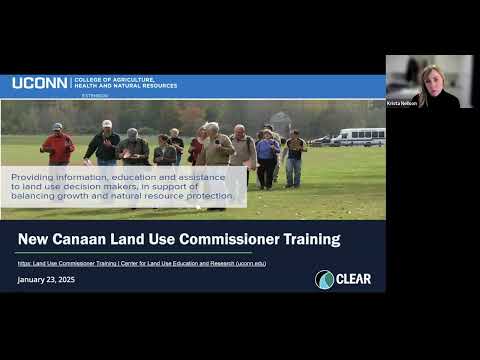
At a Jan. 23 special meeting, UConn CLEAR instructor Renata Bertotti led a training for the New Canaan Planning and Zoning Commission on statutory authority, public‑hearing practice, use of expert testimony and meeting procedures; town attorneys answered procedural questions about peer review, alternates and recordkeeping.
Renata Bertotti, an assistant extension educator with UConn CLEAR, led a Jan. 23 training for the New Canaan Planning and Zoning Commission that reviewed the legal basis for local land‑use authority, the different hats commissioners wear, when public hearings are required, and best practices for handling expert testimony and contested applications.
The session, held as a special meeting and run without a public‑comment period, canvassed state enabling statutes, case law and local regulations as the sources of the commission's authority. "Being a land use commissioner is a responsible job. Your decisions affect your community's quality of life for generations to come," Bertotti told commissioners, urging attention to incremental effects of decisions and to the concept of "fundamental fairness." Krista Nielsen, secretary of the commission, opened the meeting and said the training satisfied part of the ongoing educational requirements created by recent state law.
Why it matters: The training clarified legal limits on commissioners' discretion (broadest when adopting regulations, narrower for special permits and narrowest for site‑plan technical reviews). Bertotti and town attorneys described how procedure and recordkeeping affect the legal defensibility of decisions, including what a court will examine if an applicant appeals.
Key takeaways and guidance - Sources of authority: Bertotti summarized that state enabling statutes, duly adopted local regulations and court decisions together set the legal framework for local land use control. She cited the landmark U.S. Supreme Court decision that established modern zoning doctrine (Village of Euclid v. Ambler Realty Co.) as the federal precedent commissioners should know. - Roles and discretion: The commission acts in a legislative capacity when changing regulations, an administrative capacity when reviewing special permits, and a quasi‑judicial capacity on appeals. "When you're acting on special permits, you're actually having a little bit more limited discretion," Bertotti said. - Public hearings and time limits: Commissioners were reminded that public hearings are required by statute or local regulation for certain applications (zone or regulation changes, adoption/amendment of the plan of conservation and development, special permits and resubdivisions). Bertotti noted that the statutory clock differs depending on whether a hearing is held and that an application without a hearing may have only 65 days for action. - Expert testimony and peer review: Commissioners pressed town attorneys about whether they may rely on their own observations to reject expert testimony presented at a hearing. Town attorney Ira Bloom and other attorneys said the commission may use firsthand knowledge but that decisions generally must be supported by "substantial evidence" in the record (typically expert testimony or studies). Pete Gelderman (town attorney) said peer review by an independent consultant paid for by the applicant is standard practice on complex matters and advised that the commission should secure peer review during the public‑hearing period rather than waiting until deliberations. - Alternates, recusal and voting: The presenters described the statutory framework for alternates and cautioned that alternates must be appointed under local ordinance; a seated alternate has full deliberative rights. The group discussed abstentions and judicial uncertainty about whether an abstention counts as a yes or no vote; Bertotti and attorneys recommended avoiding abstentions where possible and instead arranging for an alternate to sit when a commissioner feels conflicted. - Site walks and meeting management: Bertotti advised that site visits must be noticed for FOIA purposes and that commissioners should avoid deliberation on site walks, instead taking notes and returning questions to the public hearing record. She emphasized clear chair control, consistent application of regulations and limiting late‑night deliberations to preserve decision quality. - Zoning regulation overhaul and delegation: Commissioners discussed the upcoming comprehensive zoning regulation update and asked how narrowly the commission can write special‑permit criteria. Attorneys and Bertotti agreed the commission may set specific standards and, where appropriate, include measurable caps (for example specific height or coverage adjustments) so long as the criteria are clear and applied consistently. The panel also explained that the commission may delegate certain routine approvals to staff by regulation, while retaining oversight for higher‑impact projects.
Questions from commissioners focused on a St. Luke's traffic example, the timing and scope of peer reviews, whether the Zoning Board of Appeals (ZBA) can be assigned additional special‑exception authority, and whether special permits may be time‑limited or subject to renewal. Attorneys confirmed that time limits on special permits are permissible, that delegating some duties to staff is lawful if done in regulation, and that transferring special‑exception authority to the ZBA is possible but not common and should be considered carefully.
The session concluded with practical advice on drafting defensible resolutions: commissioners were urged to state collective reasons on the record supported by the evidence (expert and factual) and to ask staff for draft resolutions consistent with the commission's stated findings before voting. Town staff also noted a practical offer from the town: the town will cover registration for the Connecticut Bar Association planning and zoning seminar (March 22) on a first‑come, first‑served basis for commissioners willing to attend.
What to watch next: Commissioners said a zoning regulation update subcommittee will review dated provisions in the regulations; staff and attorneys flagged provisions that have driven repeated variance requests as candidates for revision.
Ending: The training was recorded and Bertotti said slides and resources from UConn CLEAR would be shared with commissioners after the meeting.