Get Full Government Meeting Transcripts, Videos, & Alerts Forever!
Get email alerts on the Public Works Assistance Account topic
No spam. Unsubscribe anytime.
Public Works Board seeks $400 million to replenish revolving fund that backs local water, sewer and road projects
Summary
The Public Works Board told the Capital Budget Committee it has returned to a full revolving model and is requesting $400 million for the 2025-27 biennium to maintain loan repayments, meet pent-up demand and support partnerships with federal funding programs.
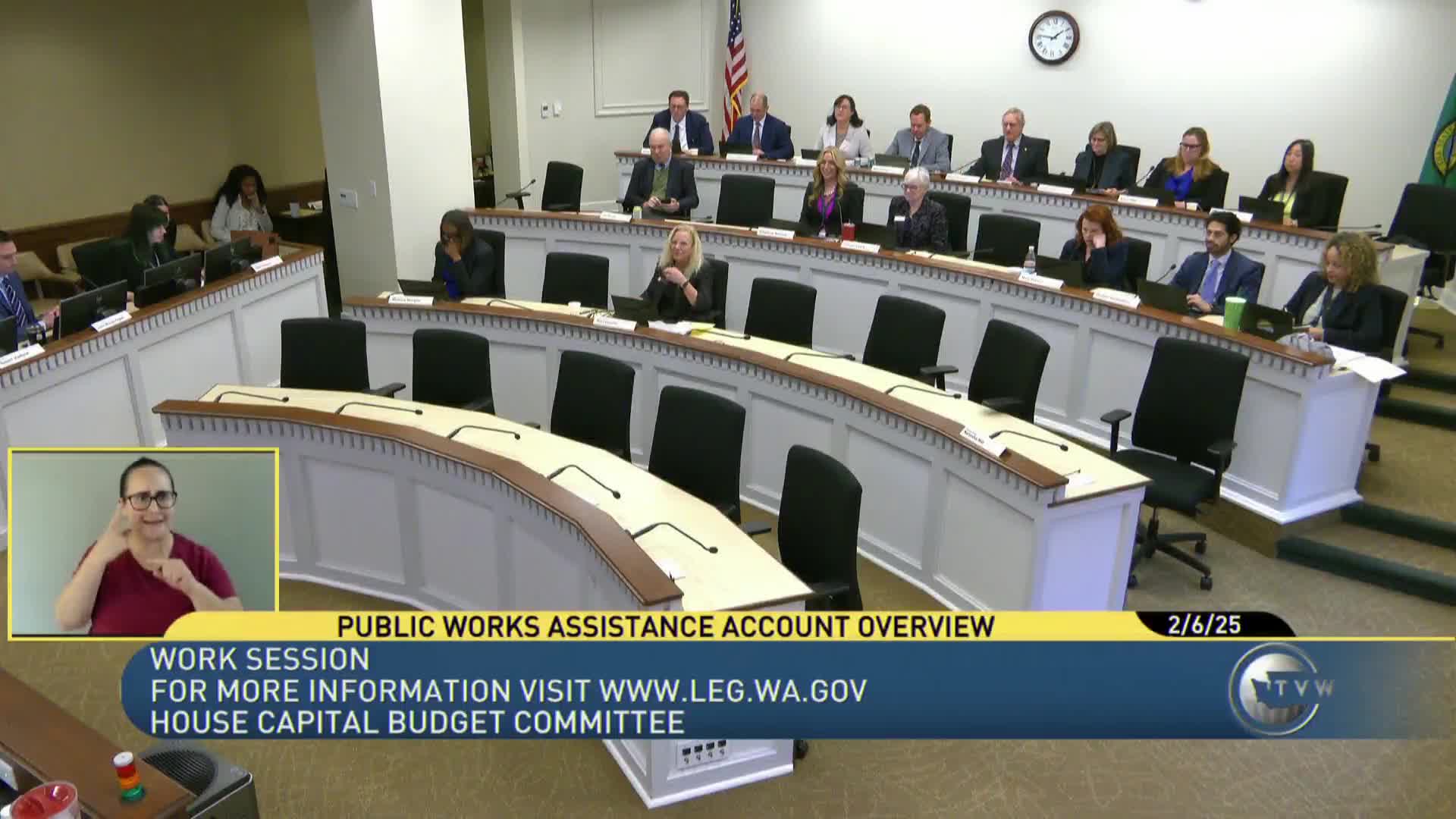
Catherine Gardeau, chair of the Public Works Board, and Maria Jawad, the board's executive director, briefed the Capital Budget Committee on the Public Works Assistance Account (PWAA) and the board's revolving loan and grant programs.
Gardeau said the Public Works Board is celebrating its 40th anniversary and described the Public Works Assistance Account as "a lifeblood of this amazing infrastructure program." Jawad told members the board has financed roughly $3.6 billion through more than 2,200 projects since the program began in 1985, with major shares going to drinking-water and wastewater projects.
Jawad outlined how the PWAA operates as a revolving loan fund: legislative appropriations and loan repayments are reloaned to jurisdictions, and local borrowers repay loans over five to 20 years depending on loan terms. The board said it now maintains an open preconstruction cycle and has awarded 37 preconstruction projects this biennium totaling $18.2 million.
The board is requesting a $400 million appropriation for the 2025-27 biennium. Jawad said that if appropriations to the Public Works Board remain at that scale, the revolving nature of the fund would sustain loan repayments and help recapitalize the PWAA; if appropriations drop, she said loan repayments and the fund's capacity would decline over time.
Jawad described the PWAA's three dedicated revenue sources: the solid-waste collection tax, portions of the public-utilities tax and a portion of the real-estate excise tax. She also explained the PWAA often provides the 20% state match that unlocks federal Clean Water and Drinking Water State Revolving Fund dollars, helping jurisdictions leverage federal infrastructure funding.
The board highlighted near-term figures: a $400 million appropriation in the current biennium allowed the board to award 100 construction projects, support 15 emergency needs, and provide $55 million in grants for distressed and severely distressed communities. The board estimated interest-rate savings to borrowers over the past six years of about $188 million compared with bond-market financing.
Jawad gave an example of loan repayment returning capital to the account: Olympic View Water and Sewer District received a $475,000 award for a lift-station upgrade and repaid principal and interest so the full amount returned to the PWAA, enabling future awards. The board also offered estimates that the program supported nearly 40,000 jobs over 40 years and generated roughly $337 million in construction-related sales tax over that period.
Committee members asked about outreach and whether smaller jurisdictions sometimes assume they are not eligible; board members said staff provide technical assistance and encouraged jurisdictions to apply. Members also discussed the board's dashboard and coordination with other agencies to reduce redundant digging and improve project efficiencies.
The presentation framed the PWAA as a state-level mechanism to make affordable, predictable financing available to local governments for water, sewer, stormwater, roads and other public works, while warning that diversions and transfers away from the account reduce its revolving capacity and future awards.