Get Full Government Meeting Transcripts, Videos, & Alerts Forever!
Get email alerts on the K 12 School Construction topic
No spam. Unsubscribe anytime.
Bill would create targeted capital grants for very small, property-poor school districts
Summary
House Bill 1538 would create a new grant program to modernize or replace instructional facilities in school districts with 1,000 or fewer students, prioritize applications by objective scoring, require a local cost share tied to remaining debt capacity and delay the program's effective date to Jan. 1, 2028.
House Bill 1538, sponsored by Representative Joel McIntyre, would create a new state capital program to help comprehensive modernization or replacement of instructional facilities in school districts with enrollments of 1,000 students or fewer.
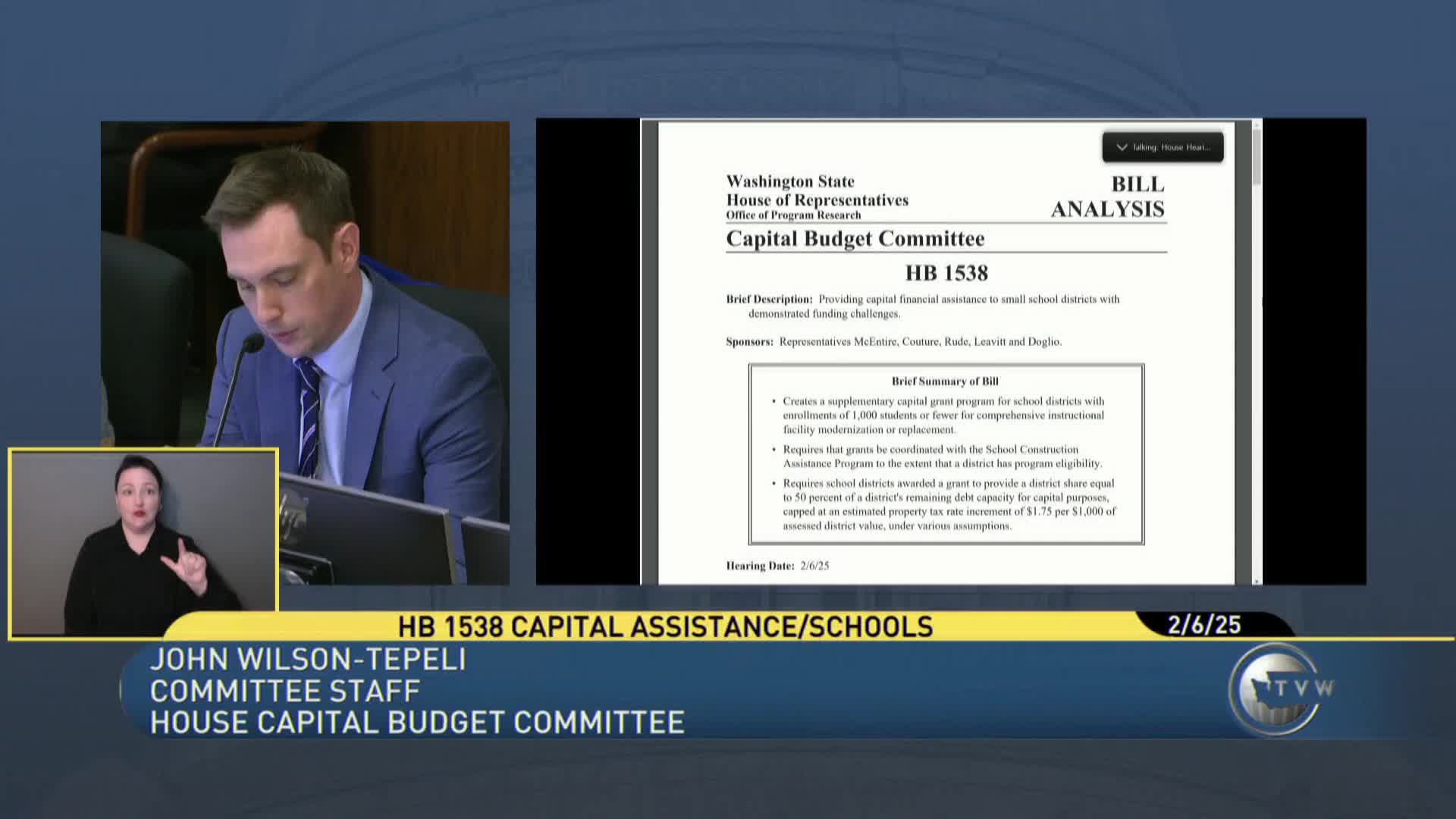
John Wilson Topeli, staff to the committee, told the Capital Budget Committee the proposal is substantially the same policy as substitute House Bill 1044 from last session except for a delayed effective date. Under the bill, projects eligible for grants must modernize or replace instructional facilities that are at least 30 years old and recorded as in poor or unsatisfactory condition. The program would fund planning, design and construction costs and be prioritized by an advisory committee using a points- and formula-based scale that gives more weight to districts with less remaining debt capacity and lower enrollments compared with statewide averages.
Representative Joel McIntyre (R-19), the bill's sponsor, described the measure as an effort to provide an objective way to identify and prioritize schools in the worst physical condition. "This bill puts into place an objective prioritization that will stack schools numerically," McIntyre said, adding that the scoring will show "where we get the most bang for our buck." McIntyre, a former teacher, cited examples of schools with leaky roofs, asbestos and insufficient heating and cooling as conditions the bill aims to address.
Under the bill, school district grantees would provide a district cost share equal to at least 50% of the district's remaining debt capacity for capital purposes, capped at an estimated property-tax rate increment of $1.75 per $1,000 of assessed value under specified assumptions about interest rates and amortization. The bill sets the program's effective date at Jan. 1, 2028. A fiscal note was requested but not yet available at the time of the hearing.
During the public hearing, small-school advocates and district leaders testified in support. Jim Kolkowsky, director of the Rural Education Center and a retired small-district superintendent, said the bill "provides hope" for property-poor districts that otherwise lack bonding capacity. John Axtell, who identified himself as a student advocate, said he "strongly support[s]" the bill while urging the committee to consider lower-cost state financing such as interest-free or very-low-interest loans. Matt Mallory, superintendent of the Mary M. Knight School District, described his district's low assessed valuation and said even at high levy rates the local capacity would not cover large building costs.
Committee staff placed the bill in context with existing statutory capital programs for K-12 education including the School Construction Assistance Program, the Small District and Tribal Compact Schools Modernization Program and the School Seismic Safety Program. Staff noted that, last session, substitute HB 1044 carried an OSPI fiscal estimate of about $440 million for the 2027-29 biennium that would have funded roughly a dozen construction grants and a pipeline of planning grants; that fiscal estimate applied to the earlier bill and the committee requested a new fiscal note for HB 1538.
No committee vote occurred on HB 1538 at this meeting; the hearing was opened and closed with the committee taking written and in-person testimony.
The bill will return to committee for further action once staff and stakeholders complete fiscal and technical work and any amendments are considered.