Get Full Government Meeting Transcripts, Videos, & Alerts Forever!
Get email alerts on the Local Sales Tax Kent topic
No spam. Unsubscribe anytime.
Kent-backed local-option sales tax proposal gets hearing; Department of Revenue raises administrative concerns
Summary
House Bill 1532 would authorize certain large industrial cities, notably the City of Kent, to impose an additional local-option sales and use tax of up to 0.3% subject to public-process requirements; the bill received extensive testimony at a House Finance Committee hearing.
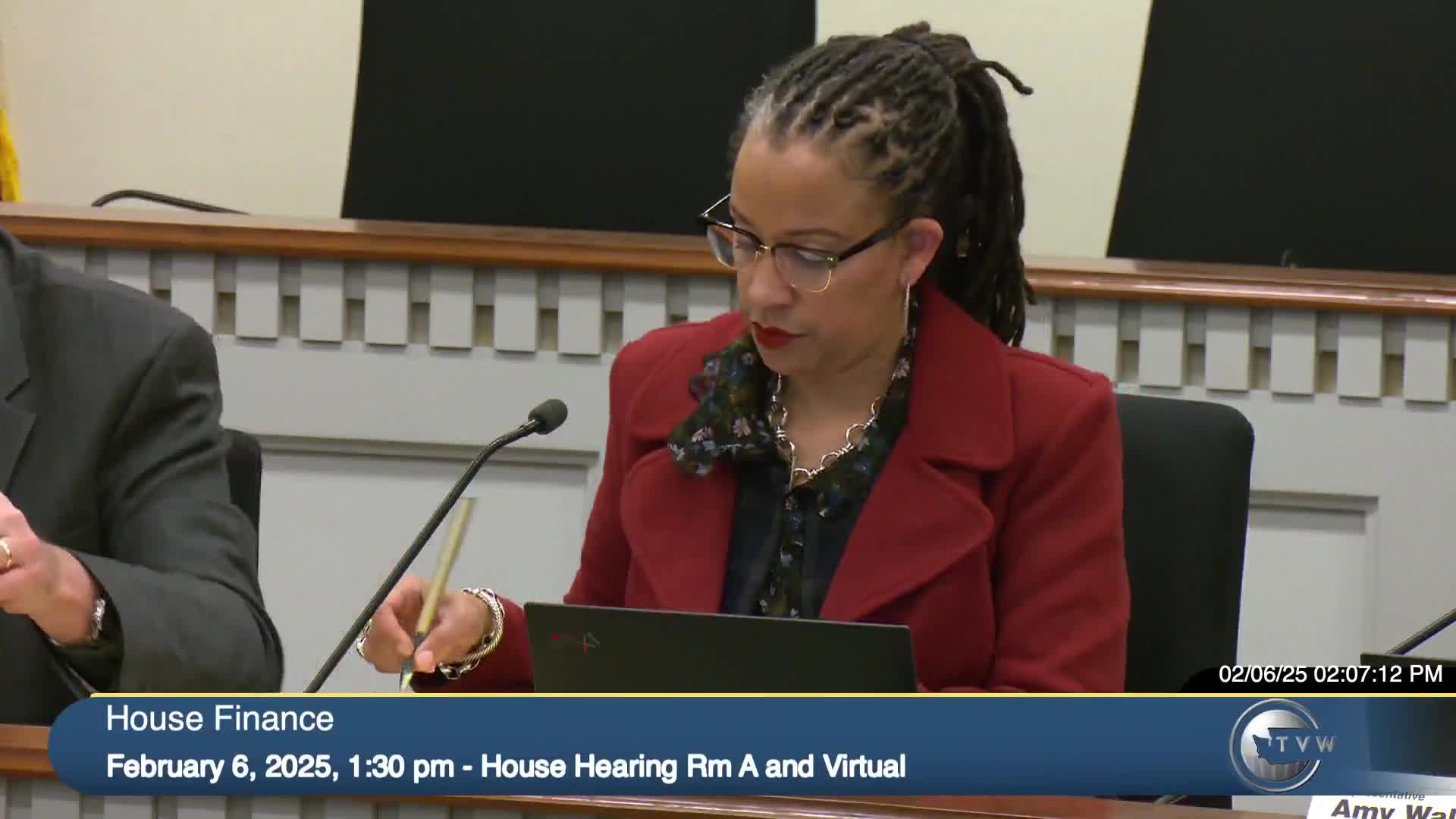
House Bill 1532 opened for public hearing in the House Finance Committee with extensive testimony focused on the City of Kent and the designation "authorized city" that would be eligible to impose up to a 0.3% local-option sales and use tax.
Tracy Taylor, committee staff, summarized the measure and the background on sales and use tax sourcing: "Under House Bill 15 32, the legislative body of an authorized city may impose an additional sales and use tax of up to point 3% ... An authorized city means a city that has a population of greater than 120,000 in the county with a population of 1,500,000 or greater and that has at least 25% of its total property assessed value derived from industrial or in warehousing industries." Taylor also summarized the fiscal note and the Department of Revenue’s administrative assumptions.
Representative Chris Stearns, the bill’s prime sponsor, told the committee he brought the bill on behalf of the City of Kent and said the city "has been harmed more than any other city in the state, by a change that the legislature made over a decade ago in how sales tax revenues are sourced or allocated." Mayor Dana Ralph of Kent described decades of revenue disadvantage attributed to destination-based sales tax sourcing and told the committee that, "If the old sales tax sourcing structure were in place today, the city would receive an additional $18,000,000 annually." She noted mitigation payments scheduled to end in 2026 total about $2.5 million and said Kent needs local tools to invest in services.
The Department of Revenue (DoR), represented by Steve Ewing, raised administrative concerns: the bill does not specify whether the city authorization should be by ordinance or resolution, DoR said it lacks the data to determine whether a city meets the 25% industrial assessed value threshold and recommended the city attest or include a finding in the enabling ordinance; and DoR noted an emergency clause would not allow immediate administration because sales-tax changes generally take effect only on Jan. 1, April 1 or July 1 and DoR estimates it needs about six months to program and test a new tax, making Jan. 1, 2026 the earliest practical effective date.
Multiple local officials, ports and business groups spoke in support, including Council President Satvinder Kaur and Council Member Bill Boyce of Kent, the Port of Seattle, the Northwest Seaport Alliance and local businesses such as Fred Meyer. Supporters argued Kent fuels statewide economic activity through warehousing and distribution while receiving comparatively little local tax revenue. Testimony in opposition urged voter approval for a local sales tax increase; Scott Hazelgrove of the Washington State Auto Dealers Association said the bill would raise Kent’s sales tax rate to near 11% and that "the public should have an opportunity to determine whether or not to impose a higher sales tax on themselves."
Staff summarized fiscal details reported to the committee: Department of Revenue assumed any city that levies the tax would do so at the maximum 0.3% and that 105,000 taxpayers would be affected; a local fiscal note (City of Kent estimate) projected approximately $3.9 million in the first four months of collections in FY 26 and $12.2 million in the first full year for FY27. Several speakers urged the committee to advance the bill to give Kent a local tool to address long-term revenue shortfalls; DoR asked for clarifying statutory language about the authorization mechanism and timing.