Get Full Government Meeting Transcripts, Videos, & Alerts Forever!
Get email alerts on the Fair Budget topic
No spam. Unsubscribe anytime.
Bonner County commissioners press fair board for budget transparency, one-page plan and use of Munis for levied funds
Summary
County commissioners and the fair manager discussed requests to make levied-fund spending more transparent, a permanent increase in the fair’s levy allocation, creation of a 1/3/5‑year strategic plan and a proposal to hire a full‑time sponsorship/grants position to boost enterprise revenue.
Bonner County commissioners and the county fair manager debated the fairgrounds’ budget and planning needs Tuesday, focusing on whether to make a recent $20,000-to-$40,000 levy increase permanent, how levied funds are tracked, and the fair board’s obligation to deliver a short strategic plan for facilities and revenue by a near-term deadline.
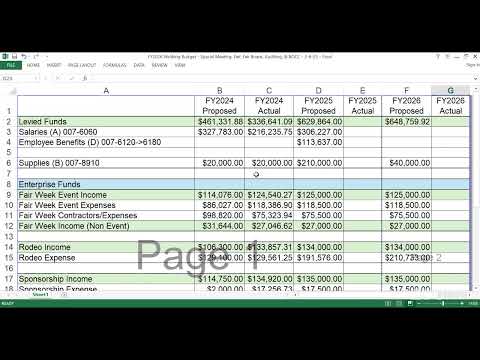
The discussion began when Mark Knapp, fair manager, presented a multi-year spreadsheet showing FY2024, FY2025 proposed and FY2026 projections and said the county provided $210,000 in levied funds for the current fiscal year and that the fair’s enterprise revenues (sponsorships and event income) remain difficult to reconcile until after the August fair and related events. “Right now…we're projecting because a lot of our enterprise funds…we really don't reconcile and know what our actuals will be for 2025 on our enterprise funds going into 2026 until pretty much FY '26 starts on October 1,” Knapp said.
Commissioners pressed for clearer accounting and public visibility before approving any permanent levy increase. Commissioner Williams said community members have raised questions about how levy money is spent and asked the fair board to show line-item spending that justifies doubling the annual allotment from $20,000 to $40,000. Jessica (county comptroller) proposed that any expense paid with levied (taxpayer) dollars be run through the county’s Munis financial system so auditors and the public can see where the money goes: “The process would be the same…auditors have concise visibility.” The commissioners indicated they would place that proposal on the next BOCC agenda for consideration.
Commissioners also pressed the fair board to produce a short strategic plan (1/3/5 years) that lays out infrastructure priorities, estimated costs and revenue strategies. Several commissioners said the fair board has a statutory obligation to deliver such a plan and asked the board to provide a draft template within 30 days so the BOCC and the public can judge whether additional levy money or county assistance is justified. Fair board members and Knapp agreed to begin drafting a template and to hold walk‑throughs of facilities to inform the plan. Glenn (Fair Board member) confirmed the board has begun planning walk‑throughs and said inviting two recently appointed members with construction and finance backgrounds could help shape priorities.
Discussion covered several infrastructure and operational items commissioners said should appear in the plan: the condition of roofs and building floors (including a cited roughly $700,000 repair estimate for one major building), a six‑figure parking/drainage fix, the bleacher replacement project already budgeted for this year, and the volatile nature of enterprise income (ticketing, rodeos, demolition derby, rentals and sponsorships). Knapp acknowledged enterprise budgets can run at a deficit on paper because sponsor receipts and event income are realized only after events conclude: “If we get rained out at fair and our events only make us $20,000, then guess what? Next year's fair, we're only gonna have $20,000 to spend on events.”
The commissioners and fair manager also discussed staffing. Knapp and others said the fair lacks a dedicated full‑time employee to pursue sponsorships and grants; current staff split event coordination and sponsorship work and commissioners urged adding a sponsorship/grant position that could be funded by a mix of levy and grant dollars and included in the upcoming budget process. Knapp said a job description exists and he intends to include a request for a full‑time sponsorship/grants FTE in the formal budget submittal.
Board members flagged a potential donated well for the grounds; commissioners advised first seeking a legal opinion and municipal clearance because the fair property lies in the City of Sandpoint and local rules may prohibit drilling. Commissioners offered to ask the county prosecutor to research the legal feasibility before the fair invests resources into casing or pump cost estimates.
No formal BOCC votes on the levy increase or staffing were recorded during the workshop. Commissioners directed staff to place a proposal to run levied‑fund bills through Munis on the BOCC agenda and asked the fair board to submit a draft strategic template within 30 days; both items will return for formal action during the regular budget process.
The meeting closed with agreement on next steps: fair board walk‑throughs of key facilities, a near‑term template from the fair board so commissioners can evaluate individual line items and an intention to preserve the county’s oversight role where taxpayer funds are spent.
The item drew multiple public comments asking for transparency and noting that levied dollars are only part of the county’s total support (staff salaries, insurance and vehicle coverage also are provided by the county).