Get Full Government Meeting Transcripts, Videos, & Alerts Forever!
Get email alerts on the Concordia Development topic
No spam. Unsubscribe anytime.
Independence planning commission hears hours of public comment on Concordia preliminary plan; no final decision
Summary
At a Feb. 4 public hearing, residents, developers and city staff debated a proposed 62-lot development on 18.2 acres behind Concordia Lutheran Church; commenters raised stormwater, tree removal, gas-well safety and procedural concerns. The commission closed the hearing but took no final action.
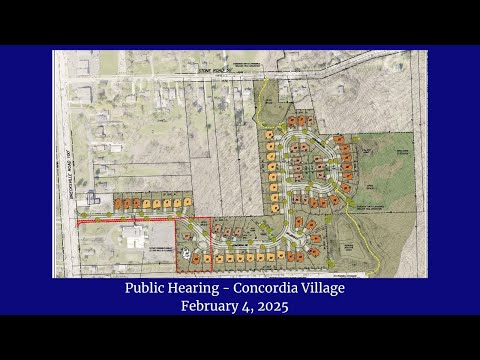
The Independence Planning Commission heard more than a dozen residents, the developer and city staff at a Feb. 4 public hearing on a preliminary plan for the Concordia property, an 18.2-acre parcel the city acquired behind Concordia Lutheran Church. The hearing closed after a roll-call vote; the commission did not approve or deny the plan and left outstanding engineering, variance and procedural questions for later consideration.
Jessica (Economic Development Director) told the commission the city worked with Concordia Lutheran Church to acquire the 18.2 acres and engaged Petros Development (Petros Homes) to propose a neighborhood of single-family homes on smaller lots under a U1A overlay. She said the developer’s updated site plan shows 62 lots, added landscape screening, a looped water line to Stone Road and a larger stormwater basin that the developer says exceeds city code. “The developer submitted a tree study in compliance with the city's preliminary site plan requirements,” she said.
The nut graf: residents who live along Stone Road and downstream from the Concordia tract strongly contested the plan’s environmental and procedural aspects, including tree removal, increased runoff and the presence of active gas wells on the site. Several speakers also alleged notice and application defects and urged the commission to require additional studies or a residents’ meeting before advancing the application.
Most substantive public comments focused on stormwater and tree removal. Petros Development representative Greg Modic said the revised plan increases the size of the south stormwater basin and adds a stormwater-management pump to reduce runoff toward Stone Road. “This will greatly, greatly reduce the amount of runoff that are going to those folks now on Stone Road,” Modic said. He described a drainage area shift on the property—from about 10 acres to roughly 1 acre directed to the new corridor—and said the project intends to exceed the city’s code requirements for stormwater management.
Several residents disputed engineers’ assurances and pressed for more detail. Pamela Dengler, whose lot borders the site, told the commission she believes the preliminary plan was incomplete when submitted and cited specific city-code sections she said were not met, including a missing preliminary-plan fee and a missing tree inventory at the time of submission (she referenced code sections cited in her remarks). She told the commission the application was therefore invalid and asked the commission to “show some integrity and follow the rules.”
Multiple speakers described changes in local drainage after prior nearby construction and urged protection against increased erosion or more frequent standing water. Katie Sailor and others cited published runoff figures (forest vs. high-density development) and asked whether the proposed work would alter the lot’s grade and divert surface water onto neighboring properties, invoking Ordinance 1351.01 (section B) as a local standard attendees said prohibits such diversion.
Several speakers raised safety and health concerns related to existing oil-and-gas infrastructure on or near the site. Dan Tabatka, a Stone Road resident, urged recusal of Mayor Kurtz (whom he called a petitioner) and criticized the proximity of gas wells and tank batteries to houses, saying such locations pose risk and citing incidents he said had occurred in Ohio. Jim Soter asked the developer for documentation on well safety and on potential long-term effects of gas extraction on subsurface stability and house settlement.
Support for the project was also expressed. Kathleen Kapusta said the housing type is “long overdue” and urged the commission to move the project forward as a way to offer smaller, lower-maintenance housing options for older residents. Diane Malaric, another resident, said she supports the development but asked that engineers’ stormwater work be carefully validated.
Process and notice issues drew repeated attention. Mary Jane Horton said the city-owned status of the Concordia property differentiates this case from prior rezoning litigation and urged commissioners to follow the extensive statutory checklist she cited (she referenced planning-commission duties in Chapter 1141.09). Horton and others also alleged that published parcel numbers in the public notice were incorrect; Horton said county records did not match the PPN shown in the notice. Several commenters asked for a resident-only forum that would allow longer discussion than three-minute public comments.
Petros representatives said they had supplied a tree survey identifying trees 12 inches or greater in diameter and that final engineering would clarify well plugging or tank-battery relocation options. Modic said the developer is in active conversations with the gas-well owner and that potential plugging or relocation could change setbacks and allow additional lots to be built; he emphasized that final configurations will be determined during final engineering.
The planning commission closed the public hearing by motion and roll-call vote; the commission did not take final action on the preliminary plan at the meeting. The developers and staff remained available to answer questions afterward, and commissioners indicated they would review submitted materials and legal/code compliance before any decision.
Votes at a glance: A motion to close the public hearing passed on a roll-call vote. “I'll have motion to close the public hearing,” said the acting chair, and a member seconded. Commissioners recorded verbal “yes” votes for Kurt (Mayor Kurtz), Hicks, Mueller, Gutterman and Peter Rauchau, after which the chair stated, “And the public hearing is closed.”
Next steps: If the commission decides to move the preliminary plan forward it would allow the developer to proceed with detailed engineering, lot splits and final site-plan and subdivision-plat approvals; the record shows the developer intends to apply to the Board of Zoning Appeals for variances the commission cannot grant. The commission did not set a date for further action at the Feb. 4 meeting.
(Reporting note: direct quotes and other statements are taken from the Feb. 4 planning commission public hearing transcript.)