Get Full Government Meeting Transcripts, Videos, & Alerts Forever!
Get email alerts on the Spaceport Exploration topic
No spam. Unsubscribe anytime.
Committee advances bill to study feasibility of Utah spaceport
Summary
A legislative committee moved first substitute Senate Bill 62 forward with a favorable recommendation to create an exploratory committee to study the feasibility of a Utah spaceport and authorize a $1 million feasibility effort funded from the Industrial Assistance Account and administered by the Governor's Office of Economic Opportunity.
A legislative committee on space and economic development voted to advance first substitute Senate Bill 62, which would create a Spaceport Exploration Committee to study whether Utah should host a spaceport and what infrastructure, environmental and economic steps would be required.
Sponsor Senator Stevenson told the committee the initiative is intended to assess whether a state-supported effort could attract private aerospace activity and expand high-paying jobs. "This initiative represents a forward thinking approach to innovation and economic growth," Stevenson said, adding that the bill would fund a feasibility study using $1 million from the Industrial Assistance Account administered by the Governor's Office of Economic Opportunity.
The bill's backers argued Utah already has workforce, runway and recovery-area advantages that merit a formal study. "We already have large runways," Stevenson said, naming Hill, Dugway and Wendover as sites with military-designated runways, and noting the presence of major contractors such as Northrop Grumman, Boeing and Lockheed. He said private-sector launch methods — including air-launch from airplanes — make a Utah spaceport feasible without the giant gantries associated with Florida launches.
Ryan Starks, executive director of the Governor's Office of Economic Opportunity (GOEO), told the committee the Industrial Assistance Account is intended to support industry initiatives and that the money earmarked in the bill would be used for workforce and feasibility analysis. "The purpose of the fund, the way it's governed, is to support industry initiatives," Starks said. "We think that this would help with workforce studies, with feasibility studies, pulling together the data to help guide kind of this next generation of development."
Committee members asked about the balance between federal and private-sector involvement and about whether the GOEO fund was already appropriated. Representative Ivory asked how the state would maintain the proper balance with federal partners; Stevenson responded that the committee is intended to define roles and that much modern space activity is private-sector led. Ivory also asked why the proposal did not appear in the governor's proposed budget; Starks said the Industrial Assistance Account is governed and used for special projects and that the money has been set aside for such initiatives.
Representative Peterson pressed for a clearer description of how the $1 million would be used; Stevenson and Starks said the funds are intended for meetings, studies and data collection rather than any construction. "So the million dollars is for folks to meet and talk and research. It's not — there's no construction of anything," Stevenson said.
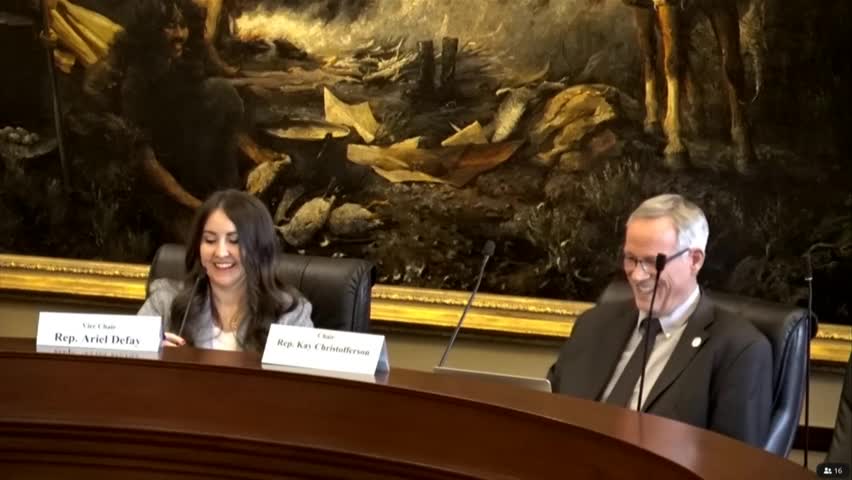
After public comment was closed (no public comments were offered during the record), Representative Kristofferson moved that the committee pass out first substitute Senate Bill 62 with a favorable recommendation. The committee voted in favor; the record shows the motion passed and the chair ruled it passed unanimously.
The bill designates GOEO to distribute the funds and calls for an exploratory committee of industry and technical experts to report back to the legislature on feasibility, potential sites, workforce needs and environmental considerations. The committee will determine membership and deliverables if the bill proceeds.
Because the proposal uses the Industrial Assistance Account rather than a general-fund appropriation, committee members said it will not require a new appropriation in the budget process at this stage. The committee forwarded the bill with a favorable recommendation to the next legislative step.