Get Full Government Meeting Transcripts, Videos, & Alerts Forever!
Get email alerts on the State Budget Social Services topic
No spam. Unsubscribe anytime.
Social Services committee hears scores of funding requests; committee adopts chair—s budget-cut list and several procedural motions
Summary
The Social Services Interim Committee heard more than 70 funding requests Feb. 6, 2025, from providers seeking one-time and ongoing appropriations for services such as diaper banks, early-childhood mental health, domestic-violence advocacy, suicide-prevention outreach and behavioral-health expansions.
The Social Services Interim Committee met Feb. 6 to hear more than 70 funding requests for programs ranging from diaper banks and early-childhood services to behavioral-health expansions and homelessness projects. Committee chairs said they had compiled a chair—s list of recommended cuts and reductions in preparation for follow-up meetings. Presenters from nonprofits, local governments and providers gave three-minute pitches for one-time and ongoing funding.
The meeting opened with a budget overview from the committee chair noting the scale of the work: "We have several there's 78 building blocks, based upon our base budget...our budget is between 8 and $9,000,000,000," he said, framing the committee—s decisions as part of a larger process of prioritized reductions.
Why it matters: The committee is balancing a constrained state budget while many community providers seek funds to maintain or expand services. Several requests asked for one-time capital to expand facilities and for ongoing dollars to sustain programs that committee members repeatedly described as delivering prevention, crisis response or cost savings to state systems.
Key requests and presentations
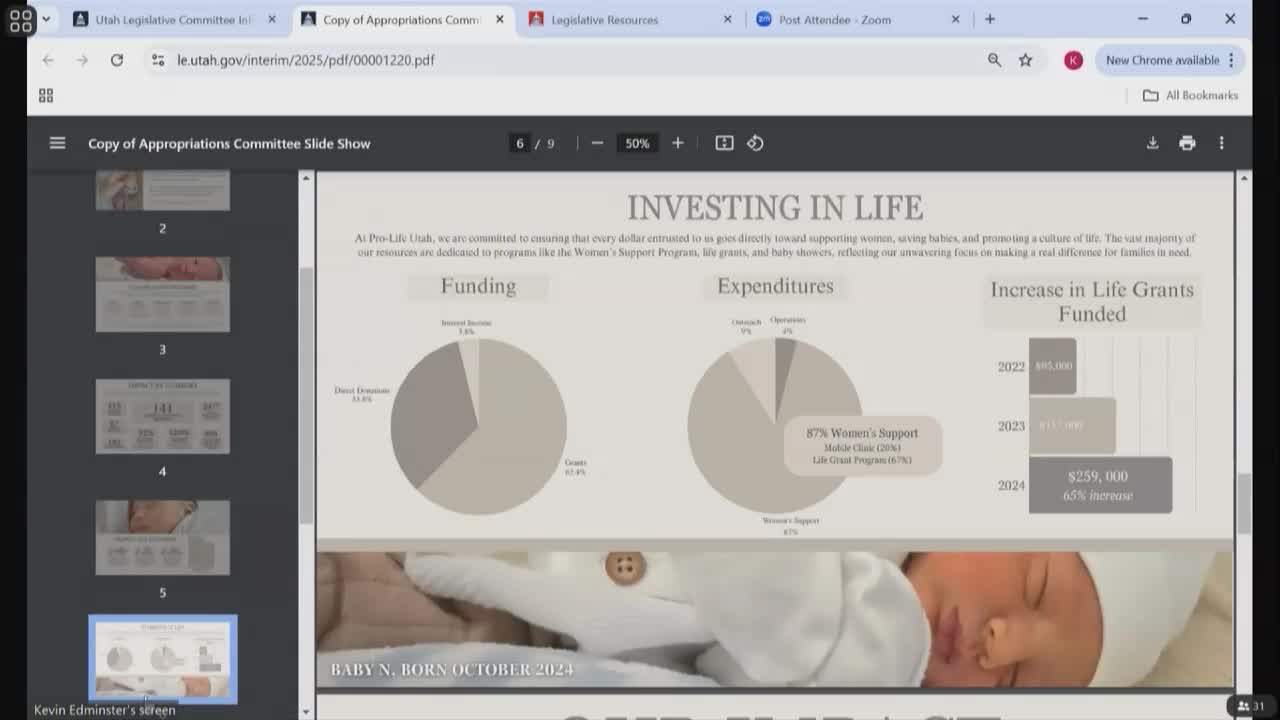
- Pro-life pregnancy support and pregnancy resource centers: Representative Shane said Pro Life Utah and related pregnancy resource centers have used prior appropriations for ultrasound and counseling services and asked for additional ongoing funding. "92 percent of the women choose life after receiving an ultrasound," Representative Shane told the committee when describing the group's outcomes. The committee was also presented a $400,000 ongoing request for statewide Pregnancy Resource Centers (11 centers statewide), intended to expand grants beyond Salt Lake area centers.
- Diaper banks and infant supplies: Little Lambs requested $3,100,000 one-time to build a 16,000-square-foot community resource and distribution center in Logan to increase diaper, formula and hygiene distribution; Little Lambs said it distributed roughly 1,600,000 diapers and served about 70,000 individuals in 2024. Separately the Utah Diaper Bank (based in Murray) presented a scaled, ongoing request ($1,530,000 ongoing) to expand operations and cover staff and supplies after operating primarily with volunteers and donated space.
- Behavioral health and treatment expansions: Multiple behavioral-health requests were heard. Valley Behavioral Health asked for one-time funds to expand its Tooele County facility to meet growing demand in a fast-growing county. Odyssey House presented a proposal to purchase a transitional housing facility for people with opioid use disorder — asking for $600,000 in opioid settlement funds to be matched by Salt Lake County and supported by Odyssey House funds; the plan includes ongoing voucher funding to support residents for several months after treatment. Camp K (Kostopoulos Dream Foundation) requested $3,000,000 one-time to support operations, insurance and construction of an accessible education center; presenters described Camp K as Utah's only overnight recreational therapy and respite provider for people with significant disabilities.
- Addiction recovery and sober living: The Sobriety Foundation described a program of two-month scholarships for people escaping initial rehab into sober living and updated its request to $250,000 one-time (an opioid-fund request). Representatives argued the approach reduces recidivism and helps people gain employment and stable housing.
- Homelessness/transformation model: The Other Side Village presented a $10,000,000 one-time capital request to expand a peer-run self-reliant community model for chronically homeless individuals (they described a target capacity of roughly 500 people in a buildout). Presenters said the project has a social-enterprise component and would be matched by private philanthropic funds.
- Early childhood, mental health and Part C services: The Children's Center Utah requested $1,000,000 ongoing to expand early-childhood mental-health treatment targeted at infants, toddlers and preschoolers statewide (including telehealth and a Utah County location). Separately, the Baby Watch Part C early-intervention system leaders requested $3,100,000 one-time and $4,603,400 ongoing to address provider pay, staffing shortages and rising caseloads; they emphasized inflation-driven erosion of provider compensation since 2017.
- Foster care and permanency programs: Several items targeted children in foster care. Raise the Future requested $1,000,000 ongoing for the Wendy's Wonderful Kids program to recruit permanent families for hard-to-place youth; presenters cited the long-term fiscal and social costs for youth who age out of care. First Lady Abby Cox and partners sought $1,800,000 one-time (plus $259,000 in related care-community funding) to expand "care communities" that support foster families and reduce placement churn.
- Domestic violence and sexual-assault prevention: CAPSA and partners asked for a $814,501 one-time pilot to scale a community-collaboration model based on a Logan partnership; the Utah Coalition Against Sexual Assault asked for $300,000 ongoing to sustain a statewide sexual-assault helpline and expand chat/text functionality and capacity. Multiple presenters cited SB 117 (2023) and the lethality-assessment protocol; a separate request of $1,400,000 ongoing was described to support victim-service providers responding to increased referrals after the lethality-assessment law.
- Suicide prevention and training: LiveOn Utah and allied prevention and training efforts presented multiple requests (both one-time and ongoing). Committee members emphasized the program—s reach through social-media campaigns and training modules; presenters said the state—s rank on suicide deaths has improved in recent years and credited prevention investments.
- Suicide/bereavement research and medical-examiner outreach: The Office of the Medical Examiner described a multi-year interview study with families bereaved by suicide and requested ongoing funding ($299,700 ongoing requested in committee materials) to scale family-outreach specialists who collect data and offer postvention supports. Presenters argued postvention is itself a prevention strategy because bereaved family members have elevated suicide risk.
- Dementia and older-adult services: The Alzheimer—s Association and legislative sponsors requested $1,500,000 ongoing to place 12 regional dementia-care specialists within area agencies on aging covering the state—s 12 AAAs; sponsors emphasized the potential Medicaid and caregiver-cost savings of keeping people with dementia supported in the community.
What the committee decided (procedural votes)
- The committee approved procedural minutes from prior meetings by voice vote.
- The committee approved an if-then intent motion labeled CD3 that the staff presented for consideration (committee vote: approved by voice vote). The committee later adopted the chair—s list of recommended budget reductions as a procedural step in the committee—s budget work.
- The committee approved ad hoc motion AZ-8 (preferred drug-list implementation language) as presented by staff.
- Chairs noted a "chair's list" of proposed reductions totaling tens of millions of dollars in ongoing and one-time savings; members were reminded the list will be refined at follow-up meetings before final recommendations to leadership.
Process notes and next steps
Presenters were asked where appropriate to take technical questions offline and return with additional documentation or edits; several presenters described their requests as "scalable," and committee members repeatedly asked whether a request could be reduced in size if fiscal constraints require cuts. Committee chairs said they will continue deliberations in follow-up meetings and finalize recommendations for executive leadership.
Ending
Committee members praised many presenters for local programs that, they said, provide prevention and reduce downstream costs to state systems. Members scheduled further discussion and votes in subsequent committee sittings.