Get Full Government Meeting Transcripts, Videos, & Alerts Forever!
Get email alerts on the Environmental Health topic
No spam. Unsubscribe anytime.
Will County committee tours health department; lab staff outline water and beach testing
Summary
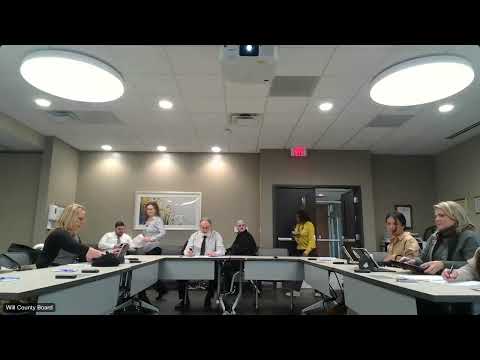
Members of the Will County Public Health and Safety Committee toured the Will County Health Department and Community Health Center, heard an environmental lab overview covering potable and nonpotable water testing, accreditation timelines and beach monitoring, and approved meeting minutes before the tour.
Members of the Will County Public Health and Safety Committee visited the Will County Health Department and Community Health Center for an informational tour and received a detailed briefing on the county’s environmental health laboratory.
Elizabeth Galata, a Will County health department staff member, opened the visit and said the tour supported the department’s strategic plan objective on communication and engagement: “I just really wanted to say thank you for coming to our campus. We are very excited to have you here at the Will County Health Department and the Community Health Center.”
The tour’s nut graf: Committee members were given a technical overview of water and septic testing services the county laboratory provides, plus information about accreditation schedules and the laboratory’s role in beach monitoring and individual mechanical system inspections.
Tricia Kaut, manager of the environmental health laboratory, described the lab’s work and capacity. “I work in the environmental health lab. I actually started as an intern in 1999,” Kaut said, and explained the lab performs both microbiology and chemistry testing for potable and nonpotable water.
Kaut outlined the lab’s routine services: total coliform and E. coli testing for private wells and other potable water, nitrate, fluoride and hardness analysis using ion-selective probes and titration, suspended solids and biological oxygen demand testing for septic and nonpotable samples, and residual chlorine measurement by titration. She said the lab also samples about 11 county beaches every two weeks during beach season and escalates sampling when bacteria levels are elevated.
Kaut gave approximate program scale and performance figures: the county has roughly 3,239 individual mechanical systems (IMS) — small onsite treatment/discharge systems — and “about 95%” of bacterial tests on those samples return within acceptable limits. She explained sampling protocol for microbiology: samplers collect 100 milliliters of sample but the lab tests 1 milliliter and multiplies colony counts by 100, which is why results are sometimes reported as “less than 100” when no colonies are observed.
Kaut also reviewed accreditation. The microbiology accreditation is overseen by the Illinois Department of Public Health and occurs biannually; Kaut said that inspection is scheduled in April. Chemistry accreditation runs through a National Environmental Laboratory Accreditation Program (NELAP/NELAC) process and is also conducted on a biannual cycle, with a September visit noted in the briefing.
Committee liaison Tim Hendricks reminded members the tour required reconvening afterward in the same room to finish business. Chair Butler and committee members thanked staff for arranging the visit and said the tour answered questions about daily lab operations and quality controls.
Votes at a glance
- Approval of minutes: Will County Public Health and Safety Committee regular meeting, Jan. 2, 2025. Motion: Dean Schlattman; second: Poston (as recorded). Vote: Berkowitz — yes; Poston — yes; Dean Schlattman — yes; Hickey — yes; Butler — yes. Outcome: approved.
- Approval of Board of Health minutes (date not specified in transcript). Motion: Dean Schlattman (as recorded). Second, vote tally and outcome: not specified in the transcript.
- Motion to adjourn. Motion recorded; verbal vote: all in favor, “Aye.” Outcome: approved.
Ending: Committee members said the tour reinforced the laboratory’s role in public health oversight for water safety and beach monitoring; staff indicated more detailed reports will return at future public health and safety meetings.