Get Full Government Meeting Transcripts, Videos, & Alerts Forever!
Get email alerts on the State Audit Finances topic
No spam. Unsubscribe anytime.
State auditor shows higher-education cash balances rose since COVID; cautions on interpretation
Summary
State Auditor Tina Cannon and staff reviewed ACFAR and Transparent Utah data for higher education, showing rising cash balances at institutions since the COVID-era infusions and recommending careful, multi-line analysis rather than single-account metrics when evaluating university savings and reserves.
Tina Cannon, the State Auditor, and staff presented an overview of higher-education financial reporting on Feb. 6, showing tools the auditor's office has published to help lawmakers and the public track university and college expenditures and cash balances.
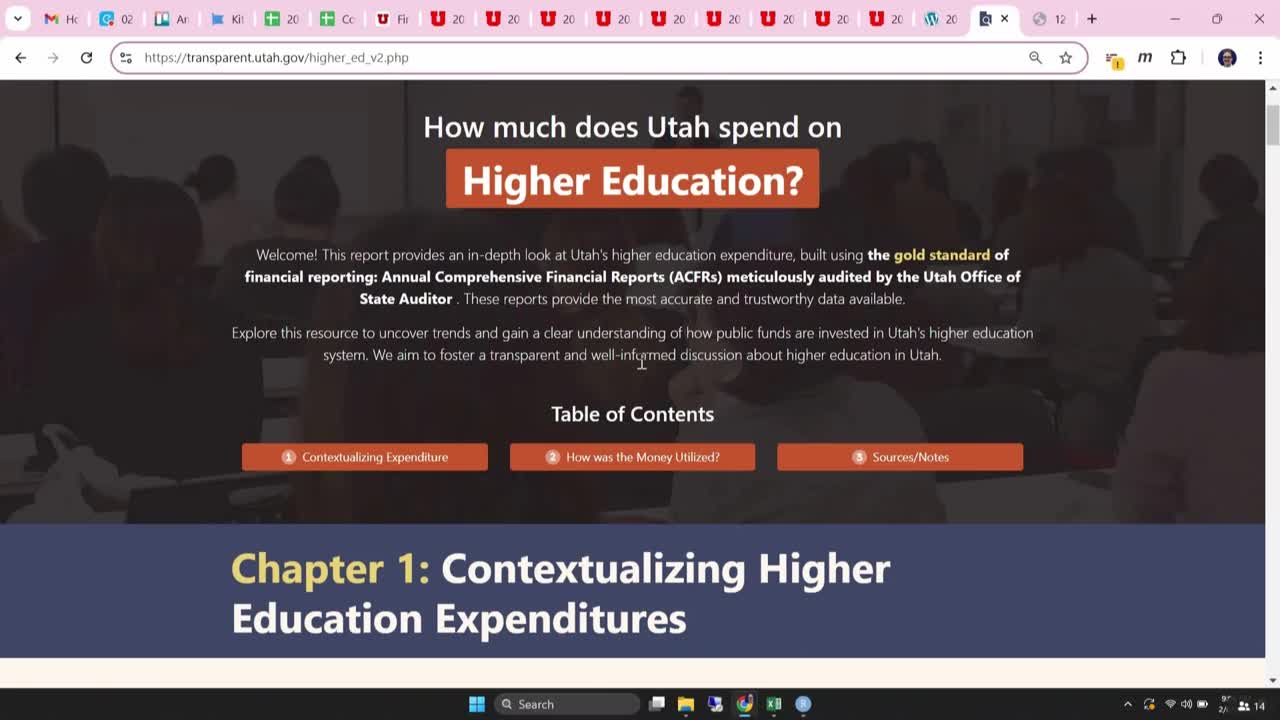
"On our website right now, we have 'How much does Utah spend on higher education,' and it's our portal taking those two sets of data and putting it into a useful format for the public to understand the overall," Tina Cannon said, referring to the auditor's Transparent Utah portal and the state's annual comprehensive financial reports (ACFARs).
Jason Allen and Alex Nielsen of the auditor's office explained the audit approach and the composition of institutional cash balances, and showed a condensed statement of cash flows for the University of Utah as an example. The presentation noted that operating activities, patient services (for medical centers), tuition receipts, endowment investments and state appropriations all contribute to changes in institutional cash balances.
Why it matters: lawmakers have asked whether universities hold large, unrestricted "savings" that could be used for other purposes. The auditor's presentation warned that answering that policy question requires analyzing multiple funds and legal restrictions; endowments and donor-restricted funds, capital project accounts and PTIF/investment balances may not be usable for general operating purposes.
Cannon said that across state institutions and agencies the auditor observed an overall increase in cash balances following federal COVID-era funding. She cautioned that some changes reflect temporary federal inflows and that investment valuations can fluctuate because of market movements (paper gains/losses) even when institutions keep assets for long-term purposes.
Jason Allen described standard audit stages (planning, testing by materiality, reporting) and noted the ACFAR combines many entities; the office also issues individual audited financial statements for each institution. Cannon and staff invited committee feedback on what additional breakdowns or visualizations would help lawmakers and said the auditor's office can prepare similar condensed cash-flow summaries for other institutions though compiling statewide, institution-level analyses is staff- and time-intensive.
Ending: the auditor's office encouraged the committee to treat the published dashboards as a starting point for policy discussion and to recognize accounting constraints and donor or legal restrictions when weighing options for use of institutional funds.