House subcommittee urges extension of CARES-era statute of limitations to prosecute pandemic UI fraud
Loading...
Summary
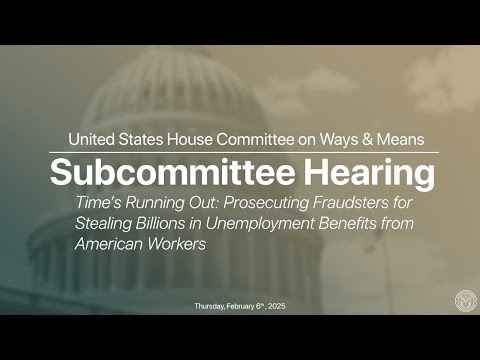
Witnesses and members told the House Ways and Means Work & Welfare subcommittee that criminal prosecutions and civil recoveries of pandemic-era unemployment insurance fraud hinge on extending a CARES Act–related statute of limitations that expires March 27, 2025.
The House Ways and Means Subcommittee on Work and Welfare opened a hearing urging Congress to extend the statute of limitations for CARES Act–related unemployment insurance (UI) fraud to preserve ongoing criminal investigations and recoveries.
The hearing’s chair emphasized the looming deadline and said Congress “must act to extend the statute of limitations.” That deadline, members and witnesses warned, threatens to close the window on thousands of federal and state investigations now under way.
The subcommittee heard testimony that pandemic-era emergency benefits were a target for large-scale criminal rings and that prosecutors and auditors need more time to pursue complex cases. Haywood Talcove, chief executive officer of LexisNexis Special Services Inc., told the committee that criminal networks used stolen personally identifiable information and that the scale of fraud exceeded the capacity of existing recovery programs. “Pay and chase does not work,” Talcove said, urging Congress to extend the deadline and give law enforcement additional time to bring cases to court.
Committee members cited multiple official estimates of program loss during the pandemic. Members quoted figures from the Government Accountability Office, Department of Labor and other witnesses ranging from roughly $100 billion to $250 billion in UI-related improper payments, and kept a consistent focus on the March 27, 2025 expiration date for CARES Act–related felony prosecutions and civil actions unless Congress acts.
Ranking Member Rep. Danny Davis (D-Ill.) opened with a bipartisan statement that Democrats want to hold fraudsters accountable but also criticized the recent firing of the Department of Labor inspector general, Larry Turner, who he said had led substantial pandemic-era UI prosecutions and recommended the statute extension to the committee. Davis told colleagues that the inspector general’s removal risked undermining enforcement capacity and the agency’s institutional knowledge.
Several members emphasized the number of ongoing federal matters. The chair cited Department of Justice figures supplied to the committee showing more than 1,600 open criminal matters related to COVID-era UI fraud and said DOJ had charged more than 600 criminal UI fraud matters with tens to hundreds of millions in associated losses. Rep. Rudy Yacom (R-Ind.) entered a Department of Justice email about uncharged matters into the record without objection.
Members also raised national-security concerns about foreign criminal groups exploiting the programs. Talcove and others described transnational rings — with activity traced to multiple nations in testimony — and said many ringleaders operate offshore, complicating prosecution.
There was also contentious discussion about recent executive-branch personnel actions and data access. Several Democrats pressed witnesses on the implications of recent removals of inspectors general and on reports that outside contractors or private individuals had been granted access to sensitive federal payment and tax data. Witnesses and members said those developments underscored the need for clear investigative authority and sufficient funding for federal watchdog offices.
The subcommittee concluded with the chair saying he would work with members in a bipartisan fashion to draft and move legislation that would extend the CARES Act–related statute of limitations before the March 27 deadline. Members were given two weeks to submit additional written questions for the record.
Ending: The subcommittee did not vote on legislation at the hearing. Members signaled they intend to pursue markup to extend the statute of limitations and requested written follow-up from witnesses and agencies to inform the drafting of any bill.