Get Full Government Meeting Transcripts, Videos, & Alerts Forever!
Get email alerts on the Attorney General Audit And Staffing topic
No spam. Unsubscribe anytime.
Attorney general briefs committee on office reorganization, appeals backlog and staffing requests after legislative audits
Summary
Attorney General Derek Brown outlined office restructuring and staff requests to address heavier litigation loads and an appellate backlog, while legislative auditors released two reports urging stronger transparency and implementation of case management and policy controls.
Attorney General Derek Brown told the Criminal Justice Appropriations Subcommittee on Jan. 31 that he has implemented administrative changes and is seeking targeted staff to respond to a surge of high‑profile litigation and an appellate backlog.
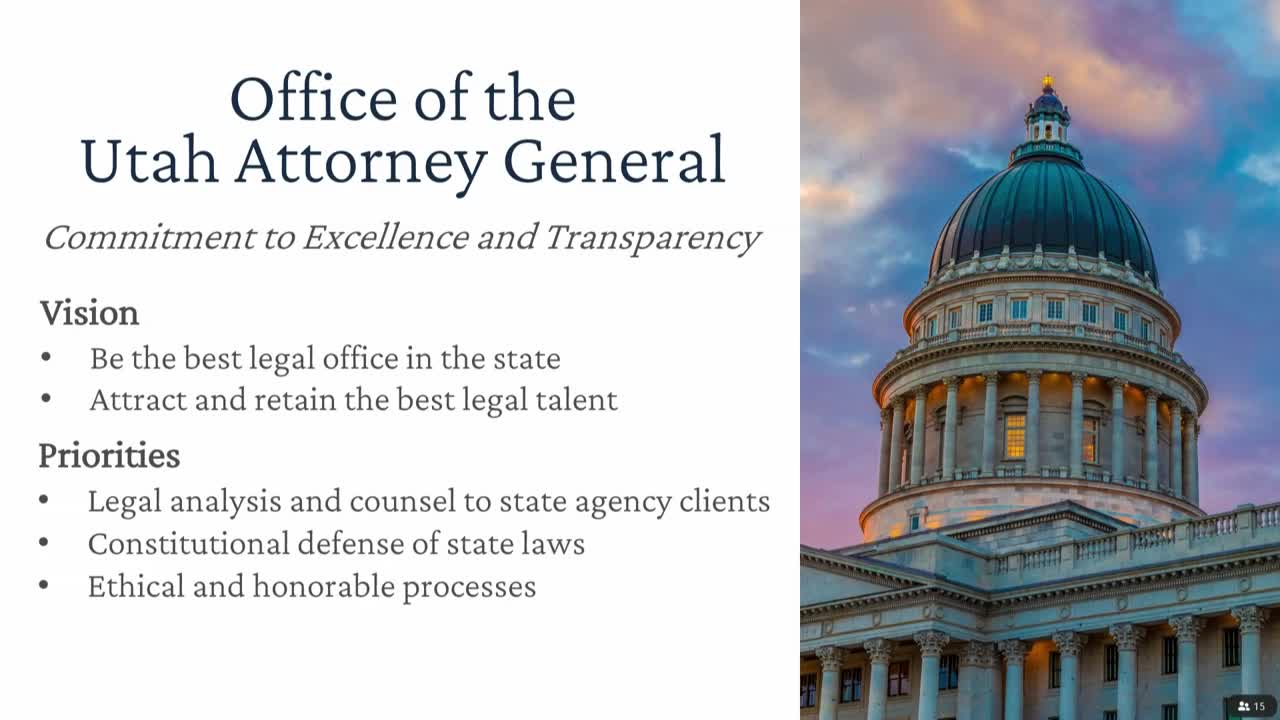
Brown said he reorganized the office to separate civil and criminal divisions more clearly, created a consumer‑protection department, added an administrator role to improve case management, and released his public calendar as part of a transparency push. "My goal is to identify things that we can do from a budget standpoint so that you know where the needs are," Brown said.
Brown outlined four priorities for additional resources: narrowing salary disparities to retain attorneys; defending the state in complex constitutional and high‑dollar litigation; reducing delays in criminal appeals; and expanding prosecution of elder‑abuse and fraud cases. He said the office faces a rise in national‑level litigation (for example, e‑cigarette, social‑media and election cases) and that private national firms can quickly staff litigation in a way the state cannot. Brown requested three additional attorneys for the constitutional/special litigation section and six FTEs for elder‑abuse and fraud prosecution in Washington County; the elder‑abuse positions are expected to be 75% federally matched.
Following Brown—s presentation, legislative auditors Brian Dean and Ryan Thalen presented two separate performance audit reports. The first examined the position of attorney general and concluded that a previous administration—s insufficient transparency "resulted in a lack of accountability for the position." The auditors reported instances in which records provided to the audit were heavily redacted under asserted attorney‑client privilege and said some redactions did not appear privileged when compared with other sources. The auditors recommended statutory guardrails and reporting requirements to limit conflicts of interest and require more disclosures about outside nonprofit involvement by the AG.
The second report focused on the Office of the Attorney General—s operations. Auditors recommended a strategic plan with measurable performance goals, full implementation of an office‑wide case management system (auditors noted a prior 2016 recommendation to implement a system that has not been completed), and clearer written policies for prosecutorial discretion and civil-division practices. Auditors said the criminal‑appeals unit had lost a significant portion of its staff while workloads and complexity increased, producing delays in appeals responses.
Committee members asked whether county prosecutors handle appeals (Brown said the office generally handles criminal appeals statewide to ensure consistent case law) and questioned costs tied to amicus briefs; Brown said most amicus filings do not require payment of outside attorneys— fees by the state and that his office uses an internal review process and consults affected state agencies before joining such briefs.
Ending: Brown asked the committee for cooperation on budget items tied to talent retention, case management improvements and targeted FTEs to address elder‑abuse prosecution and special litigation demands.