Get Full Government Meeting Transcripts, Videos, & Alerts Forever!
Get email alerts on the Forest Health Grant Support topic
No spam. Unsubscribe anytime.
Lake County supervisors approve letter backing Napa–Lake forest‑health grant, 4‑1
Summary
The Lake County Board of Supervisors voted 4‑1 to approve a letter of support for a Napa–Lake collaborative forest‑health project seeking Cal Fire forest health grant funds.
The Lake County Board of Supervisors voted 4‑1 to approve a letter of support for a Napa–Lake collaborative forest‑health project seeking Cal Fire forest health grant funds.
The project, led by Napa‑based organizations with Lake County partners, seeks to remove dead material and weakened trees, collect seed from local conifers for reforestation, support cultural burning by the Middletown Rancheria Pomo Indians on their trust lands, improve forest health at the Monticello Ranch adjacent to Robert Louis Stevenson State Park, and restore habitat on Bureau of Land Management lands. Terry Logsdon, Lake County’s chief climate resiliency officer and tribal liaison, brought the letter to the board for consideration.
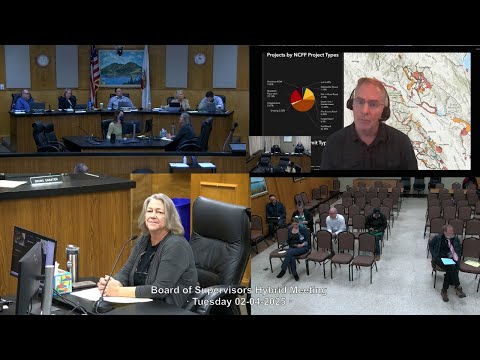
The project targets forested areas affected by the 2015 Valley Fire and the 2020 LNU (Lake/Napa Unit) fires and is intended to increase wildfire resilience across parcels that cross county boundaries. “Today I’m bringing to you a letter of support from the Napa Communities Firewise Foundation, who’s seeking your support on a grant application to Cal Fire’s forest health grant,” Logsdon said.
Joe Nordlinger, CEO of Napa Firewise, said the application bundles several landowners and local fire‑safe councils to increase the grant’s impact and to leverage matching contributions. “Fire doesn’t really care about whether you’re a private landowner or a public landowner,” Nordlinger said. He told supervisors that landowners in the project area are contributing match, either financially or in‑kind, and that partners include local Resource Conservation Districts and multiple Fire Safe Councils.
Some supervisors urged caution about using public‑backed grant support for work that will include private parcels. One supervisor commented that private owners “should take responsibility” for work on private property and said the board should not be asked to support projects that appear to benefit large private holdings without clearer evidence of public benefit or owner “skin in the game.” That supervisor reiterated concern that large landowners should not receive priority over owners of small parcels who cannot afford fuel‑reduction work.
Other supervisors emphasized public safety and the regional nature of wildfire risk. A supervisor who said she had used discretionary funds to support defensible‑space work described several county programs that assist lower‑income and older residents with property‑scale mitigation and said forest‑health grants are designed to address large tracts and evacuation routes. Board discussion noted Highway 29 over the mountain as an important evacuation route and described the Cal Fire forest health grant as targeting larger parcels and long‑term maintenance rather than small defensible‑space projects.
The board approved a motion to adopt the letter of support and authorize the chair to sign. The motion carried 4‑1. The record did not list individual roll‑call votes by name; the meeting minutes show a 4‑1 tally.
Logsdon and partners said they will continue pursuing other grant opportunities and coordinating with neighboring counties to leverage future funding, including monitoring for disbursements tied to Proposition 4 and previously announced Bureau of Land Management funding that was later rescinded.
Ending: The board’s action is a formal endorsement of the application; any funding or on‑the‑ground work remains contingent on successful grant awards and partner commitments to match and maintain treatment areas.