Get Full Government Meeting Transcripts, Videos, & Alerts Forever!
Get email alerts on the Broadband topic
No spam. Unsubscribe anytime.
Lake County reviews broadband implementation plan as state and federal funding moves forward
Summary
County staff and consultants presented an implementation plan and funding updates, including state middle-mile construction and CPUC awards to local ISPs; supervisors emphasized a Dig Once policy, accountability for providers and outreach to low-income households.
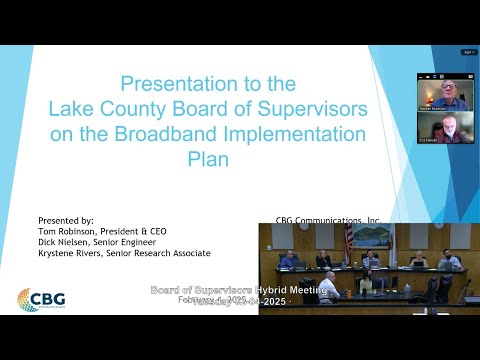
Lake County officials heard an update on broadband initiatives and an implementation plan during the Board of Supervisors meeting, with Deputy County Administrative Officer Ben Rickleman and the county's broadband consultant describing funding awards, timelines and near-term actions to expand service across the county.
The presentation matters because Lake County has been identified as having pockets of unserved and underserved households; state and federal programs, combined with local policies, will shape whether those residents, businesses, schools and public-safety sites gain higher-speed, more reliable internet access.
Rickleman told the board, “Thankfully, there's now significant movement in the broadband space,” and summarized several parallel efforts: construction of the Statewide Middle Mile Broadband Network through the county, a federal funding-account (FFA) allocation managed by the California Public Utilities Commission, and several pending state and federal grant programs, including the federal BEAD program and state digital-equity grants. He said Lake County has about $28,400,000 allocated through the FFA process and that the CPUC recently awarded roughly $14,600,000 to three projects in the county, leaving about $13,800,000 still to allocate.
The consultant team from CBG Communications described the county's implementation plan, a follow-up to a 2023 master broadband plan update. The plan focuses on eight priority areas, including: ensuring community anchor institutions (government facilities, schools, hospitals, public safety and public housing) can access symmetrical 1 Gbps service; streamlining rights-of-way permitting; promoting Dig Once and microtrenching policies to reduce future construction costs; coordinating with providers on redundancy and backup power; pursuing grant and loan programs; expanding digital literacy and device loaner programs; and maintaining ongoing outreach and a county broadband clearinghouse.
CBG's senior engineer said the consultant inventory looked at roughly 221 anchor-institution entries (about 50 distinct buildings) and found most locations are within about a mile or less of broadband, while more remote sites require additional investment. The consultant also described microtrenching — a narrow, shallow cut in pavement that allows fiber installation with smaller surface disruption — and recommended clear county standards and oversight to avoid past construction problems seen elsewhere.
On funding and technology, presenters highlighted: the Statewide Middle Mile project (six miles completed in Lake County, the rest planned for 2025 with anticipated completion in 2026–2027); CPUC-administered FFA awards to AT&T and Mediacom for projects in multiple supervisorial districts (including Districts 1, 3, 4 and 5, and communities such as Spring Valley, North Lakeport, Big Valley/Finley and Cobb); and the forthcoming BEAD allocations, for which census-block-group eligibility and high-cost designations will affect required local matches. The CBG consultant said BEAD awards in California will likely be announced in late 2025 and that Lake County currently contains five or six census block groups qualifying as high-cost under the federal formula (remoteness, topography, density and income).
Presenters discussed technology tradeoffs. County staff noted that satellite options such as Starlink are widely visible on FCC maps but currently do not meet some state and federal program goals for symmetrical speeds and long-term scalability, and the equipment and monthly costs can be a barrier for low-income households. The consultant said fixed wireless and satellite remain important tools in very rural pockets where fiber is cost-prohibitive and recommended a mixed-technology approach: fiber where cost-effective, and fixed wireless or satellite elsewhere.
Supervisors pressed for practical steps. Supervisor Sabatier urged the board to prioritize a Dig Once policy to protect roadways and reduce future construction costs, saying the county should adopt and implement a version previously provided by a regional consortium. Supervisor Sabatier also raised questions about Starlink availability and ISP map transparency. Supervisor Owen asked how many unserved households would be reached by the recent FFA awards; the consultant estimated roughly 3,100 households tied to the recently announced round but said the figure will be confirmed and that more awards and allocations remain.
On accountability, staff said local enforcement is limited but the CPUC holds contractors to FFA contract terms. County staff urged the board to monitor ISP build progress and report compliance issues to the CPUC; consultants recommended the county maintain an oversight and advocacy role while the CPUC enforces contractual obligations. Staff also indicated the county will pursue state digital-equity capacity subgrants (approximately $341,000 available to Lake County through a state program) and will consider partnering with libraries, colleges and nonprofit organizations on NTIA or other federal competitive grant proposals.
The presentation closed with a recommendation that the county act as a clearinghouse for broadband information, keep a public-facing broadband webpage, continue community surveys (English/Spanish), and expand device loaner and digital literacy programs, particularly targeted at low-income households.
No formal motions or board votes were recorded on the item; supervisors thanked staff and consultants and directed continued work on the implementation plan and related policy items such as Dig Once.