Get Full Government Meeting Transcripts, Videos, & Alerts Forever!
Get email alerts on the Public Employees topic
No spam. Unsubscribe anytime.
ITD Seeks Targeted Pay Increases and New Hires to Reduce High Turnover Among Maintenance Workers
Summary
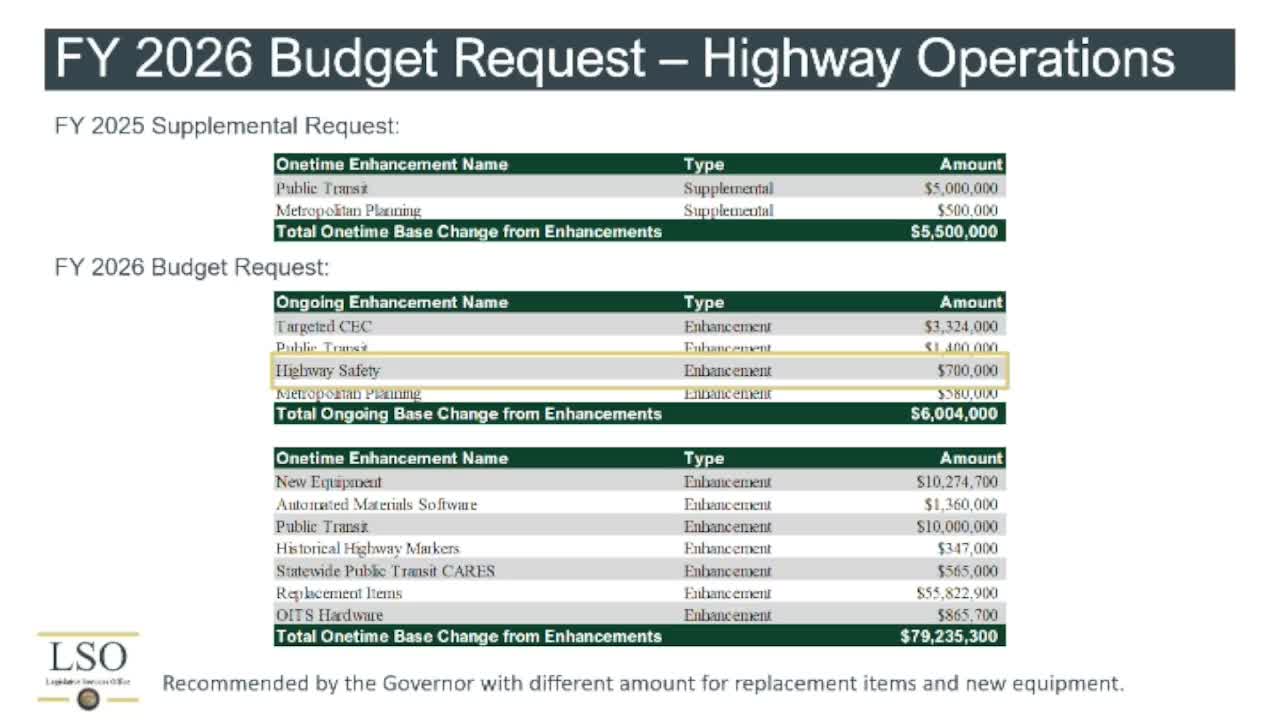
ITD requested targeted CEC pay increases and staffing authorizations to address high turnover in maintenance crews and to staff 53 positions approved last year. Lawmakers pressed the agency for details on costs, where positions are located, and retention strategies.
The Joint Finance‑Appropriations Committee spent significant time on Idaho Transportation Department proposals to boost pay and hire maintenance personnel, with the department arguing the steps are needed to reduce turnover and preserve institutional expertise.
Director Scott Stokes and staff told the committee the department is requesting a targeted compensation adjustment (CEC) that would raise pay rates for maintenance staff (transportation technicians and related positions) by $2.50 per hour across the horizontal career paths. Brooke Dupree, the Legislative Services Office analyst, summarized the highway operations enhancement as a targeted CEC affecting roughly 505 positions in the division to lift starting and step pay rates.
Stokes said the agency has averaged about 78 maintenance departures per year over the last three years among roughly 400 maintenance employees and described the cost of turnover: many new hires lack a commercial driver’s license (CDL) and require 6 to 12 months of training, during which the department invests time and training resources. "Having experienced and institutional knowledge is the key thing for us," Stokes told the committee.
Lawmakers asked how the targeted CEC interacts with broader pay proposals and whether increases would simply follow private‑sector or local government pay climbs. Representative Mitchell asked whether raises would be offset by private market competition and whether the department could retain employees after investing in training such as CDL certification. Stokes said most departures go to cities and counties rather than private industry, and that entry‑level attrition is the main concern: "Once they get into the system, we keep them for a few years," he said.
The committee also checked on the 53 new front‑line positions approved last year. Stokes reported about half of the 53 had been recruited; the committee had appropriated $3,753,000 in ongoing personnel costs, $174,000 in ongoing operating costs, and $946,000 in one‑time capital outlay related to those positions. Several members asked for a follow‑up report on software, equipment and ongoing funding lines tied to newly added FTPs.
Members said they want clearer wage‑survey comparisons and a plan showing how the proposed increases would change retention rates and long‑term costs. The department said it has mapped local pay rates and will provide additional detail when requested. No vote was taken on the targeted CEC during the hearing.