Get Full Government Meeting Transcripts, Videos, & Alerts Forever!
Get email alerts on the State Prisons Security topic
No spam. Unsubscribe anytime.
After staff shooting, prisons division seeks drone detection, mail scanning and transport bureau expansion
Summary
Following a spring transport ambush that left three IDOC staff wounded, the Idaho Department of Correction requested funding for digital mail scanning, drone detection, phone-call transcription, expansion of a transport bureau with 12 positions and a federal body-worn camera pilot.
The Idaho Department of Correction asked the Joint Finance Preparations Committee on Feb. 4 for new and ongoing funding to harden prisons against contraband and threats after an incident last spring in which staff were shot during a transport.
Noah Peterson, budget and policy analyst with the Legislative Services Office, outlined supplemental requests tied to an April incident that the agency said revealed vulnerabilities when an inmate who had been transported to a hospital was being returned by facility staff. "Three IDOC staff were shot and then the suspect and the inmate are suspected of committing two murders before being apprehended, 36 hours later," Peterson told the committee as background for several proposed safety upgrades.
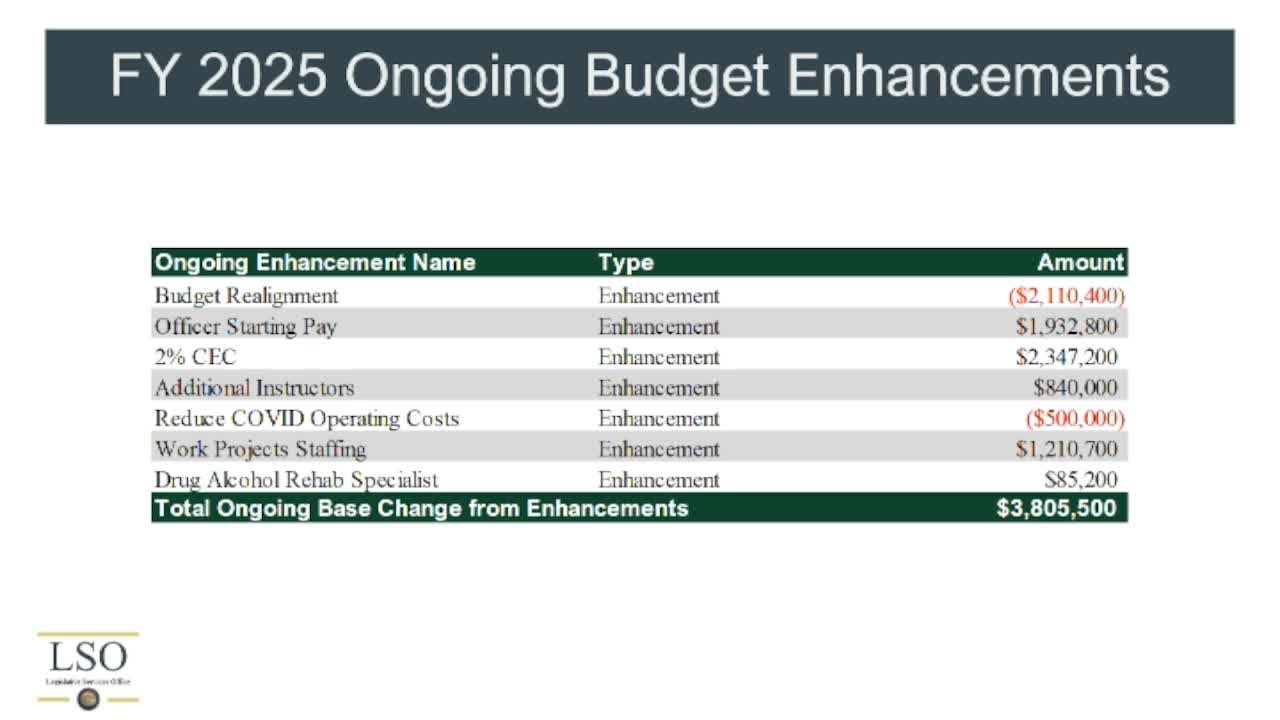
The department proposed a package labeled "advanced surveillance technology," initially described as a $795,000 supplemental to implement digital mail scanning, drone detection and phone-call transcription and analysis. Peterson said the full-year ongoing cost would be $2,397,000 and provided a per-technology breakdown: digital mail scanning $1,011,000 ongoing, drone detection $385,500 ongoing, and the LEO phone transcription and analysis technology $1,000,000 ongoing.
Director Josh Tewalt framed mail digitization as a critical risk-reduction step. "The mail scanning and digitizing the mail, completely eliminates our most porous point of entry for contraband in our facilities," he said, arguing staff currently spend substantial time screening mail and could be redeployed to other security tasks.
The committee also heard a supplemental request of $1,148,000 one-time to expand the Transport Bureau. The expansion would add 12 positions and equipment for seven vehicles (Peterson listed six SUVs and a wheelchair van) and training to allow the bureau to handle emergency transports rather than rely on facility staff who perform the duty as an additional assignment. Peterson and Director Tewalt said excessive overtime on existing staff drives part of the need; Tewalt cited 20,000 overtime hours at one facility and 14,000 at another in recent reporting.
A federal body-worn camera pilot was also on the list. Peterson said the fiscal-year 2025 supplemental would cover the first-year costs, with $1,024,000 from federal funds and $27,000 from the general fund; the state would later be responsible for part of the match and ongoing licensing costs in FY2026 and FY2027.
Other requested items included a skid-steer (skid loader) for the St. Anthony work camp to reduce rental costs; the agency asked for $83,200 ongoing for a skid-steer line but the governor recommended contracting snow removal instead at $30,000 ongoing. The Division of Financial Management told the committee it preferred contracting for seasonal snow removal rather than purchasing the equipment outright.
Director Tewalt said the threat landscape has changed. "The level of sophistication that is being deployed today to introduce contraband into correctional facilities is unlike anything any of us in the field have ever seen," he said, citing drones and novel methods to conceal drugs. He also described the LEO transcription capability as a tool to help law enforcement and prosecutors by making large volumes of call data searchable and actionable.
Committee members asked about alternatives, relief-factor staffing implications and whether equipment purchases represented the best value; agency and DFM staff said they would provide follow-up information to clarify ongoing costs and operational impacts. No formal votes were taken at the hearing.