Get Full Government Meeting Transcripts, Videos, & Alerts Forever!
Get email alerts on the Higher Education topic
No spam. Unsubscribe anytime.
House approves increase in community college tuition cap amid debate over property-tax reliance
Summary
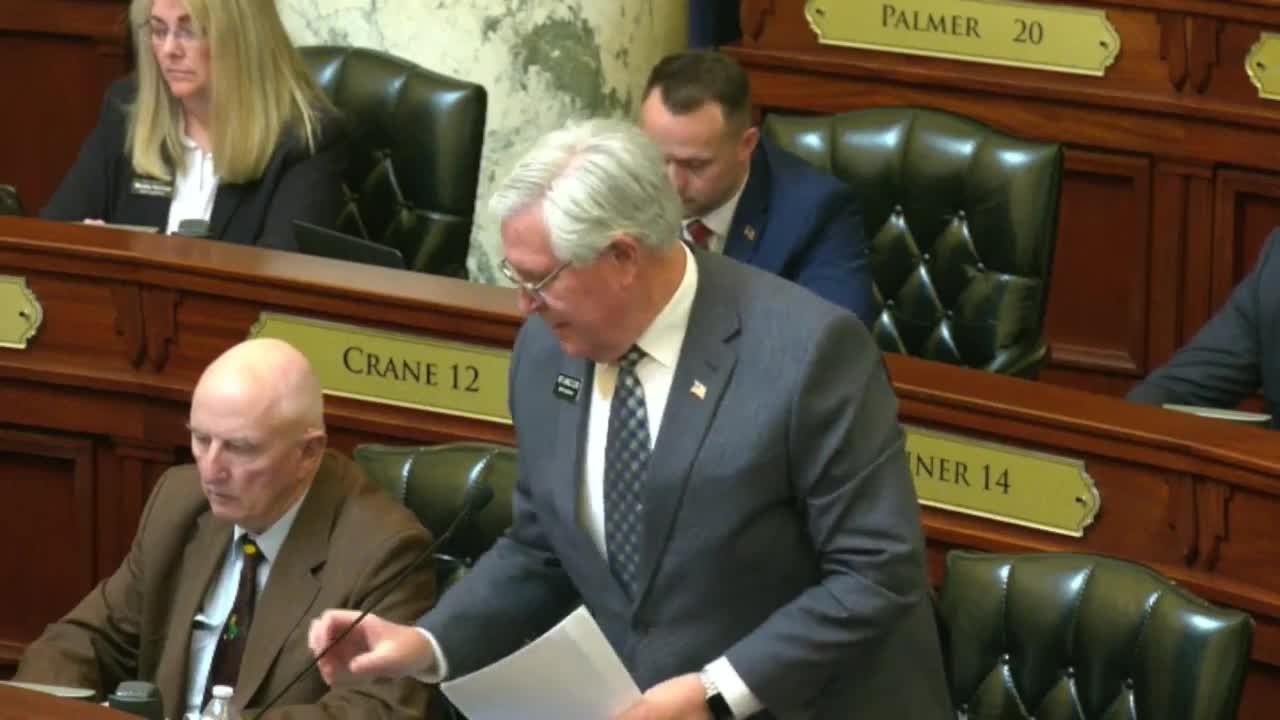
On Feb. 5, 2025 the Idaho House passed House Bill 79 to raise the statutory tuition cap for community colleges; the floor debate included concerns about property-tax reliance and inconsistent figures about the new cap in the sponsor’s remarks. The measure passed 52–17 with one member absent or excused.
BOISE, Idaho — The Idaho House of Representatives on Feb. 5, 2025 approved House Bill 79, a measure to raise the statutory cap on community college tuition. The bill passed on a recorded vote of 52 ayes, 17 nays, and one member absent or excused.
Sponsor remarks on the House floor described the bill as primarily changing a statutory dollar figure previously set at $2,500. In one floor explanation the sponsor said the bill would "change 1 number, the number $2,500 to $3,500" and noted technical corrections included in the measure. In subsequent floor comments the sponsor characterized the change as a 30% increase "to go to $3,250," and said community colleges last received a cap increase in February 2008. The transcript thus records inconsistent figures for the new cap in the sponsor's on‑the‑floor remarks.
The sponsor (identified in the transcript as the "good gentleman from 25") told colleagues that the change would not require additional state funds and that if community colleges averaged a 5% tuition increase the cumulative statewide additional revenue would be about $1.5 million. He said community colleges rely on property taxes, tuition and fees, and state support for continuing education, and that salary competition with public school teachers creates financial pressures for colleges.
A floor opponent (identified in the transcript as the "gentleman from 25") urged a no vote, saying community colleges have received roughly a 46% increase in property-tax revenue since 2019 and expressing concern about adding further pressure to taxpayers. He said, "I cannot vote for this bill." The opposition framed the change as part of broader compensation increases that are "trickling down" to public institutions.
After debate closed, the House recorded the vote and passed HB79. The clerk recorded named individual votes for a small number of members in the pairing/recording process during the vote (the transcript records "Mathias votes aye. Marmon votes nay"). The bill was transmitted to the Senate after approval on the floor.
Committee action: The sponsor told members the bill "came out of the education committee with the unanimous vote." The transcript does not include the committee report text or the bill's full statutory language on the floor record provided.
Key numbers and inconsistencies from the floor record: sponsor said the current statutory cap was $2,500; he said in one instance the bill replaces that figure with $3,500, and in another instance described the requested increase as 30% to $3,250. The transcript does not supply the enacted statutory language or final corrected title on the floor beyond the vote tally.
Votes at a glance: House Bill 79 — Passed the House, 52–17, 1 absent/excused. The floor record includes named votes for individual pairings but does not list a full roll-call by name in the provided excerpt.
The House transmitted HB79 to the Senate; the transcript does not record amendments or implementation steps on the floor day beyond committee referral history and floor debate.