Get Full Government Meeting Transcripts, Videos, & Alerts Forever!
Get email alerts on the Legislation Referrals topic
No spam. Unsubscribe anytime.
Idaho House refers dozens of bills to committees, including measures on blood donations, Medicaid and daylight saving
Summary
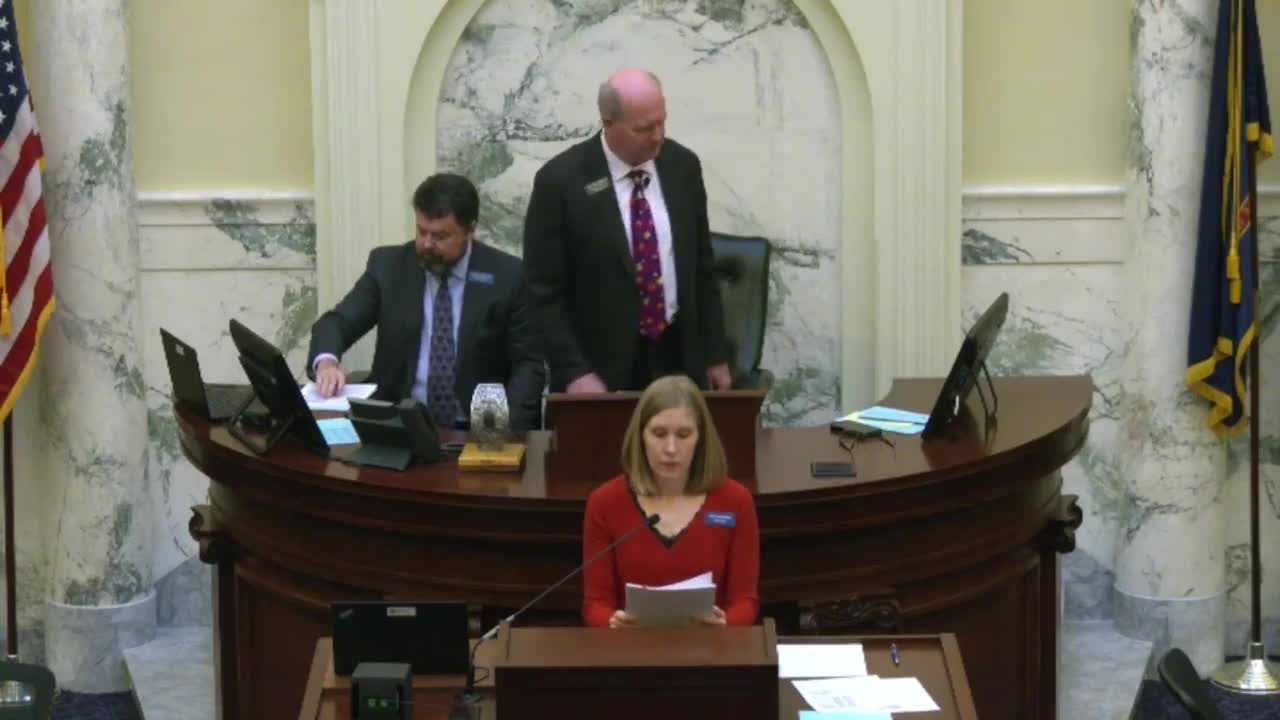
On Feb. 4, 2025 the Idaho House of Representatives heard committee reports and formally referred a large slate of bills to standing committees, including measures on blood donation disclosures, Medicaid eligibility conditions, and a proposed daylight saving exemption.
BOISE, Idaho — The Idaho House of Representatives on Feb. 4, 2025 received committee reports and referred a large group of bills to standing committees, ranging from changes to workers' compensation and insurance law to measures on blood-donor disclosure, Medicaid eligibility and a proposed daylight-saving exemption.
The House, which recorded 66 members present at the start of the session, approved the previous day’s journal by voice vote after a motion from Representative Skogg and a second from Representative Gannon. Committee chairs then summarized bills the committees had printed or recommended for referral.
Committee reports sent multiple bills to committee for further consideration. The Judiciary Rules and Administration Committee reported printing House Bills 107–114 and, together with other standing committees, sent many introduced bills to committee for referral and printing. The Commerce and Human Resources Committee reported that House Bills 34 and 55 should “do pass.” The Health and Welfare Committee redirected House Bill 89 to the second-reading calendar.
Notable bills introduced or reported on the floor included: - House Bill 115 (Commerce and Human Resources): Workers’ compensation changes related to medical examinations; bill summary in the committee report included an emergency clause and an effective date. - House Bill 116 (Business Committee): Multiple technical amendments and repeals in Title 41 regarding conversion plans and related small-employer provisions. - House Bill 117 (Business Committee): Creation of an Insurance Data Security Act (new chapter in Title 41) that would require licensees to establish information security programs, provide notice and investigation provisions for cybersecurity events, and include penalties and rulemaking authority. - House Bill 118 and 119–123 series (Business Committee): Repeals and technical changes affecting licensed professions including genetic counselors (HB118) and certified shorthand reporters (HB119), and a package of proposed changes to barber and cosmetology statutes (HB120–122 series). - House Bill 131 (Health and Welfare Committee): A bill that, according to the committee summary, would require blood-collection entities to require donors to disclose certain vaccination statuses, to conspicuously mark blood from certain donors, and to recognize a transfusion recipient’s right to blood based on a donor’s vaccination status. The committee summary included an emergency clause and an effective date. - House Bill 132 (Health and Welfare): Establishes a dietitian licensure compact (a new section added to Title 54). - House Bill 133 (Health and Welfare): Changes to tobacco products and electronic smoking device statutes and related administrative rules, including provisions about posting signs and enforcement actions. - House Bill 134 (Health and Welfare): Creation of a new chapter in Title 39 establishing provisions regarding breast cancer screening. - House Bill 137 (Health and Welfare): Amending Idaho’s controlled substances schedule to list mifepristone and misoprostol as scheduled drugs, per the committee summary and with an emergency clause. - House Bill 138 (Health and Welfare): Amendments to Medicaid-related statutes to add conditions for implementation of Medicaid eligibility expansion, to require notification to the Legislature, and to provide for conditional termination of expansion; the committee summary included an emergency clause. - House Bill 139 (State Affairs): Changes to absentee voting statutes, including revisions to who may vote absentee and prohibitions on misrepresentations, with an emergency clause. - House Bill 140 (State Affairs): Legislative intent language and statutes proposing an exemption from Daylight Saving Time in Idaho’s Mountain and Pacific time zone portions, and a provision to conform to any federal law that makes daylight saving time permanent; the committee summary included contingent effective dates. - House Bill 141 (Education Committee): A bill relating to higher education and Title IX compliance, adding a new section to Title 33.
Several other bills (many numbered in the 100–130 range and multiple sub-bills labeled as technical or sectional variants) were also named in committee reports and referred to committees for printing or placement on second- or third-reading calendars. Where the committee report listed a bill but provided only statutory references or general summaries, the House referred the bill to the committee named in the report for further action.
The House also received two joint memorials from committees: House Joint Memorial 3 regarding the Corporate Transparency Act and House Joint Memorial 4 regarding grizzly-bear delisting; both were referred to the Judiciary Rules and Administration Committee for printing.
On a separate procedural matter, the House unanimously agreed to return House Bill 42 to the Education Committee at the sponsor’s request under unanimous consent. The session closed with a motion to adjourn; the House adjourned to reconvene at 11 a.m. on Wednesday, Feb. 5, 2025.
The session was largely procedural: committee reports and referrals dominated the floor time on Feb. 4, and most bills were placed in committee or onto reading calendars rather than being debated or voted on for final passage. Committee meeting times for the coming days were announced on the floor.