Get Full Government Meeting Transcripts, Videos, & Alerts Forever!
Get email alerts on the Higher Education Compact topic
No spam. Unsubscribe anytime.
Midwestern Higher Education Compact briefs committee on savings, enrollment trends and effective college‑access practices
Summary
The Midwestern Higher Education Compact told the Senate Higher Education Committee that its contracts and programs generated about $9.26 million in savings for Minnesota in FY 2024 and highlighted enrollment trends, interstate student flows and evidence on what college‑access interventions work.
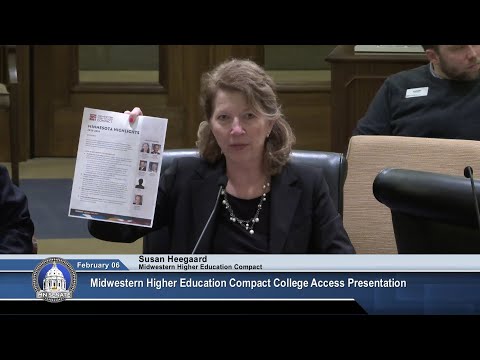
Susan Heegard, president of the Midwestern Higher Education Compact (MEC), and Dr. Eric Wiederspan (presented as Dr. Wiederspan) gave a briefing to the Senate Higher Education Committee on MEC services, statewide savings and research on college‑access strategies.
Heegard described MEC’s dual focus on cost‑saving contracting and policy research and told members the compact produced roughly $9.26 million in annual savings for Minnesota institutions in fiscal 2024 and an estimated 81‑to‑1 return on the state’s membership appropriation. “For FY ’24 the cost savings for Minnesota [were] $9,260,000 in total annual savings for the colleges, university, school district, state and local government,” Heegard said, adding that the compact’s vendor contracts and reciprocity programs streamline purchasing and regulatory work for institutions.
Heegard and colleagues reviewed higher education attainment metrics and enrollment patterns. MEC presented data showing that Minnesota’s postsecondary attainment rate (residents with a credential beyond high school) is above the national average and that Minnesota is a net exporter of college students a year after graduation; in MEC’s snapshot roughly 64% of Minnesota high‑school graduates who enrolled in higher education stayed in state, 26% went to other Midwestern states and 11% enrolled out of region.
Dr. Wiederspan summarized research on interventions that can increase FAFSA completion and college enrollment. He identified six categories of effective actions in high schools: personalized information (including targeted financial‑aid letters), targeted text messaging and reminders, strengthened school counseling, one‑on‑one advising or coaching partnerships, virtual advising when necessary, and school‑embedded college‑going programming. He emphasized that personalization and counselor capacity are important: general, untargeted materials are less effective than individualized outreach.
Committee members asked for additional context to interpret interstate comparisons, including counts of higher education institutions and annual graduate totals in comparator states. Heegard said MEC maintains a data dashboard and offered to share state‑level data on enrollment and program participation to help the committee interpret the compact’s comparisons.
MEC also noted operational changes they are tracking nationwide — demographic shifts in graduating classes and mixed enrollment trends at two‑ and four‑year institutions — and offered technical support and procurement contracts to Minnesota colleges and K‑12 districts.
The compact’s staff said they will provide committee members additional data and a copy of the briefing materials on request.