Get Full Government Meeting Transcripts, Videos, & Alerts Forever!
Get email alerts on the Elections Constitutional Amendment topic
No spam. Unsubscribe anytime.
Senate panel advances constitutional amendment to enshrine "free, fair and equal" elections after contentious amendment votes
Summary
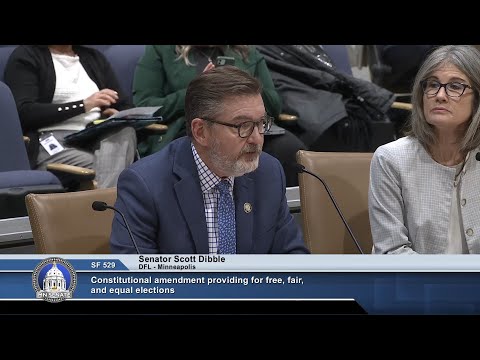
The Senate Elections Committee advanced a constitutional amendment bill to enshrine free, fair and equal elections in the Minnesota Constitution (Senate File 529). Multiple floor amendments were proposed and defeated by roll call; the committee voted 6–5 to pass and refer the bill to Rules and Administration.
The Minnesota Senate Elections Committee voted Feb. 6, 2025, to advance Senate File 529, a proposed constitutional amendment that would add a guarantee of "free, fair and equal" elections and bar civil or military interference with the right to vote. The committee's action sends the measure to the Committee on Rules and Administration by a roll‑call vote of 6–5.
Senator John Dibble (bill sponsor) opened the discussion by saying the amendment is intended to enshrine voting as a fundamental right and to provide an additional constitutional guard against laws or practices that suppress access to the franchise. "We understand very clearly that for every person, they are entitled to one vote," Dibble told the committee, and he cited other states that have used similar language.
Testimony supporting the amendment came from David Fisher of Clean Elections Minnesota and Jean Massey of FairVote Minnesota, who urged the committee to let Minnesota voters decide the question. Fisher invoked historical and contemporary examples and argued the amendment could "clear the air" around contested election rules; Massey called the proposal a bipartisan, nonpartisan safeguard to protect access and confidence in elections.
The committee's debate focused on the amendment's wording and possible judicial interpretation. Senator Lucero proposed an oral amendment to insert "ensuring 1 eligible citizen, 1 vote" after the phrase "free, fair, and equal." Lucero said the insertion would clarify the intent and emphasize "one person, one vote." The committee held a roll‑call vote on that amendment; it failed 5–6. Later, Lucero offered a second oral amendment to add the phrase "have integrity" (and to include similar language in the ballot question). That amendment also failed on a roll call, 5–6.
Senator Matthews offered a written A2 amendment to add the words "transparent and secure" after "free, fair, and equal." The sponsor, proponents and testifiers discussed whether adding adjectives would introduce ambiguity or invite litigation; some testifiers warned additional qualifiers could create more grounds for legal challenges. The Matthews A2 amendment was put to a roll call and failed 5–6.
After further discussion, Senator Limmer moved to lay the bill on the table for further review; that motion failed on a roll call, 5–6. The committee then voted on Senator Dibble's motion that Senate File 529 be recommended to pass and be referred to the Committee on Rules and Administration. The clerk recorded a roll‑call vote of 6 ayes and 5 nays; the motion prevailed and the bill was forwarded to Rules.
Throughout the hearing members raised concerns about the potential breadth of the proposed language, possible consequences in emergencies or for administrative changes, and whether the concepts of "free, fair and equal" require additional definition. Supporters argued the language is short, consistent with provisions adopted by 30 other states, and would serve as a constitutional guardrail in future disputes over election law.
The committee also recorded requests for roll call on several amendments and on the final motion. No final judicial interpretation was made at the hearing; senators debated both the rhetorical value of the amendment and the practical risks of inserting additional qualifiers into constitutional text.