Get Full Government Meeting Transcripts, Videos, & Alerts Forever!
Get email alerts on the Public Water Districts topic
No spam. Unsubscribe anytime.
Committee hears bill to lower voter threshold for dissolving public water supply districts
Summary
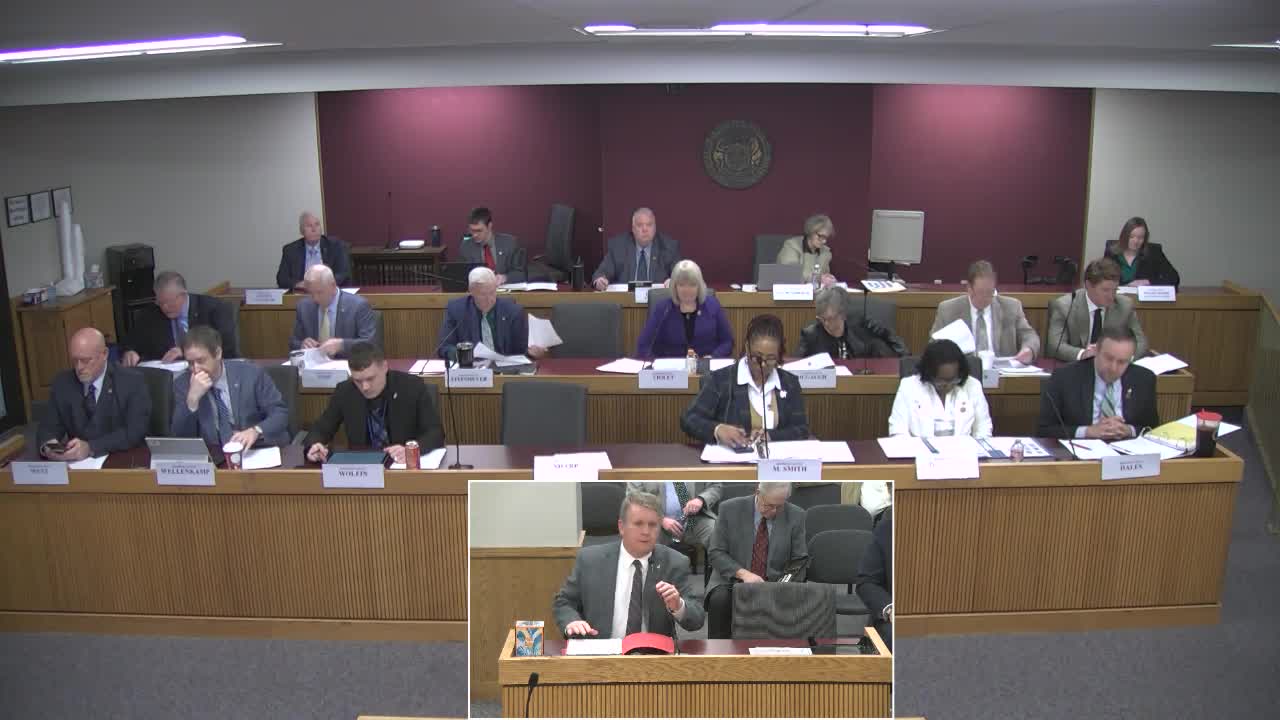
Representative Bob Bromley, sponsor of House Bill 923, told the Missouri House Committee on Local Government that the bill “pertains to public water supply districts” and would change the voter-approval threshold required to dissolve such a district from two-thirds to four‑sevenths.
Representative Bob Bromley, sponsor of House Bill 923, told the Missouri House Committee on Local Government that the bill “pertains to public water supply districts” and would change the voter-approval threshold required to dissolve such a district from two-thirds to four‑sevenths.
The change would only alter the percentage of votes needed in the district election; the other procedural safeguards in current law would remain, Bromley said. He described the existing process: petitioning the circuit court, a board vote to place dissolution on the ballot and review by the Public Service Commission to determine whether a sale would be detrimental to the public interest.
Why it matters: Supporters said the measure addresses a recurring procedural problem for small public water districts that lack scale and capital. Matt Jesse, director of government affairs for Missouri American Water, told the committee that some districts have repeatedly fallen short of the two‑thirds threshold despite majority support. Jesse cited a Sheridan County example in which voters backed dissolution at 59% in one election and 65% in the next, but still failed to reach the two‑thirds requirement, and said “there's never going to be a hostile takeover of public water supply district.”
Opponents urged caution. Trent Watson, a registered lobbyist for the Missouri Rural Water Association, said creating a public water supply district is deliberately difficult and argued the reversal should be equally difficult: “It should be equally difficult to dissolve one,” he said, adding that the existing rules are working as intended in contested cases. The State Public Advocate spoke in opposition as well, stressing the importance of preserving local control and saying the decision to dissolve a district is “a huge decision” for communities and should not be made easier absent broader safeguards.
Committee members asked whether the lower threshold would enable hostile purchases or remove protections for customers. Bromley and witnesses replied that the statutory process contains multiple checks — court petition, board action, and Public Service Commission review — and that most sales occur because districts lack the revenue and technical capacity to finance major upgrades rather than because an outside buyer is seeking a takeover.
The committee did not take a final vote at the hearing. The bill remains before the committee for further consideration.
Ending: The committee closed public testimony on House Bill 923 after hearing multiple witnesses for and against the measure and several questions from members about safeguards and the practical effects on small districts.