Get Full Government Meeting Transcripts, Videos, & Alerts Forever!
Get email alerts on the Truth In Sentencing topic
No spam. Unsubscribe anytime.
Sponsors push truth‑in‑sentencing package; opponents cite racial and fiscal concerns
Summary
A group of bills (HB 389, HB 314 and HB 862) proposing higher mandatory minimum served percentages for repeat offenders drew support from sheriffs and prosecutors and opposition from criminal‑justice reform advocates who warned of disproportionate impacts and high costs.
Representatives Benny Cook, David Castillo and others presented a package of bills that they described as "truth‑in‑sentencing" legislation designed to reduce what they called a revolving door of repeat felony offenders.
Sponsors said current sentencing practice allowed people with multiple felony convictions to serve only a fraction of their statutory sentence because many earlier dispositions did not include a Department of Corrections commitment. The bills would change when mandatory minimum served percentages apply and would increase the minimum percentages for repeat offenders — for example raising requirements to 50% or 80% after successive convictions and in some proposals requiring 100% of sentence for the most serious offenses.
"We have folks that are going in maybe for a hundred and 20 days, but they're getting right back out," Representative Castillo said. Sponsors argued that the changes would give predictability and accountability to sentencing and cited examples from sheriffs of repeat offenders who return to crime after short county stays.
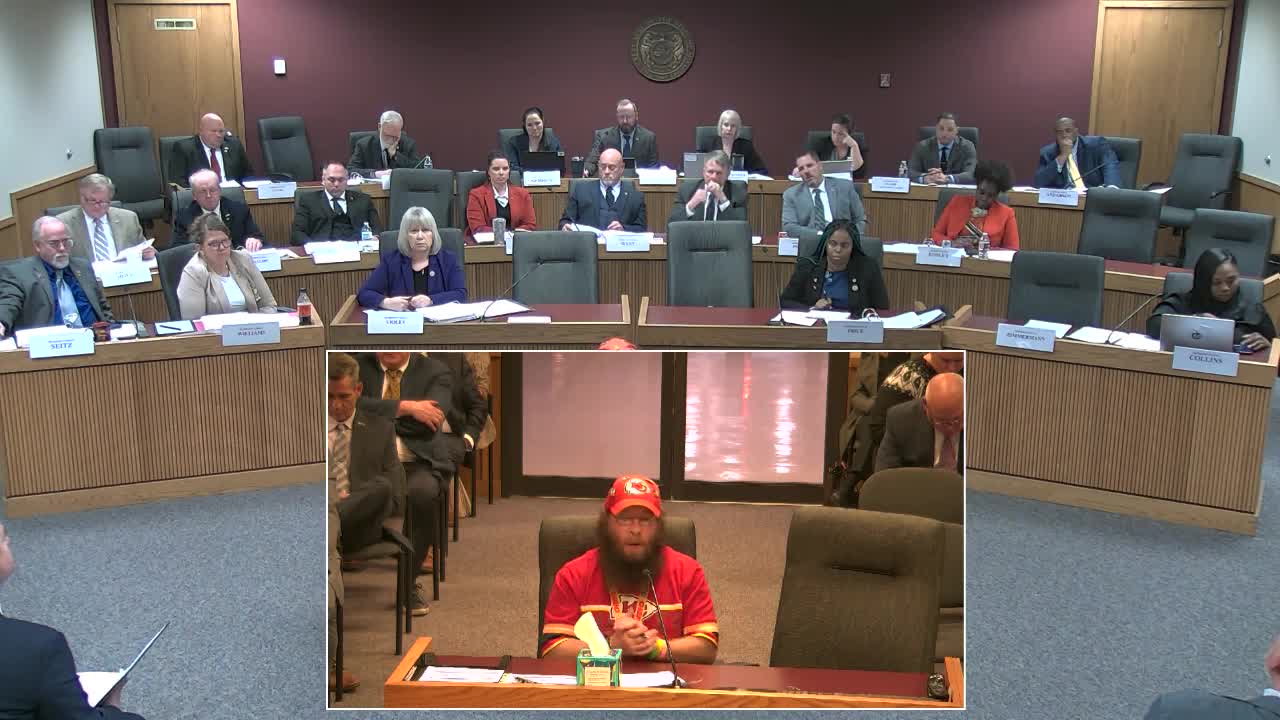
Supporters at the microphone included county sheriffs and the Missouri Sheriffs United lobbyist, who provided examples of repeat offenders and argued for clearer expectations about how long offenders will actually serve. Roy Cole, a Webster County sheriff, said he wanted transparency so the public could know how long a person will actually serve; Sheriff Mike Bonham from Osage County testified that citizens were "upset" that repeat offenders return quickly and said local costs are substantial.
Opponents included criminal‑justice reform advocates, civil‑rights organizations and advocacy groups that warned the bills would produce disproportionate impacts, particularly in communities of color, that long mandatory minimums do not demonstrably reduce crime and that the state already faces large corrections spending. Sharon Goway Jones (on behalf of Dream.org and the Missouri State Conference of the NAACP) and Mallory Rush (Empower Missouri) urged a different approach focused on rehabilitation, treatment and improving clearance rates. Advocates also raised a fiscal warning: one witness cited a $27 million ten‑year cost estimate for a prior approach and another witness referenced a $165 million fiscal oversight figure for some proposals.
Committee members debated tradeoffs. Some expressed sympathy with sheriffs and victims and supported the bills as a deterrent and a response to repeat offending; others warned of the racial history of three‑strikes policies and urged caution and study of alternatives that improve investigation and prevention.
No committee vote on the truth‑in‑sentencing bills is recorded in the provided transcript; sponsors indicated they would work on drafting details and suggested the bills could be combined into a package for floor consideration.