Get Full Government Meeting Transcripts, Videos, & Alerts Forever!
Get email alerts on the Emergency Medical Services topic
No spam. Unsubscribe anytime.
Minnesota lawmakers hear EMS task force findings, pilot program readied after $24M aid and grants
Summary
The Minnesota Senate Health and Human Services Finance and Policy Committee heard updates Thursday on a statewide effort to stabilize emergency medical services, including the new state Office of Emergency Medical Services, the distribution of a $24 million emergency ambulance aid appropriation and a locally led “sprint paramedic” pilot set to begin operations in late winter.
The Minnesota Senate Health and Human Services Finance and Policy Committee heard updates Thursday on a statewide effort to stabilize emergency medical services, including the new state Office of Emergency Medical Services, the distribution of a $24 million emergency ambulance aid appropriation and a locally led “sprint paramedic” pilot set to begin operations in late winter.
Senator Seaburger, co-chair of the legislative EMS task force and a firefighter-paramedic, told the panel the task force found consistent problems across the state: staffing shortages, inadequate compensation for non-transport calls and difficulty retaining personnel. "It all boils down to the same problems that we're seeing," Seaburger said.
The task force convened across Minnesota to gather input from providers; members and providers told the committee they were relieved to be heard and urged continued oversight. The new Office of Emergency Medical Services, created by legislation (House File 4738 and the EMS omnibus bill from the previous session), replaced the prior Emergency Medical Services Regulatory Board and reorganized regulatory duties under a single director and three deputy-led divisions for physicians, organizations and workforce.
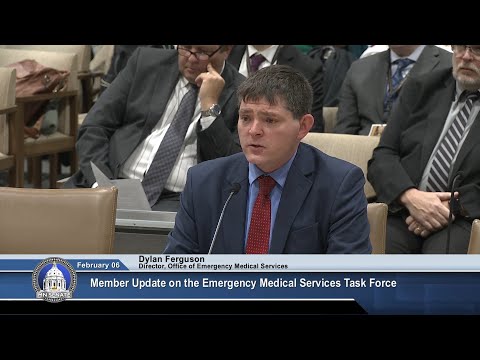
Dylan Ferguson, director of the newly formed Minnesota Office of Emergency Medical Services, told the committee the office's structure includes three advisory councils for physicians, ambulance organizations and labor/providers and that the agency will produce a statewide EMS strategic plan and report annually to oversight committees. Ferguson said the agency handled a $24 million general-fund distribution to ambulance services via a legislated formula: 40% by square mileage of a service area, 40% by 2023 EMS call volume (weighted to help lower-volume services), and 20% as a base amount. He said the Department of Revenue conducted payments and that feedback from services has been positive.
Ferguson summarized small ongoing budget requests for the office: $35,000 in state fiscal 2026 and $70,000 in state fiscal 2027 and beyond to address personnel and contracted services costs for implementation. He also said the office is administering a $6 million legislative grant program for pilot projects and cited a $5 million paramedic scholarship program administered by the Office of Higher Education that has issued nearly 300 scholarships to help EMTs become paramedics.
Local leaders described how the funding and pilots are being used. Becca Hubish, director of Perham Area EMS and board chair of the West Central Sprint Paramedic Pilot Program, described a seven-agency collaboration across Otter Tail and Grant counties that purchased three quick-response pickup trucks outfitted with cardiac monitors, airway equipment and medications. The sprint paramedics will be embedded in rural areas rather than centralized cities to shorten response times, Hubish said, and the pilot will be staffed and operated by advanced-life-support partners while transport revenue remains with the local basic-life-support agencies. "We are on track to begin operations at the end of the month," she said, adding that Otter Tail had already expended about $300,000 of its grant for capital purchases.
Association and local-government representatives urged durable funding and accountability. Buck McAlpin of the Minnesota Ambulance Association highlighted workforce and Medicaid reimbursement issues and said the scholarship program has been unusually effective at producing new paramedics. Eric Simonson of the Coalition of Greater Minnesota Cities said more than half of licensed primary ambulance service areas are owned by local governments and that nonmetro services reported combined deficits in 2023 that exceed $30 million; he said any long-term funding solution must target services with operational deficits and include accountability measures.
Committee members and witnesses discussed the frequent problem of non-transport calls. Ferguson said Minnesota recorded about 608,224 emergency ambulance responses in 2023 and that, statewide, about 25% of those responses do not result in transport to a facility. He noted Medicaid will sometimes reimburse non-transport responses if criteria are met but that Medicare does not, and many private insurers look to Medicare guidance when setting payment policy.
Several speakers urged continued monitoring and evaluation of pilots and of innovation zones already in place. Senator Seaburger recommended reconstituting the task force to track outcomes and adjust policy. Several providers emphasized that short-term grants have kept some services from closing but that sustainable reimbursement reform will be required to address long-term deficits.
The committee did not take formal votes at the hearing. Lawmakers asked for ongoing reports from the Office of Emergency Medical Services and indicated they expect more detailed budget and implementation information in follow-up briefings.
Many witnesses offered to provide data and ride-along experiences to legislators to illustrate operational challenges and to support fine-grained policymaking.The committee is scheduled to receive additional updates and will continue oversight of the pilot programs, statewide aid use and the office's rulemaking and reporting obligations.