Get Full Government Meeting Transcripts, Videos, & Alerts Forever!
Get email alerts on the Drug Trafficking topic
No spam. Unsubscribe anytime.
Missouri committee hears bill to raise penalties for fentanyl, carfentanyl trafficking
Summary
Representatives and supporters urged stiffer penalties in House Bill 49, which would lower weight thresholds for first- and second-degree drug‑trafficking felonies and add carfentanyl-specific penalties; proponents framed the bill as targeting distributors, not users.
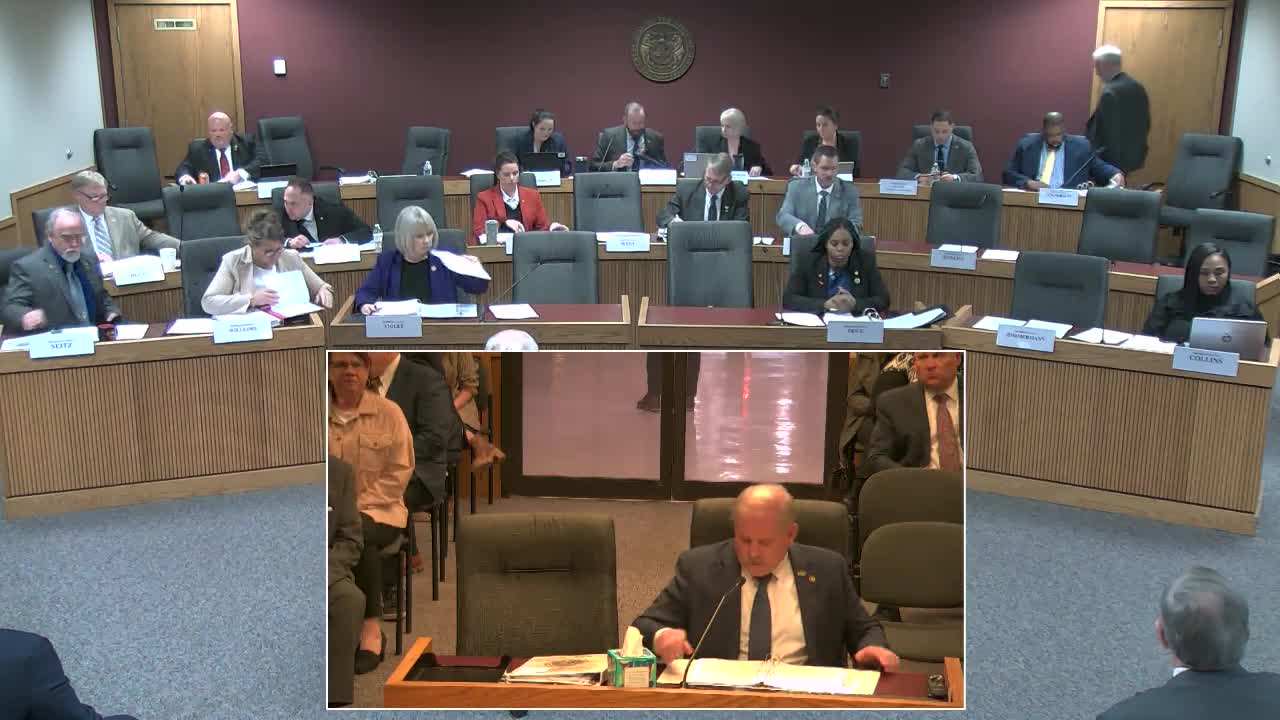
Representative Willard Haley, R‑District 58, introduced House Bill 49 to the House Committee on Crime and Public Safety, asking lawmakers to increase penalties for people who distribute highly potent opioids such as fentanyl and carfentanyl.
Haley told the committee that earlier versions of the proposal had drawn bipartisan support in previous sessions and defended the bill as focused on distributors, not people with substance‑use disorders. "To me, this bill has everything to do about those individuals who are distributing drugs and those individuals who are actually dealing death in our communities," Haley said. He described fentanyl as "up to 50 times stronger than heroin and up to a hundred times stronger than morphine."
Under the version described in committee testimony, HB 49 would change the weight thresholds used to distinguish first‑ and second‑degree drug‑trafficking felonies for fentanyl. Testimony telegraphed lowering the threshold that triggers first‑degree (class B) felony treatment to amounts of roughly 3 milligrams up to less than 14 milligrams, with larger amounts treated as higher‑level felonies. The bill would also specify that any amount of carfentanyl up to 0.05 milligrams be prosecuted as a class B felony in some circumstances, according to Haley's presentation.
Arnie C. ACDinos, who identified himself as the State Public Advocate, testified in support: "We really need to do something with fentanyl and, other such drugs that are hurting our streets of Missouri and the children of our communities and adults across our state," he said. Supporters told the committee that raising penalties would give prosecutors additional tools to pursue distributors who knowingly lace other drugs with fentanyl or carfentanyl.
Committee members asked technical and enforcement questions, including whether the proposed weight thresholds would capture the quantities typically used in distribution and how the changes would interact with prior law. Haley acknowledged those implementation questions and said he expected more witnesses later in the hearing to provide detail.
No final action on HB 49 was recorded in the committee during the hearing.
The hearing record shows supporters stressing the bill's aim at sellers rather than people with addiction; opponents did not appear at the microphone during the portion of the transcript provided. The committee paused afterward and moved on to other bills on the agenda.