Get Full Government Meeting Transcripts, Videos, & Alerts Forever!
Get email alerts on the Public Housing Statewide Funding topic
No spam. Unsubscribe anytime.
Senate committee backs $100 million bonding bill to rehabilitate public housing
Summary
A Senate committee moved Senate File 915, a $100 million general-obligation bonding bill to rehabilitate publicly owned housing, after testimony from housing authorities that federal funds and operating grants are failing to keep up with capital needs across Minnesota.
Senators on the Minnesota Senate Committee on Housing and Homelessness Prevention voted to recommend Senate File 915, a $100 million general-obligation bonding request intended to rehabilitate and preserve publicly owned housing across Minnesota.
The measure, introduced by Senator Clare Mohammed, was moved and referred to the Senate Committee on Capital Investment after more than an hour of testimony on statewide public housing needs. "Hundred million dollars to rehabilitate and preserve public housing across Minnesota," Mohammed said in opening remarks, calling it a bid to "save what we have and ensure that it remains livable for future generations."
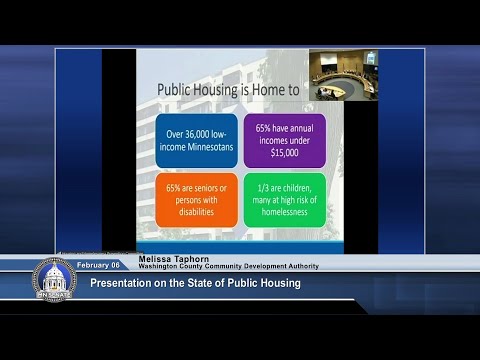
The day’s hearing featured a presentation from Minnesota NARO (the National Association of Housing and Redevelopment Officials) and housing authority officials who described a widening gap between the condition of public housing properties and available capital and operating funds. Melissa Taphorn, executive director of the Washington County Community Development Agency and legislative chair of Minnesota NARO, told the committee that federal and state resources have not kept pace with needs. Taphorn said Minnesota has about 32,400 housing choice vouchers actively leased and that public housing is home to more than 36,000 low-income Minnesotans, of whom 65 percent are seniors or people with disabilities and a similar share have annual incomes below $15,000.
Why it matters: housing authority leaders told senators that decades of underfunding have built up large backlogs of deferred maintenance — boilers, windows, electrical systems and other capital repairs — that threaten the continued operation of aging buildings. Taphorn said a five-year total of identified needs reached about $500 million and that the unmet portion of that needs total is "just under $200,000,000." Committee testimony also noted that the state has provided roughly $100 million in POP (Publicly Owned Housing Program) funding over recent allocation rounds, but officials said more is required to address the backlog.
Presenters also described operating funding shortfalls. Lisa Gafford (identified in testimony as a housing official) said that, under HUD’s formula, Minnesota is eligible for about $51.4 million in operating subsidy but has been funded at roughly $49.4 million, creating an annual shortfall that requires tradeoffs in staffing and resident services.
Officials described how POP and other state grants have been used locally to leverage federal, county and private funds for life-safety work and behind-the-walls infrastructure. Red Wing HRA Executive Director Kurt Kiena and St. Paul Public Housing Authority Executive Director Louise Seba gave examples of window and boiler replacements, electrical upgrades, and multi-year modernization projects paid for in part with POP awards. "POP funds have made critical life safety improvements at Saint Paul PHA properties possible. Without them, we could not do the work that we do," Seba told the committee.
Committee members pressed on planning and sustainability. Senators asked how housing authorities budget for long-term capital cycles, and witnesses described multi-year capital plans, use of HUD capital funds, local levy dollars, tax-credit financing and one-time state cash to close major gaps. Witnesses also outlined federal policy changes — including HUD repositioning tools (RAD conversions) and Buy America requirements — that can affect costs and financing choices.
Action and next steps: Senator Mohammed moved that Senate File 915 be recommended to pass and re-refer to the Committee on Capital Investment. The motion carried by voice vote and the bill was sent to capital investment for consideration; the committee record notes a voice vote and does not record a numerical tally. Committee materials indicate the sponsor’s intention that the measure become part of the capital investment package for the 2025 Legislature.
The hearing record and testimony underline a common theme: committee members and housing authority leaders agreed on the importance of preserving existing public housing while also expanding supply, but they emphasized that patching decades of deferred maintenance will require sustained, multi-source funding to avoid losing units.
Votes at a glance: Senate File 915 — motion to recommend to pass and re-refer to committee on Capital Investment; mover: Senator Clare Mohammed; outcome: approved by voice vote (exact counts not recorded in the transcript).