Get Full Government Meeting Transcripts, Videos, & Alerts Forever!
Get email alerts on the Energy Land Use topic
No spam. Unsubscribe anytime.
Richland County to ask 18 townships whether to restrict large wind and solar under Ohio law
Summary
Commissioners told township trustees they will send a letter and a model resolution to all townships asking whether each township wants the county to adopt restrictions on large wind and large solar projects under Ohio Senate Bill 52; townships must respond by April 30, 2025.
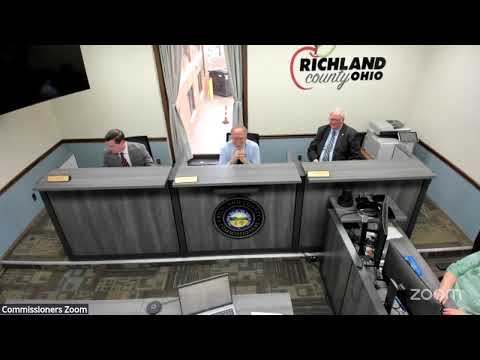
At a Feb. 6 meeting, the Richland County Commissioners said they will send a letter and a model resolution to all 18 township boards of trustees asking whether each township wants the county to adopt restrictions on large wind and large solar projects under state law. The board requested replies by April 30, 2025.
County Administrator Andrew Keller told trustees and guests the request follows Senate Bill 52, enacted in late 2021, which gives county commissioners jurisdiction over ‘‘large wind’’ and ‘‘large solar’’ projects that meet the statutory capacity thresholds. Keller said the statute allows commissioners to regulate or prohibit those projects in unincorporated township areas.
Keller summarized the statutory thresholds: large solar or large wind generally refers to a single interconnection facility with a capacity of 50 megawatts or more; ‘‘economically significant wind’’ refers to projects producing between 5 and 50 megawatts. Keller told trustees the commissioners will defer to township input and that any county action would apply only to unincorporated portions of townships. He said a public notice and hearing process would govern any county restriction.
Dan Fletcher, Madison Township trustee, and guests from township associations attended the discussion. Keller described the next steps: a letter with a sample resolution will be mailed to trustees, the township may adopt the model resolution if it wishes to prohibit development in its unincorporated area (or in a delineated portion of the township), or the township may take no action. If a township takes no action, developers could still approach property owners and potentially pursue a project that the commissioners would then address on a case-by-case basis.
Keller explained the practical effect to a trustee’s question: ‘‘This statute gives the commissioners the authority to prohibit the development of large wind and large solar in the unincorporated area of our townships.’’ He added a technical example in response to a resident’s question about scale: ‘‘Onshore wind turbines commonly have a capacity between 2 and 3 megawatts ... roughly 20 turbines’’ would produce about 50 megawatts — a rough approximation intended to give trustees a visual sense of scale.
Trustees raised concerns about property rights, zoning status, and long-term project abandonment. Several trustees said they preferred to decide at the township level whether to permit, restrict or prohibit such projects. The commissioners said they did not want to impose zoning on townships that currently have no zoning without the trustees’ support, and that the draft letter and model resolution are intended to solicit that guidance.
Timing and process
The commissioners said the letter and draft resolution would be sent to all townships and asked that townships notify the commission by April 30, 2025, whether they support adopting restrictions. If a township proffers a restriction, the commissioners said they would hold public hearings before taking any binding county-level action.
Ending
Commissioners characterized this as an informational and consultative step; townships can adopt the draft resolution, take other formal action, or decline to act. The commission will consider township returns and, where asked, may proceed with county-level restrictions in accordance with the statute and required public-notice procedures.