Get Full Government Meeting Transcripts, Videos, & Alerts Forever!
Get email alerts on the Facilities Maintenance topic
No spam. Unsubscribe anytime.
Sumner County maintenance says in-house trades saved millions; completed over 12,700 work orders last year
Summary
Maintenance director Andy Brown told the board his 72-person department handled more than 13,000 work orders last school year, keeps many trades in-house to save money and runs an emergency response trailer used for sprinkler or flood events.
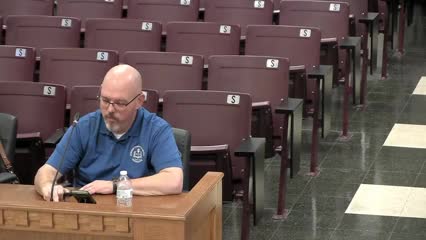
Sumner County Schools’ maintenance and operations director Andy Brown told the school board on Feb. 4 that his in-house trades crews completed more than 12,700 work orders last school year and that keeping skilled trades — plumbing, electrical, HVAC, roofing, carpentry and electronics— inside the district produces substantial savings.
Brown described the scope: 52 school buildings, six support buildings and roughly 6.4 million square feet of district property under maintenance. The department reported 72 employees in maintenance and grounds, including specialized technicians for electronics (fire panels, cameras), HVAC, plumbing, electrical and masonry. Brown said an internal warehouse carries inventory “like a Home Depot” to support repairs.
The presentation listed last school year’s volume: about 13,388 work orders logged and more than 12,700 completed. Brown described the department’s emergency trailer equipped with air movers, dehumidifiers and antimicrobial products used after sprinkler triggers, pipe ruptures or fires, and said the team regularly responds to after-hours emergencies. He cited an incident in which a small fire triggered sprinklers; rapid response and remediation reduced classroom closure time.
Brown discussed preventive maintenance and apprenticeship approaches. The department employs three box-truck crews whose year-round responsibility is filter replacement across many HVAC units; he said this illustrates the sheer number of units the district maintains. Trades also perform in-house roofing repairs, grounds shaping and concrete work, and the district operates its own lawn-mower repair capability and non-ethanol fuel supply to prolong equipment life.
Brown acknowledged hiring challenges in skilled trades, noting a recent pay increase helped retention and recruitment. The department uses mentors and apprentices and recruits through TCAT and local networking. He said large projects (for example, whole-roof replacements or major HVAC replacement) are still contracted out, but many renovations and repairs occur in-house at lower cost. Brown gave an example: an elementary football restroom building was quoted around $110,000; in-house work completed comparable work for about $48,000.
Board members asked about work-order turnaround and priorities. Brown said critical issues (cafeteria freezers, intercoms, fire panels) receive immediate attention; routine and lower-priority requests are scheduled and prioritized through the district maintenance system (SchoolDude). He and other administrators said capital planning is ongoing to address deferred maintenance: roofing, HVAC and other large-ticket items remain in multi-year plans.
No formal board votes were taken. Brown thanked his staff and said the department intends to continue a mix of in-house work, apprenticeship, and selective contracting for larger projects.