Get Full Government Meeting Transcripts, Videos, & Alerts Forever!
Get email alerts on the School Calendars topic
No spam. Unsubscribe anytime.
Maury County school officials debate early-release calendar to give teachers regular PLC time
Summary
District staff presented incomplete two-year calendar options that would convert some stockpile days into ten one-hour-48-minute early-release days for teacher professional learning. Board members expressed mixed views and directed staff to continue refining the proposal, poll families and staff and return with a calendar in the spring.
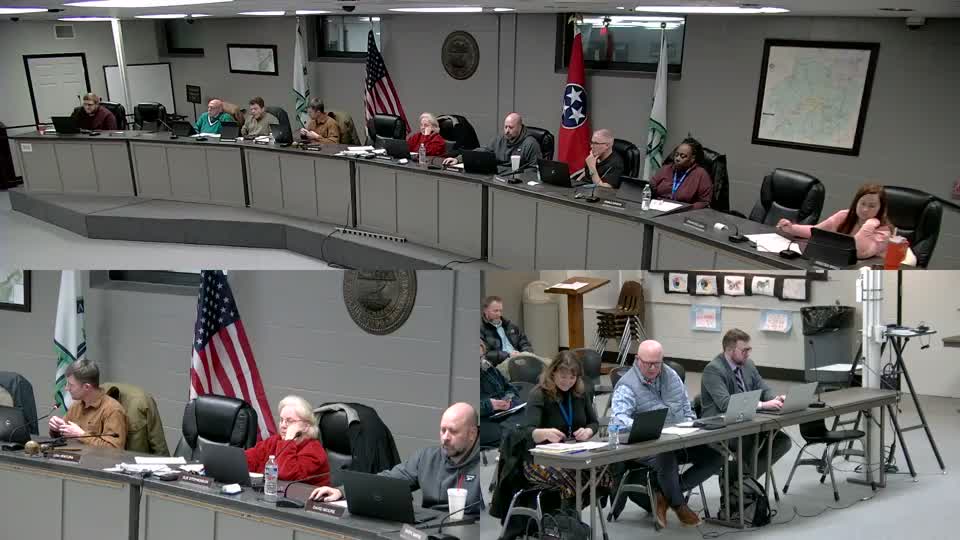
Maury County Board of Education members spent the bulk of the meeting debating a proposal to convert some stockpiled inclement-weather days into short, regular early-release days so teachers have protected Professional Learning Community time.
The proposal, presented by Mr. Stacy (staff member), would use three stockpile days and spread the lost instructional minutes across ten early-release days of one hour and 48 minutes each, or pursue late starts for some grade bands. "These are incomplete. They are incomplete on purpose and for specific reasons," Stacy told the board, adding that staff sought guidance before completing the calendars.
The plan rests on the district's ability to earn "stockpile" days by adding 30 minutes of instruction on certain days. Stacy said the district typically uses eight to nine of the 13 stockpile days for inclement weather and the remainder for teacher training. He described the tradeoffs: "If we release early, we don't earn the stockpile day for that day...so we could take all 13 of our stockpile days and take 3 away from it and release students early by 1 hour and 48 minutes." He framed the educational goal as providing frequent, smaller chunks of professional development and more timely teacher collaboration around student data.
Board members were sharply divided. Mr. Moore said, "No. I don't have an appetite for it right now," citing family schedules and the risk that shortened days become inefficient. Ms. Scholl and Ms. Stevenson both described concerns about disrupted family schedules and potential boredom for students left unsupervised. Others, including Ms. Ventura, pressed for a formal polling process of teachers and families before any decision: "If you have an appetite for this, we will, of course, poll teachers, poll our families," she said.
Staff clarified operational logistics: buses would run at the same scheduled time on early-release or late-start days so families who need regular bus service would have it; parents would retain the option to pick up students earlier without penalty. Schools would be responsible for publishing an "early release/late start" bell schedule so families know the daily routines.
The board did not adopt a calendar. Instead the group gave staff direction. Mr. Stacy said he would refine the proposal, pull together staff input, and return a revised calendar in the spring so the board could consider a 2026-27 or 2027-28 two-year calendar approach. Multiple board members asked that any proposal be accompanied by polling results and a clear plan describing what classroom time and learning outcomes the shorter sessions would protect.
Why it matters: The change would shift how professional development time is delivered across the school year, altering instructional minutes, family logistics and the district's cushion for inclement weather. The debate also ties into planning timelines: the district is seeking earlier multi-year calendar approvals so families and staff can plan vacations and other commitments.
What comes next: Staff will poll teachers and families, continue refining the calendar options (including partial rollouts or doing shorter days every nine weeks), and bring a revised proposal to the board in the spring that can be considered for adoption as part of the two-year calendar process.