Get Full Government Meeting Transcripts, Videos, & Alerts Forever!
Get email alerts on the Roads Budget topic
No spam. Unsubscribe anytime.
Story County engineers present FY2026 secondary roads budget; shop expansion and equipment purchases debated
Summary
County engineers reviewed proposed FY2026 revenues and expenses for the secondary roads fund, recommending equipment purchases and outlining a possible $850,000–$1,000,000 shop expansion. Officials discussed reestimates for FEMA, gravel costs, bridge projects and the county's local-effort threshold under HF 718.
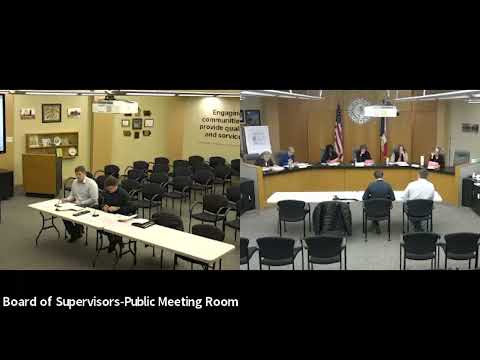
Darren Moon, engineer, and staff reviewed the proposed FY2026 secondary roads budget at a Feb. 6 Story County Board of Supervisors work session, projecting $9,367,959 in FY2026 revenues and a FY2025 reestimate of $8,889,930 while flagging several revenue and cost uncertainties.
The review focused on revenue reestimates, materials and equipment costs, and a potential shop expansion. Moon said road-use tax receipts have repeatedly come in higher than county estimates and that the county should be cautious about FEMA reimbursements after federal funds were temporarily frozen; staff reduced a FY2026 FEMA revenue projection from $195,000 to $169,000, and noted some items were deemed ineligible. "They've underestimated for a number of years now," Moon said of the DOT's road-use tax projections, but added that recent three-year averages have exceeded internal estimates.
Why it matters: the secondary roads fund finances road maintenance, equipment replacement and small construction projects that affect residents, farming and commercial traffic across Story County. Staff said the fund needs to maintain a healthy ending balance to cover future motor-grader replacements and to absorb unexpected bridge repairs or storm damage.
Key budget items and staff recommendations
- Revenues and reestimates: Moon recommended increasing a miscellaneous auction revenue line for FY2026 (Purple Wave sales) to $15,000 and boosting a FY2025 reestimate for secondary road materials from $1,500 to $7,000 because of unanticipated billing credits from Martin Marietta. Overall FY2026 revenues were presented as $9,367,959 with the FY2025 reestimate at $8,889,930.
- FEMA and grants: staff warned that FEMA funds were temporarily frozen and said some costs would not be reimbursed. The department is carrying a $50,000 state grant for temporary traffic signals that cannot be purchased until 2026 and noted cost- and reimbursement-sharing with Boone County.
- Materials and operating costs: Moon said crushed limestone costs from Martin Marietta have risen about 38 percent in three years; the department proposed increasing the gravel/crushed-limestone appropriation from $1.2 million to $1.4 million for FY2026 to reflect higher unit prices.
- Equipment and capital: the department requested $155,000 in FY2026 for equipment (an excavator, a skid loader and a tandem truck component). Moon said one tandem truck ordered previously may arrive in spring and that the department placed $325,000 per truck into the draft budget. The county also plans to shift some prior lease savings toward truck purchases. Staff noted long lead times for some equipment and past delays for vehicles and trucks.
- Shop expansion: Moon described safety and operational reasons for a shop expansion at the county shop in Nevada, including a heated wash bay, additional enclosed storage for vehicles currently parked outdoors, and a break/training room to protect electronics from dust. He said early schematic work with the county architect is underway and provided a preliminary cost range of $850,000 to $1,000,000. Moon said the expansion is not currently in the department's formal asking but could be added; as proposed, one option was to remove a $325,000 tandem truck from FY2026 to make room for the building cost in the capital plan.
- Local construction program: the department will focus on smaller wood-bridge replacements in FY2026 and one paving project (500th Avenue). Moon said the 500th Avenue work would use a thinner pavement section because the route receives little agricultural heavy-vehicle traffic. A separate bridge project (Howard 11) was identified for a federal bridge grant application; staff said the county's application is prepared and County Engineer's Group believes the county is highly likely to receive the grant, which would cover a roughly $700,000 bridge.
- Traffic signals and development-driven costs: Moon said Ames has requested permanent traffic signals at a couple intersections, and that developer agreements and potential annexation complicate timing and cost-sharing; permanent signals can cost into the millions, and if the city or developers do not resolve agreements the county could still be asked to pay a portion.
Fund balance, risk and board direction
Moon projected an ending FY2026 secondary-roads fund balance of about $4.1 million without the shop expansion, and told supervisors he prefers holding at least $2.5 million as a prudent reserve for motor-grader replacements and storm repairs. Staff discussed the 75 percent local-effort threshold under House File 718 (HF 718), saying Story County's local effort was about 83 percent in the FY2024 annual report. County staff advised caution about reducing local effort too quickly because state restrictions could freeze funds if the county falls below required levels.
Supervisor Lisa Heddens and other board members asked for input on whether to include the shop expansion now or defer it to FY2027; several supervisors said they did not want to reduce the county's reserve too far. Moon and staff said the building is primarily a one-time capital cost and could be funded from secondary roads, general fund or capital funds, but noted that road fund dollars are restricted and, once transferred, cannot be returned to other funds.
Quotes from the meeting
"We need a wash bay, a heated wash bay," Moon said, describing safety risks after two recent electrical shocks in an area not designed for pressure washing.
"If we wanted to add the $850,000 in this budget in FY '26, I could say I would remove the $325,000 tandem truck," Moon said when discussing trade-offs between equipment and the shop expansion.
What happens next
Staff scheduled more detailed discussion of local construction programming and the five-year program at an upcoming meeting the department said will take place later in February; Moon asked for board input on whether to include the shop expansion in FY2026 or defer implementation to FY2027. Supervisors did not take a formal vote during the work session; staff said final budget decisions will be made after all departments provide numbers and the board reviews levy options.
Ending
County engineers urged a cautious approach to the FY2026 secondary roads budget that preserves reserves for equipment replacement and unexpected bridge or storm repairs while noting options to fund a shop expansion through reductions in other capital purchases or by moving the project into the next fiscal year.