Get Full Government Meeting Transcripts, Videos, & Alerts Forever!
Get email alerts on the Pctc Budget topic
No spam. Unsubscribe anytime.
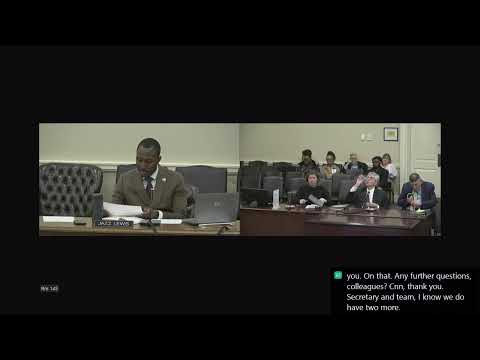
Police and Correctional Training Commission faces funding choices as MPTSC fund transfer could delay $6M simulation project
Summary
DLS presented the PCTC fiscal 2026 analysis noting a proposed transfer from the MPTSC fund that could cut the fund balance and delay training projects including a planned $6 million scenario-based simulation training environment. The department described prioritized purchases and said the commission will reprioritize if the transfer occurs.
Catherine Barber of the Department of Legislative Services summarized the fiscal 2026 budget for the Police and Correctional Training Commission and flagged a potential short-term funding shift that could delay planned training and equipment investments.
Barber said the PCTC fiscal 2026 allowance totals $13.7 million, a 10.3% increase from the prior year, with about 60% of the budget dedicated to personnel costs. The analysis noted 78 regular positions in the budget, including 12 positions transferred from other divisions. Barber also reported 13 vacancies as of Dec. 31, 2024, although the Department of Public Safety and Correctional Services told DLS that seven of those vacancies were filled by Jan. 8, 2025.
Barber highlighted the Maryland Police Training and Standards Commission (MPTSC) special fund, which receives about $2 million annually from court fees and has accumulated a significant balance because expenditures historically lagged receipts. Before fiscal 2024 the fund's balance reached about $9.6 million; DLS noted the BRFAA of 2024 temporarily expanded allowable uses of the fund and required a spending strategy after underutilization. The BRFAA of 2025, as introduced, would authorize the governor to transfer up to $7 million from the fund to the general fund by the end of fiscal 2025. DLS said that if the full $7 million transfer occurs and PCTC expends the current $2.7 million appropriation, the fiscal 2026 starting balance could fall from roughly $8.3 million to $1.3 million, potentially delaying projects in the spending strategy.
Kate Gossett, Executive Director for the Public Safety Education and Training Center, told the subcommittee the capital scenario-based simulation training environment is estimated at about $6,000,000 per DGS and the Department is reviewing vendors for architectural and engineering plans. She said if the fund is reduced, that project would likely be put on hold until funds could be accrued. Secretary Carolyn Scruggs of the Department of Public Safety and Correctional Services told the panel the transferred positions were mainly conversions from contractual roles to permanent merit positions and that priorities for MPTSC fund spending include a multi-interactive learning objective system, advanced trauma simulators, adjunct faculty, a training coordinator, two-way radio replacement and classroom upgrades.
Wayne Silva, Executive Director of the Police Training and Standards Commission, described statewide uptake of the body-worn camera model program and said most departments are adopting it; he noted data storage and retention costs are the most frequent challenge for smaller agencies. Silva and others said commission staff are evaluating software and artificial intelligence tools to help identify anomalies in footage, but final review will remain a human supervisory responsibility.
DLS recommended concurring with the governor's allowance. The department said it would reprioritize projects if the proposed fund transfer in the BRFAA reduces the MPTSC fund balance.