Get Full Government Meeting Transcripts, Videos, & Alerts Forever!
Oklahoma tax commissioners, OMES staff outline how state revenue estimates are produced and risks tied to oil, grocery tax cut
Summary
The Oklahoma Tax Commission and the Office of Management and Enterprise Services briefed the Senate Appropriations Committee on how revenue forecasts are built, the Board of Equalization certification process and the main sources of uncertainty, including oil-and-gas volatility and the recent grocery sales tax cut.
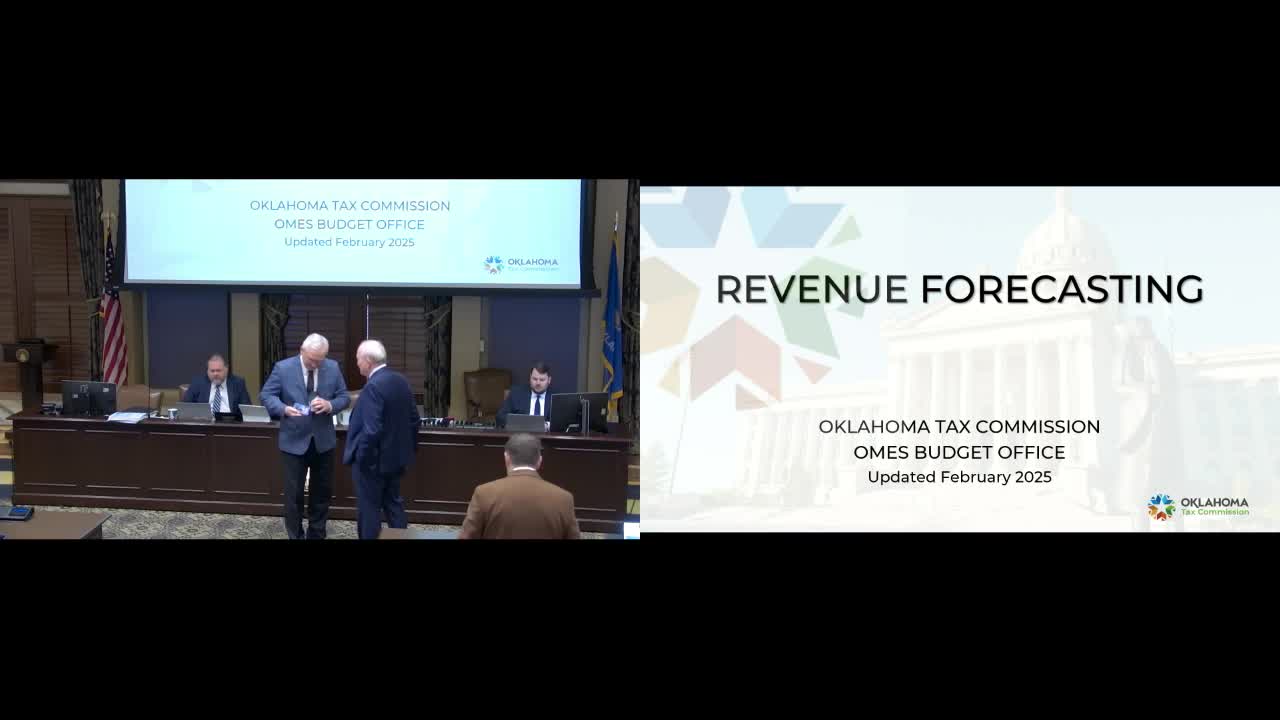
The Senate Appropriations Committee heard a two-hour briefing on the state—udget—orecasting process on a presentation led by Marie Schubel, director of tax policy and research at the Oklahoma Tax Commission, and John Gilbert, deputy director of revenue and budget at the Office of Management and Enterprise Services (OMES).
Schubel told the panel the Board of Equalization, created by the Oklahoma Constitution, relies on tax collection estimates produced by the Tax Commission and OMES and then certifies an amount the legislature may appropriate. "The BOE will certify that, and that then tells the legislature the amount of money that you can spend during session," she said. "The certification by the BOE is a 95% certification of that number, and that allows a 5% cushion to prevent some sort of revenue failure."
The presentation described the multi-step process used to produce apportionable revenue estimates. The Tax Commission develops detailed forecasts for major tax categories, including individual income, sales, motor vehicle, corporate and gross production (oil and natural gas) taxes. The Commission draws on two contract economists, internal staff, historical collections data and federal benchmarks from the U.S. Energy Information Administration (EIA) for oil and gas prices; OMES then applies statutory apportionments to produce the statewide certified numbers presented to the Board of Equalization in December and again in February for final certification.
Why it matters: The BOE—ertified number sets the upper bound on what the legislature can appropriate under Oklahoma—onstitutional rules for a balanced budget. Small changes in forecasted collections can translate into tens or hundreds of…
Already have an account? Log in
Subscribe to keep reading
Unlock the rest of this article — and every article on Citizen Portal.
- Unlimited articles
- AI-powered breakdowns of topics, speakers, decisions, and budgets
- Instant alerts when your location has a new meeting
- Follow topics and more locations
- 1,000 AI Insights / month, plus AI Chat