Get Full Government Meeting Transcripts, Videos, & Alerts Forever!
Get email alerts on the Outdoor Advertising Billboards topic
No spam. Unsubscribe anytime.
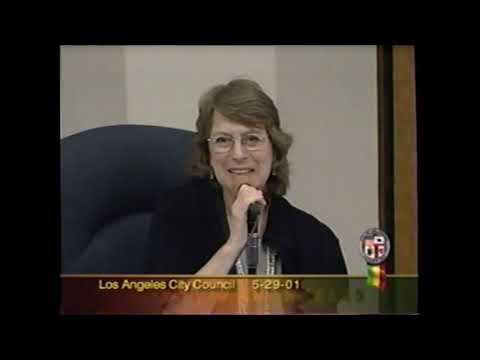
Los Angeles City Council delays decision on proposed billboard ordinance after large public outcry
Summary
After more than two hours of public testimony and hours of council debate, the Los Angeles City Council continued consideration of a proposed billboard ordinance for one week so staff and members can reconcile enforcement, safety and inventory questions.
The Los Angeles City Council continued a contentious proposal to alter the city's billboard rules after a lengthy public hearing in which neighborhood groups, architects and business representatives urged delay and greater study.
The hearing, on May 29, 2001, drew speakers from neighborhood associations, the Chamber of Commerce and anti-billboard groups who raised safety, environmental review and enforcement concerns. Councilwoman Cindy Misakowski introduced a substitute motion that would require registration of billboard structures, a permanent interim control ordinance, a permitting and inspection regime administered by the Department of Building and Safety and additional enforcement tools before any trade-off or allowance of new freeway signage.
Why it matters: The proposed changes would allow new billboard placements in some locations while offering billboards as a trade for removing others. Opponents say the city lacks a reliable inventory of existing signs, cannot distinguish legal from illegal boards without a systematic inspection program and has not completed an environmental or traffic-safety study the California Environmental Quality Act requires for ordinances with significant environmental impacts.
Public commenters pressed the council on several recurring points. Walter Prince of the Northridge Chamber of Commerce said, "The ordinance calls for signs that can be 60 feet high. There's safety issues," and urged the council to inventory how many billboards are legal or illegal and measure potential economic impacts on companies, landlords and the city. Joyce Foster of Citizens to Ban Billboard Blight told the council the Department of Building and Safety estimates "approximately 10,000 boards in the city" and said roughly "4,000 have code violations," urging that those be brought into compliance or removed before any new allowances are considered. She also said a full CEQA study is necessary for any ordinance that may significantly affect the city's environmental quality.
Council debate centered on three competing approaches staff and committees had developed: maintain the city's longstanding prohibition on freeway billboards and focus on enforcement, pursue a trade-off plan to reduce street-level billboards by allowing some freeway placements, or adopt the planning department's alternative that attempts to control concentration and remove blighted boards. Councilman Mike Feuer and Councilwoman Misakowski both urged caution: Feuer called a trade executed without a clear inventory "a deal in the dark," and Misakowski said the substitute motion would let the city attack illegal signs without "giving anything away" on freeway rights.
Several council members said they supported the concept of reducing visual blight but not until the city can say which signs are illegal and how many exist. Councilman Mark Ridley-Thomas asked colleagues to consider the planning department's "scenario 3" as a starting point, with additional amendments from Misakowski's proposal. Council members representing districts with a high concentration of newly erected signs, including Councilman Nick Pacheco, asked for a better formula for how impacts would be distributed among districts.
Council action: After extended debate, council members agreed to continue the item for one week to allow staff and departments to respond to the inventory, enforcement and safety questions raised during testimony and by council members. The council did not adopt the substitute motion or any ordinance that day; it set a continuance to permit further technical work and negotiation.
Context and next steps: Speakers repeatedly requested a citywide inventory of signs, expedited enforcement against illegal boards and an environmental and traffic-safety review before any ordinance that would alter the city's longstanding approach to freeway signage is adopted. The council directed staff to return with more information during the continuance period.
Ending: The council's continuance keeps the status quo in place while staff compile inventories, cost estimates and legal analyses requested by members and the public. The item is scheduled for further consideration at the next council meeting.