Get Full Government Meeting Transcripts, Videos, & Alerts Forever!
Get email alerts on the School Violence Intervention topic
No spam. Unsubscribe anytime.
City pilot places community teams in four high schools; $250,000 per-school funding cited
Summary
The mayor’s Office of Neighborhood Safety and Engagement told the Public Safety Committee that a four‑school pilot of community-led violence intervention teams is in operation, funded by a mix of private, state and local sources and designed to reduce incidents and improve school climate.
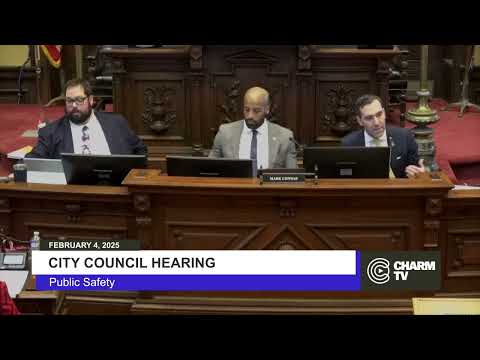
The mayor’s Office of Neighborhood Safety and Engagement (MONSE) told the Public Safety Committee on Feb. 11, 2025, that a school‑based violence intervention pilot is active in four Baltimore high schools and has produced early signs of reduced suspensions and improved school climate.
Stephanie Mavronis, director of MONSE, described the pilot as a partnership with Baltimore City Public Schools and community-based organizations in which teams of intervention specialists and student ambassadors work in and around schools to provide conflict mediation, youth development and wraparound services. “The goal is to promote a positive school and community environment by addressing violence through a coordinated approach,” Mavronis said.
Scope and staffing: The pilot operates at Mervo, Carver, Digital Harbor and Edmondson Westside. Each school’s initial staffing model includes a program supervisor, two intervention specialists and eight student ambassadors (two per grade). MONSE told the committee the preliminary allocation is roughly $250,000 per school, with the bulk of funds paying staff, stipends for student ambassadors and program activities.
Funding: MONSE reported $700,000 from Wells Fargo and the National League of Cities to support the first phase of the pilot (Movement Team and PEACE Team contracts), state allocations for safe-streets initiatives directed to the program, and a multiyear commitment to Digital Harbor from the casino local impact fund.
Early outcomes and evaluation: Arnetta Shelton, chief of community violence intervention, described initial tracking in an Apricot database that will capture mediations, interventions, home visits, restorative conversations and student-engagement measures as well as demographic details. Shelton said principals have reported preliminary improvements: at Digital Harbor the presentation cited a 50% reduction in suspensions compared with the prior year during overlapping reporting windows, and principals attributed better attendance and climate in part to the Movement Team’s proactive engagement.
Shelton said the city will identify an evaluation partner and finalize performance metrics. “We are in the early stage of this program and the data are promising,” she told the committee, noting the need for a baseline and at least one full school year of implementation to support a rigorous evaluation. The office said it will collect attendance, suspension, repeated-incident counts and school-climate survey data in collaboration with City Schools.
Victim services and referrals: Mark Mason, chief of victim services for MONSE, said his team has received referrals from the pilot and provided stabilization services including victim support and relocation assistance in specific cases. MONSE said it is formalizing a referral process so school-based intervention staff can connect students and families quickly to victim services and other supports.
Next steps: MONSE said it will continue site visits, host parent information sessions, finalize the Apricot tracking system and identify an external evaluator. Staff told the committee they will provide further program metrics to the Public Safety Committee at future oversight hearings and will work with councilmembers who requested school-level and neighborhood-level outcomes.
Speakers quoted in this article are identified from the hearing transcript. No ordinance or formal vote was taken on the pilot during the hearing.