Get Full Government Meeting Transcripts, Videos, & Alerts Forever!
Get email alerts on the Police Statistics topic
No spam. Unsubscribe anytime.
Police present higher clearance rates and new youth-targeted robbery pattern; council seeks more data
Summary
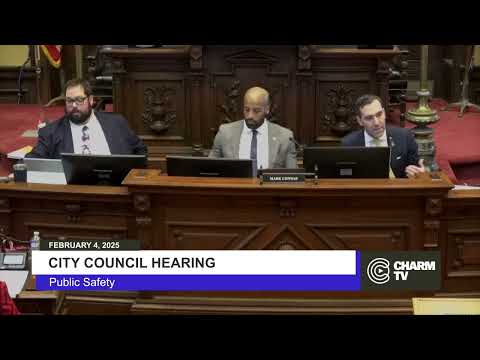
At a Baltimore City Council Public Safety Committee oversight hearing on Feb. 11, 2025, the Baltimore Police Department reported year-to-date increases in clearance rates and described new enforcement priorities — including a pattern of youths being robbed for branded jackets — while councilmembers pressed for more detailed data.
At a Baltimore City Council Public Safety Committee oversight hearing on Feb. 11, 2025, the Baltimore Police Department reported higher clearance rates compared with the same period in 2024 and described emerging patterns: an increase in juvenile arrests, a rise in narcotics violations, and a citywide series of robberies in which youths were targeted for branded jackets.
The report, delivered by the department’s Deputy Commissioner, said officers and detectives have used intelligence-led approaches, expanded video and license-plate technology, and focused detective time to improve case closures. “We continue to work diligently with our investigative units to improve these numbers leveraging technology and intelligence based policing,” the Deputy Commissioner said during the presentation.
Why it matters: Council members called the clearance-rate improvements and the 2024 homicide decline encouraging, but pressed for more granular data to understand whether better clearance percentages reflect more solved cases or simply a smaller denominator. That distinction matters for budget and oversight decisions about staffing, technology and prevention programs.
The Deputy Commissioner told the committee that homicide and robbery clearance rates have increased year to date and that the department’s homicide and robbery units have been able to “do actual detective work” because a reduced caseload in 2024 freed investigative capacity. The presentation also said narcotics violations have risen “for a long period of time” and remain an enforcement priority.
Council President Nick J. Cohen praised the department’s work. “Baltimore is a safer city than it was last year and than it was the year before that,” Cohen said, adding that reductions in nonfatal shootings and homicides reflect work by police, the mayor’s office, state partners and community organizations.
On juvenile crime, the Deputy Commissioner described a pattern of youths being “targeted for their North Face jackets,” noting an estimated 11 cases citywide in the previous week concentrated in the Northern District. He said investigators are using school police notification, targeted patrols, body-worn camera review and search warrants to identify suspects. “We are being proactive in those areas… getting out of the car, engaging individuals,” he said.
Councilmembers pressed for follow-up data. Chair Mark Conway and other members requested a breakout showing the numerator and denominator behind the clearance-rate percentages so the committee can see how many cases underlie the rates and whether the improvement is driven by more closures, fewer crimes, or both. The Deputy Commissioner agreed to provide more detailed clearance-rate data at the March oversight session.
Narcotics enforcement: Committee members asked the department to separate types of narcotics arrests (misdemeanor possession versus possession with intent to distribute). Aaron Murphy, identified in the hearing as a department data/government-affairs contact, said the department can supply arrest counts based on initial CJIS arrest codes and will try to parse possession-only versus possession-with-intent categories for future briefings while noting that court outcomes can later change charging classifications.
CAD productivity and response: Councilwoman Porter raised concerns that CAD (computer-aided dispatch) records may not reflect all police responses and asked whether response gaps were being missed in the presented “CAD productivity” slide. The department said unit numbers are the basis for the report (responses are tied to unit activity) and offered to look into specific missing-response questions after the hearing.
Other operational questions included equitability of proactive deployments across districts. The Deputy Commissioner said district commanders choose tactics (foot, bike, vehicle, or specialized units) and that regional enforcement teams are used when districts need additional sustained presence. Council members asked the department to keep monitoring and to prioritize proactivity where violent crime trends indicate the need.
What the committee directed or requested: - BPD to provide the underlying counts (numerator/denominator) used to compute clearance rates at the next oversight hearing in March. (Requested by Chair Conway and President Cohen.) - BPD to provide a disaggregated narcotics-arrest report (possession vs. possession-with-intent where feasible) for future briefings; data will be based on arrest codes and subject to subsequent court classification. (Aaron Murphy accepted this task.) - BPD to investigate CAD nonresponse questions raised by Councilwoman Porter and report back.
Speakers quoted in this article are identified from the hearing transcript. No formal votes or ordinances were taken during this part of the hearing; the committee used the session for oversight questioning and data requests.