Get Full Government Meeting Transcripts, Videos, & Alerts Forever!
Get email alerts on the Property Tax Nonprofit Low Income topic
No spam. Unsubscribe anytime.
Committee reviews extension of nonprofit low-income rental property-tax exemption (SB 104)
Summary
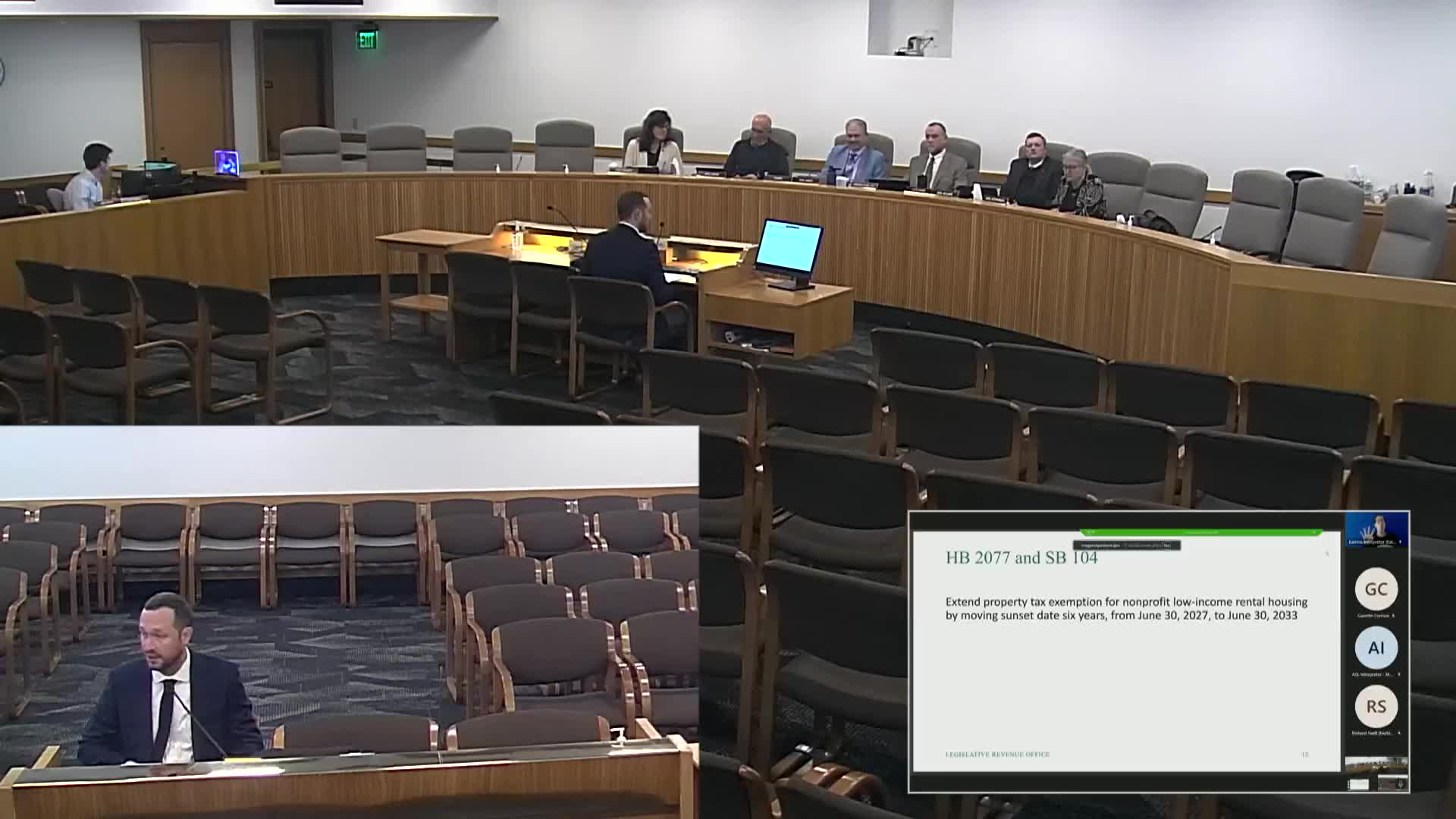
Senate Bill 104 would extend the property-tax exemption for nonprofit low-income rental housing from June 30, 2027, to June 30, 2033. Staff reported the exemption is the largest of the three reviewed, with nearly 900 accounts and an average real market value lower than vertical housing exemptions; Tax Fairness Oregon supported the extension.
Senate Bill 104, which would extend the property-tax exemption for nonprofit low-income rental housing, was discussed in a Feb. 5, 2025 public hearing before the Senate Committee on Finance and Revenue.
Bo Olin of the Legislative Revenue Office told senators the exemption’s apparent policy purpose is to increase the supply of low-income rental housing in Oregon. The exemption applies to property owned, purchased, leased or held for development by nonprofit corporations (501(c)(3) and (4) entities and certain partnerships) where occupancy income limits and other eligibility conditions are met.
Olin summarized eligibility rules: in the first year of exemption, tenants must have household incomes no greater than 60% of area median income (AMI), except for properties that receive federal Low Income Housing Tax Credits (LIHTC), which may allow some units up to 80% AMI as long as the overall average is 60% AMI; after the first year the threshold for tenants may be up to 80% AMI. The exemption can apply to city or county taxes and to all taxing districts if districts representing at least 51% of the tax rate adopt an ordinance.
Olin said SB 104 is the largest of the three exemptions the committee reviewed in usage: nearly 900 exempt accounts exist, with an average real market value of about $3.5 million per account. He said the account count leveled off in the 2000s but increased after a 2015 change that allowed local governments additional discretion and allowed an AMI step-up to 80% after the first year. Olin noted a 2023 Portland pilot program (Regulated Affordable Multifamily Program, RAMP) that couples utility-bill discounts with exemption approval and requires pass-through of savings to renters.
Richard Swift of Tax Fairness Oregon testified in support of SB 104, saying the exemption supports the production and preservation of low-income housing and that Tax Fairness Oregon endorses extending the exemption.
Senators asked clarifying questions about program scope, the definition of LIHTC (federal Low Income Housing Tax Credit) and filing deadlines; Olin said applications for the upcoming fiscal year generally must be filed by March 1 with some exceptions.
No formal votes were taken at the hearing; staff said materials and the LRO report are available on OLIS for committee review and that further work sessions may follow.