ODE Outlines Student Success Plans, Grant Monitoring and Early Results to Senate Committee
Loading...
Summary
The Oregon Department of Education presented an overview of Student Success Plans tied to the Student Success Act and HB 2275, discussed grant monitoring, evaluation and expansion plans, and listed program outcomes and grantee counts; officials emphasized community-led planning and a cross-plan framework of six pillars.
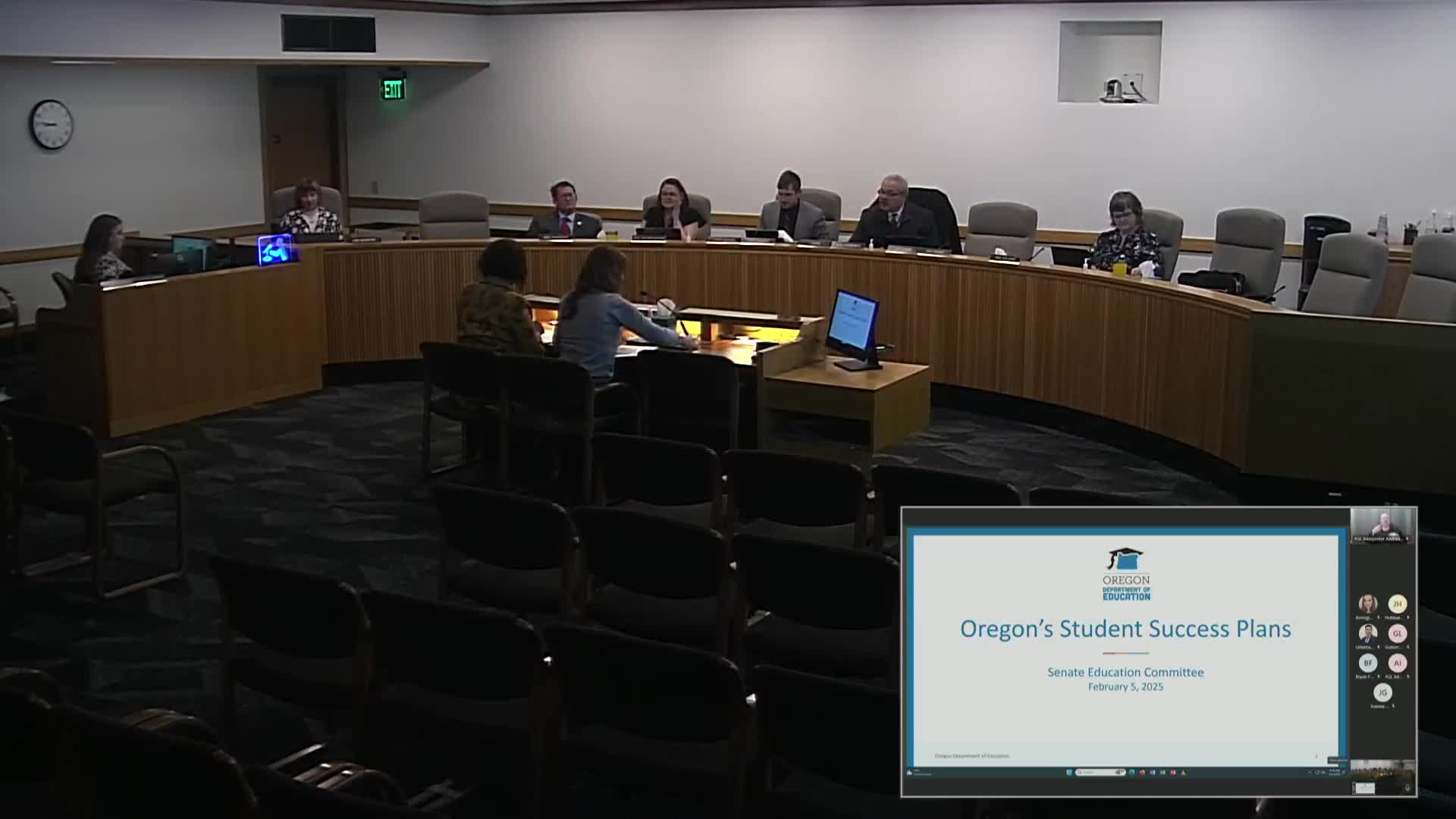
The Oregon Department of Education presented an informational briefing Feb. 5 on the state’s Student Success Plans, describing the evolution, grant monitoring, evaluation and initial outcomes for plans focused on historically underserved student populations.
Dr. Charlene Williams, director of ODE, and Teneal Weatherall, chief of staff, told the Senate Committee on Education that Student Success Plans have been developed “by the community for the community” and build on long‑running efforts that began with an American Indian/Alaska Native plan in the 1980s and continued with additional plans in subsequent years. They said the Student Success Act and House Bill 2275 reinforce advisory roles and require grant applicants to consider advisory recommendations.
ODE described a three‑part structure for each plan: (1) statewide development and community‑led implementation, (2) advisory groups providing ongoing guidance, and (3) grantee work to implement evidence‑based strategies. ODE said grantees will publish free resources on Oregon Open Learning by 2028 and that ODE uses monthly reports, site visits, progress reports, participant surveys and external evaluations to monitor grant performance.
What ODE reported: Officials cited examples of recent grant results and participation counts. In the 2023–24 grant year, ODE said LGBTQ2SIA+ plan grantees served nearly 4,000 educators and organizational staff, engaged over 6,000 family and community members, and impacted more than 55,000 youth through grant projects; ODE identified pillars that organize strategies across plans — cultural identity and language development, academic success, service learning, family engagement, coordinated systems of care and leadership development. The department also described a cross‑plan external evaluation effort, referenced an earlier AABSS (African American Black Student Success) external evaluation and listed recommended improvements including stronger data collection and learning collaboratives for grantees.
Grantee awards and rollout: ODE said four‑year grants were awarded in October for multiple plans; the transcript records grant counts as read in testimony: AABSS grantees (as read in session: “20 '1”); 17 Latino/Latinx grantees; 14 LGBTQ2SIA+ grantees; and 15 Native Hawaiian/Pacific Islander grantees. ODE said the immigrant/refugee student success plan was finalized in December 2024 and will provide targeted supports. Officials emphasized the plans are not a panacea and said they are focused on scaling, accountability and publishing resources for statewide use.
Ending: Committee members asked clarifying questions about whether local grant efforts could be tied to state priorities such as early literacy; ODE responded that academic support goals (including literacy) are represented in the cross‑plan pillars and that individual grantees choose activities aligned to their communities’ priorities. The presentation closed as an informational briefing; no committee action or vote was taken.