Get Full Government Meeting Transcripts, Videos, & Alerts Forever!
Get email alerts on the Property Tax Vertical Housing topic
No spam. Unsubscribe anytime.
Senate committee reviews extension of vertical housing property-tax exemption (SB 117)
Summary
Witnesses briefed the Senate Finance and Revenue Committee on Senate Bill 117, which would move the sunset for the vertical housing property-tax exemption from Dec. 31, 2025, to Dec. 31, 2031. Staff described the exemption’s mechanics, usage trends and estimated revenue impacts; advocates said the exemption helps projects pencil out.
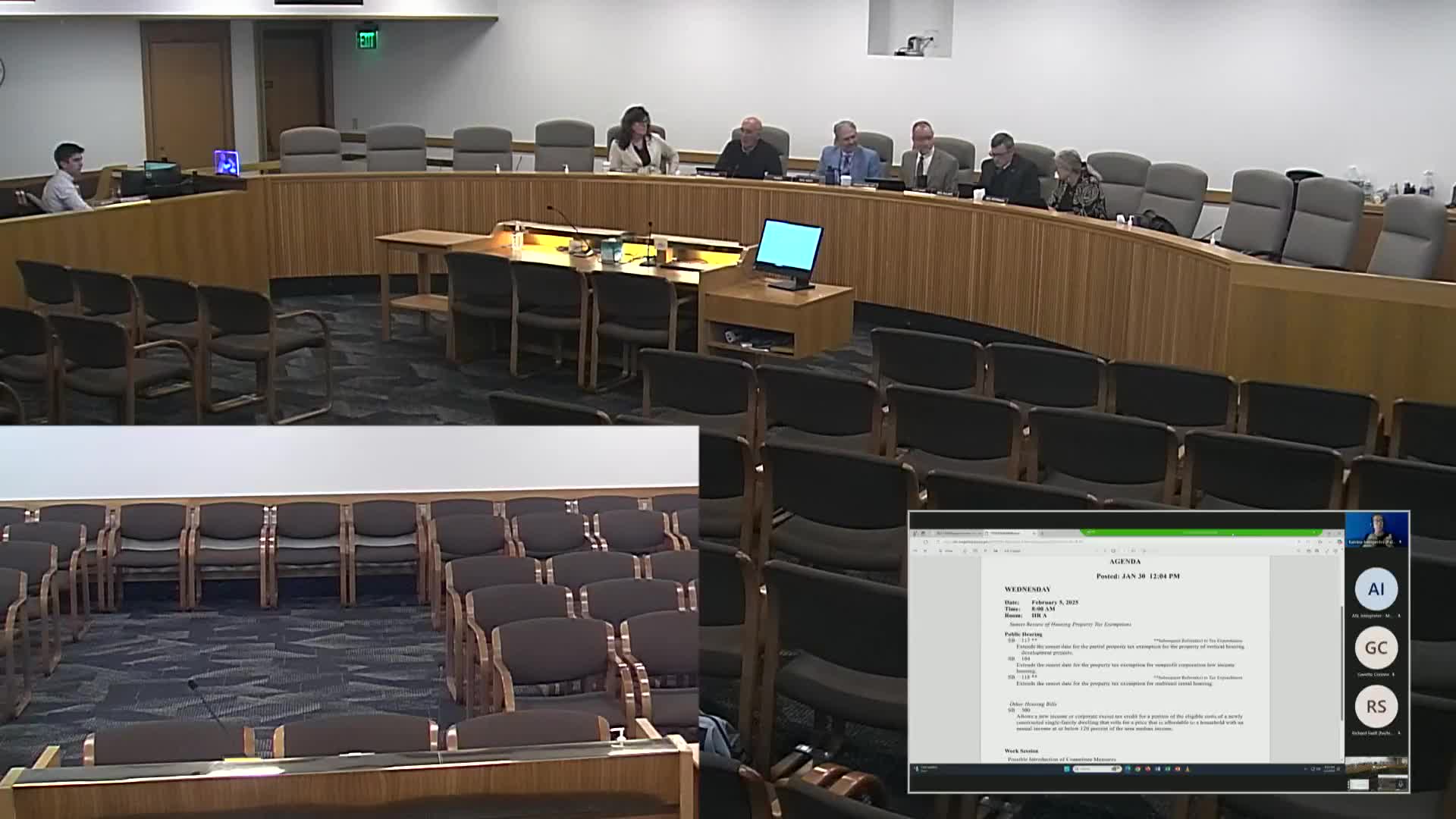
Senate Bill 117, which would extend the property-tax exemption for vertical housing development projects, was the subject of a public hearing before the Senate Committee on Finance and Revenue on Feb. 5, 2025.
Legislative Revenue Office analyst Bo Olin told the committee the bill would move the exemption’s sunset date from Dec. 31, 2025, to Dec. 31, 2031 and walked members through the policy purpose and the exemption’s mechanics. Olin described three primary drivers of the exemption: the share of a project devoted to residential use, the share of that residential housing reserved for low-income households, and the number of floors (the exemption is designed for projects of at least two stories and targets roughly two-to-five story buildings). He said some configurations of low-income share and story count can cause the exemption to apply to both improvements and the land.
The policy purpose, Olin said, is to encourage development of residential, including low-income, housing in city centers to produce agglomeration effects that spur further development. He said the Legislative Revenue Office (LRO) and staff materials, presented to the interim committee and available on OLIS, form the basis of the briefing.
Committee members pressed for usage and impact data. Olin said usage has trended modestly upward since about 2020—roughly three new exempt accounts per year—and average real market value per account has increased. He said about 20 zones have been designated historically and named recent projects in Lake Oswego, The Dalles and Beaverton. Olin reported that 23 accounts across four counties used the exemption in the 2021–23 biennium, with total foregone revenue in that period staff summarized as $11,800,000 (staff-supplied figure). He also presented LRO projections that the revenue impact of current and expected projects could be roughly $1,111,000,000 in total under current enrollments, with additional impacts of about $1.3 million in 2025–27, $3 million in 2027–29 and about $5 million in 2029–31 driven by new projects coming online; Olin identified Lake Oswego, The Dalles and Beaverton as sources of upcoming projects.
Senators asked operational questions: Senator Patterson asked how “low income” rents are set; Olin said the Executive Branch agency Housing and Community Services uses AMI (area median income) definitions. Senator Taylor asked how many units the exemption has created; staff said recent projects in Lake Oswego (about 75 units), The Dalles (about 125 units) and several Beaverton projects of more than 100 units each were examples, but Olin said a complete, project-level unit tally was not available at the hearing and staff offered to follow up.
Richard Swift of Tax Fairness Oregon testified in support, saying the exemption has produced a “net positive” for low-income and workforce housing where used and that it can help projects “pencil out.”
No formal action or vote occurred at the hearing; committee staff and members said the briefing is preparatory to later work sessions.
The committee closed the SB 117 public hearing and moved to the next item on the agenda.