Get Full Government Meeting Transcripts, Videos, & Alerts Forever!
Get email alerts on the Paid Parent Caregivers topic
No spam. Unsubscribe anytime.
Senate hearing spotlights SB 538, "Tenzi's Law," to allow paid parent caregivers for Oregon's highest-need children
Summary
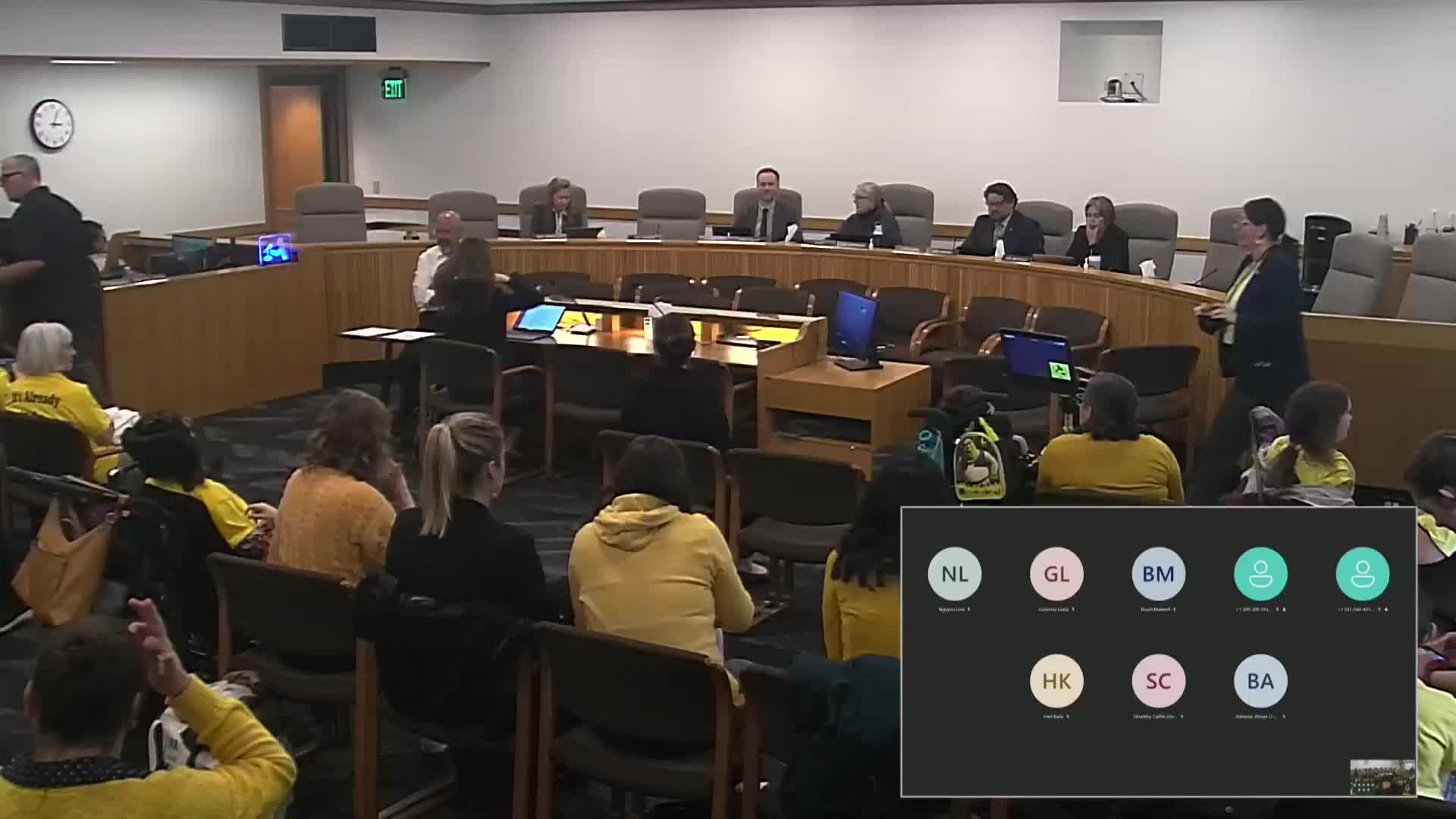
At a Feb. 5 public hearing, sponsors and dozens of parents, clinicians and advocates urged passage of SB 538 to let parents be paid for authorized attendant care hours for children with very high medical and behavioral needs, arguing staffing shortages and safety concerns leave assessed hours unused.
PORTLAND, Ore. — On Feb. 5, the Oregon Senate Committee on Health Care heard public testimony on Senate Bill 538, known as "Tenzi's Law," which would prohibit the Oregon Department of Human Services from restricting the number of attendant care service hours a parent may provide to a child with very high medical or behavioral needs, except where a parent chooses not to provide the hours or where an employer, collective bargaining agreement or the client child restricts that care.
Supporters told the committee the bill is intended to ensure children already assessed as eligible for care receive the hours they are authorized, by allowing parents to be compensated for those hours when professional caregivers are unavailable.
The bill’s technical description was presented by Mr. Deetz, who told the committee SB 538 "would prohibit the Oregon Department of Human Services from restricting the number of care attendant service hours provided by a parent caregiver except by choice of the parent provider, the agency that employs a parent provider, any applicable collective bargaining agreement, or the client child." Senator Sarah Gelser Bluhm, who has led legislative work on the issue for multiple sessions, and Representative Courtney Neron also voiced sponsorship and support during the hearing.
Why it matters: Supporters said the state already assesses hours of care for roughly 10,000 children who qualify for developmental disability services, and a smaller subset — about 1,500 children — are on a waiting list for the Children's Extraordinary Needs (CEN) waiver. Representative Courtney Neron told the committee "over 1,500 eligible children remain on the wait list for the Children's Extraordinary Needs waiver," and framed SB 538 as a way to make the authorized hours usable without creating new budgetary entitlement.
Parents and advocates described practical problems that lead assessed hours to go unused: an insufficient workforce, short‑staffing, high turnover and safety concerns when undertrained attendants are assigned to medically complex children. Shasta Kearns Moore of Advocates for Disability Supports told the committee the "system of care for disabled youth is broken and enormously complicated" and urged lawmakers to "free us from that dysfunction with the stroke of a pen." Toby Raetz of the Autism Society of Oregon described a family's decade‑long difficulty finding in‑home providers, saying that despite an assessment for more than 350 hours per month for his son, his family found ‘‘exactly one in‑home care provider’’ who could cover fewer than half the hours.
Clinicians and nurses who testified described both safety and workforce data. Dr. Alicia Ibaraki, an associate professor of psychology and analyst for Advocates for Disability Supports, cited a survey of 24 families in which 91 percent were not using all of their assessed hours; 57 percent attributed that to workforce shortages and 41 percent to safety concerns. "Compensating families for their skilled labor simply will help them to survive another day with a greater sense of agency and predictability," Dr. Ibaraki said.
Multiple parents gave first‑hand accounts of medical emergencies, chronic staffing gaps and financial strain. Callie Ross, whose son Tensie is on the waiver wait list, told the committee, "Per ODDS, Tensie will not live to see his spot filled," and described performing CPR on her child for 12 minutes during a cardiac arrest when no additional caregiver was present. Other parents said paying parents for hours already authorized by the state would stabilize families, keep children at home, and reduce pressure to move children into institutional settings.
Supporters cited prior temporary programs and federal guidance. Witnesses noted that during the COVID‑19 public health emergency, federal rules and a temporary Oregon program allowed parents to be paid caregivers; they also cited SB 91 (2023) as a prior legislative step that created a statutory pathway but left most eligible families unfunded. Several testifiers said CMS technical guidance (2024) encourages states to prioritize paid parent caregiving.
Opposing testimony or formal analysis was not part of the public testimony presented during the hearing. Committee members asked clarifying questions about state fiscal estimates posted to OLIS; one senator noted a state fiscal analysis suggested utilization could rise and therefore costs could increase if additional eligible families engaged services, and committee members discussed whether allowing parent caregivers should be treated as budget neutral because the hours are already authorized.
The committee closed the public hearing without a vote. At adjournment the chair announced upcoming committee business, including informational and public hearings scheduled for Thursday on the state‑based marketplace (Oregon Health Authority and DAS), SB 388 (Oregon Health Policy Board governance), SB 140 (reimbursement for inpatient psychiatric hospitalization) and SB 846 (CCO reporting on children served).
The hearing brought sustained, emotional testimony from dozens of families, clinicians and disability advocates urging that legislation be enacted so assessed attendant care hours become usable for the children to whom they were assigned. The committee will decide next steps in future hearings and caucus deliberations.