Get Full Government Meeting Transcripts, Videos, & Alerts Forever!
Get email alerts on the Oregon State Hospital topic
No spam. Unsubscribe anytime.
Oregon State Hospital warns capacity and federal restoration limits keep facility at or near full
Summary
Interim superintendent Dr. Sarah Walker told the Senate Committee on Early Childhood and Behavioral Health that the Oregon State Hospital is operating at about 98% capacity amid rising aid-and-assist orders and federal limits on restoration time; legislative technical fixes in Senate Bill 834 were presented at a public hearing.
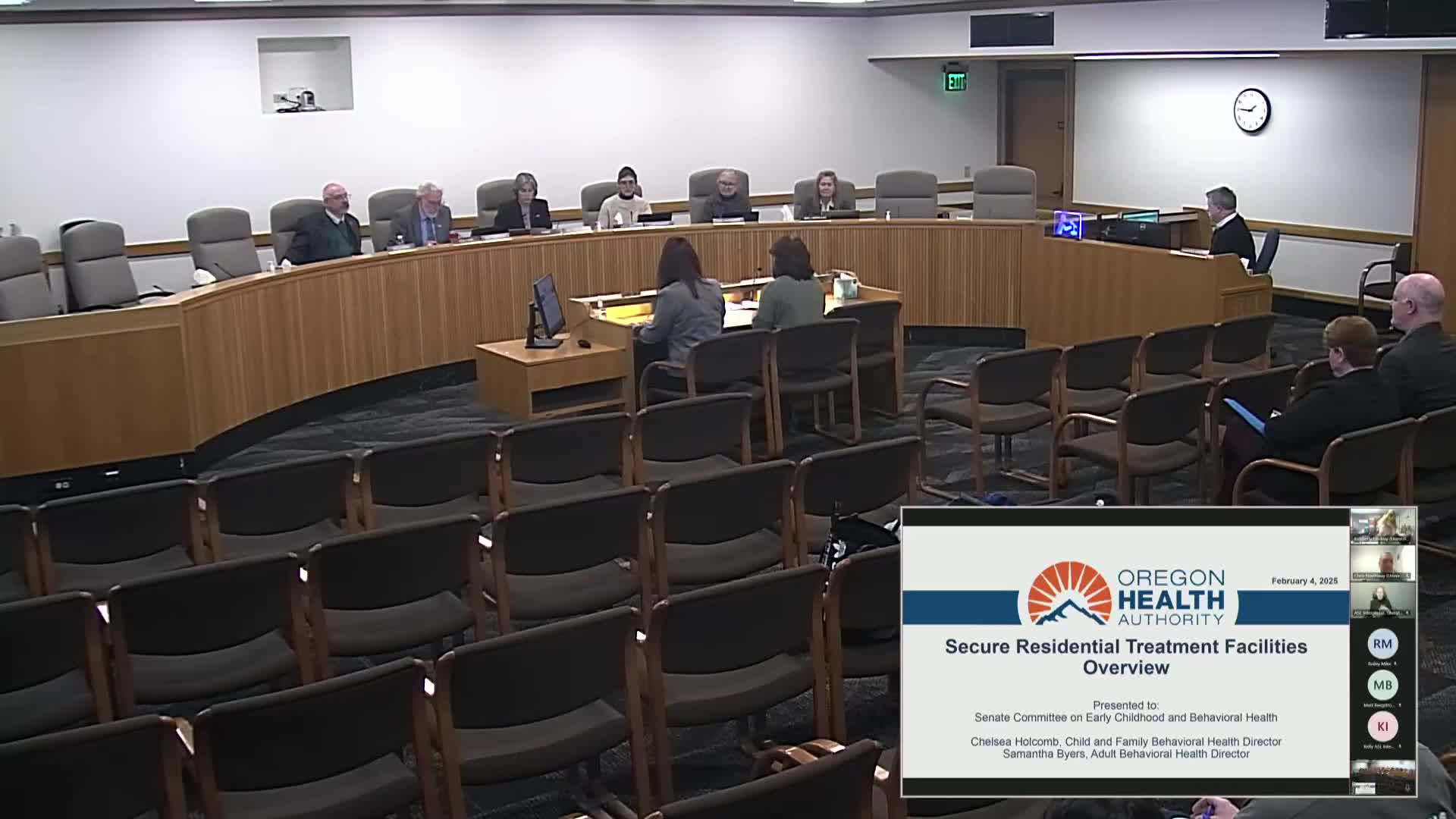
Dr. Sarah Walker, chief medical officer and interim superintendent of the Oregon State Hospital, told the Senate Committee on Early Childhood and Behavioral Health on Feb. 4 that the hospital is full and operating under pressure from a federal court restoration order and rising criminal forensic referrals.
Walker said the hospital admits about 94 people a month under so‑called aid-and-assist commitments and discharges roughly the same number, leaving little room for additional orders. “We are at 98% capacity, so to admit a patient requires discharge of a patient,” Walker said, describing months in 2024 when incoming orders exceeded the hospital’s ability to admit and the state fell out of compliance with the federal restoration timeline.
The hospital’s population is now largely forensic: Walker described roughly 55% of patients as admitted under aid-and-assist commitments for restoration to competency, roughly 35% as individuals found guilty except for insanity under Oregon’s GEI process and smaller shares under civil commitments and the “extremely dangerous person” civil commitment. She said median lengths of stay differ sharply by commitment type: about 90 days for many aid-and-assist patients and multiple years for the GEI population.
Why it matters: Walker told the committee the combination of more orders, higher patient acuity on arrival and long stays for some civil‑commitment patients constrains the hospital’s ability to meet the federal court’s timelines for restoration. She traced the timeline to litigation filed by Disability Rights Oregon and metropolitan public defenders and to an order from U.S. District Judge Michael W. Mosman in 2002 that established limits on maximum hospital restoration durations. Under those limits, Walker said, the hospital must discharge or otherwise resolve restoration cases within predefined time caps tied to the severity of the underlying charge.
Walker described the hospital’s services and staffing model: the two main campuses (the Peter Courtney Salem campus and a smaller Junction City campus), a range of long‑term treatments and supports, on‑site medical and dental care, and several secure residential treatment units licensed at a different level. She said substance use disorders are common among patients—official charts list about 65% of patients with a diagnosed substance use disorder, and staff report many more with substance use histories—and that the hospital is rebuilding and expanding substance use disorder treatment capacity.
On staffing and resources, Walker said the hospital is seeing higher acuity on units, more one‑to‑one staffing needs, greater use of seclusion or restraint and more unmet medical needs among patients who are often homeless at arrest. She said the hospital largely lacks Medicaid coverage for patients while they are detained and that many staff are new following pandemic turnover.
During the same meeting the committee opened a public hearing on Senate Bill 834, a technical bill affecting Oregon State Hospital statutes. Katie Hart, committee staff, summarized SB 834 as proposing to prohibit minors from receiving care at the state hospital, permit psychiatric nurse practitioners to determine eligibility for the “extremely dangerous person” civil commitment, separate the superintendent and chief medical officer roles, require certified patient evaluators for evaluations, and replace the term “symptomology” with the more precise clinical term “symptomatology.”
Walker told the committee she supports the technical fixes and said the hospital has not operated a child and adolescent program since 2005. She also urged aligning statutes to recognize psychiatric mental health nurse practitioners who perform forensic evaluations and long‑term care work at the hospital.
The committee took public testimony on SB 834; no committee vote was recorded during the Feb. 4 session.