Get Full Government Meeting Transcripts, Videos, & Alerts Forever!
Get email alerts on the Biennial Energy Report topic
No spam. Unsubscribe anytime.
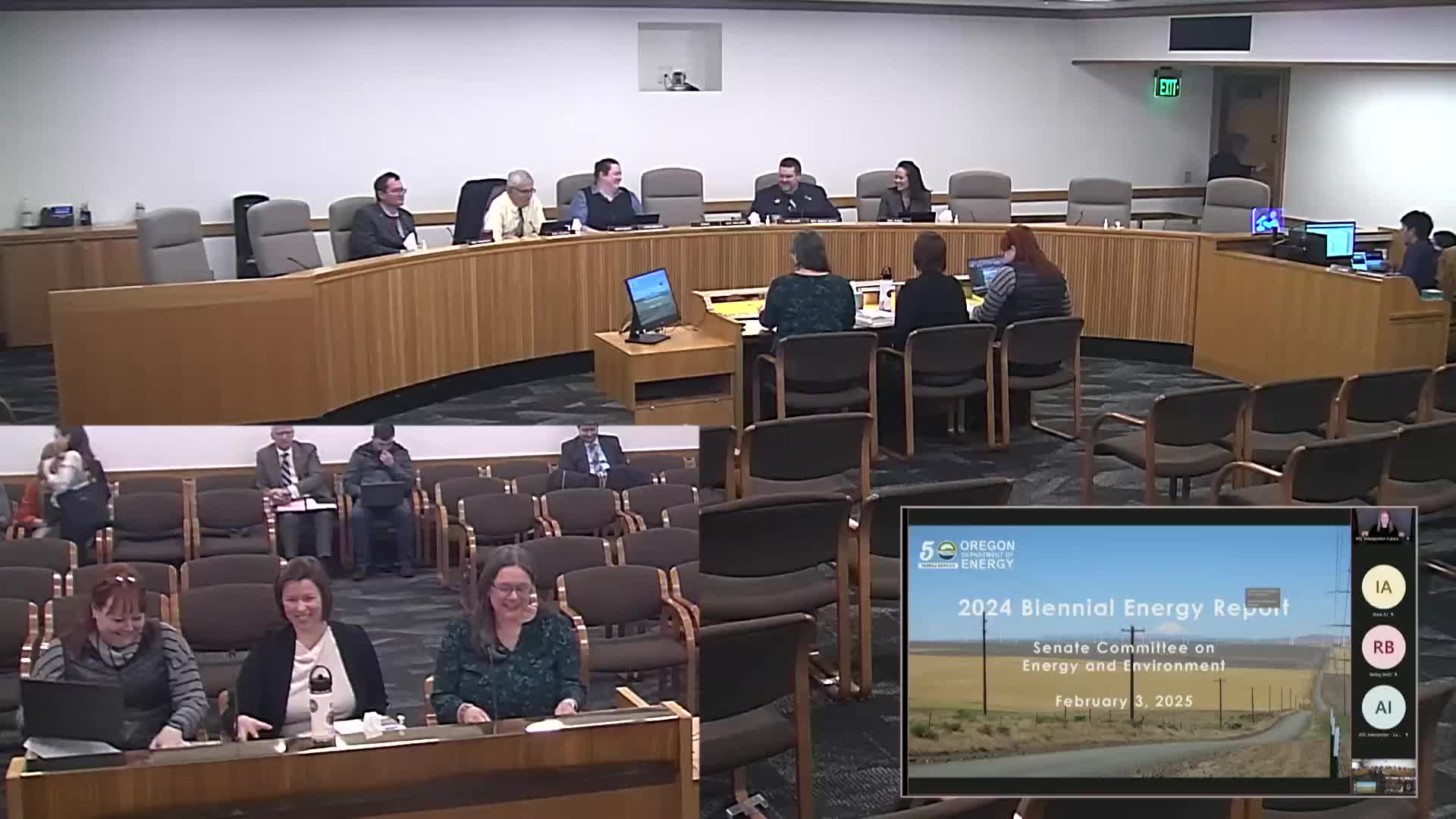
Department of Energy presents 2024 biennial energy report; Climate Action Commission urges carrying forward existing programs
Summary
Oregon Department of Energy staff briefed the Senate Energy and Environment Committee Feb. 3 on the 2024 biennial energy reportcovering energy flows, costs, emissions trends and energy burden. The Oregon Climate Action Commission gave a high-level update and recommended continuing existing programs to remain on track for emissions goals.
The Oregon Department of Energy presented highlights from its 2024 Biennial Energy Report and the Oregon Climate Action Commission delivered a brief update to the Senate Energy and Environment Committee Feb. 3, focusing on energy consumption, costs, greenhouse gas trends and household energy burden.
Kristy Split, government relations coordinator for the Oregon Department of Energy, opened the informational presentation and said the report is intended as a central repository of energy data and analysis for the legislature and other decision-makers.
Stephanie Cruz, an engineer in ODOE—s energy efficiency section, summarized key data: Oregon—s total energy expenditures rose to $19.5 billion in 2022, an increase of $7.4 billion since 2020, driven largely by higher transportation fuel costs. Cruz also noted that while per-capita energy consumption has declined over decades, electricity demand could increase rapidly: a regional forecast cited in the presentation projects as much as a 30% rise in electricity consumption across the Pacific Northwest in the next ten years.
The presentation covered the state—s resource mix for electricity, noting hydropower remains the largest in-state resource and that coal-fired generation serving Oregon customers is expected to end under the state—s coal-to-clean policy by 2030. Jessica Rikers, ODOE—s technology and policy manager, said increases in short-term market purchases are reflected in a new "unspecified" category in the state—s resource accounting; those purchases vary in price depending on regional supply at the time of purchase.
The department also highlighted social impacts. Cruz said 477,540 Oregon households (about 28.5% of households) were considered highly or severely energy burdened in 2022, an increase of roughly 100,000 households since 2020. "Energy burden is a significant concern for Oregonians, and the number of energy burden households is higher in many rural areas of our state," she said.
Committee members asked about drivers of recent rate increases and whether wildfire mitigation costs are a major component. ODOE staff said drivers include rising wholesale power costs, infrastructure and weather extremes; the department offered to follow up with specific utility cost breakdowns. Members also discussed alternatives to building new transmission and ways to reduce wasted energy on the system.
Catherine McDonald, chair of the Oregon Climate Action Commission, said the commission—s biennial report and a separate report on investments in the Natural and Working Lands Fund were filed with the legislature in December and recommended the legislature commit to carrying forward programs already passed that the commission expects will be critical to meeting Oregon—s 2035 emissions goals. "Our biggest recommendation is for the legislature to really make a commitment to carrying those programs forward," McDonald said.
The informational session covered multiple technical topics (hydrogen hubs, agrivoltaics, peak demand, energy resilience and transmission alternatives) and ODOE staff said the full biennial report (and related topic briefs) is available online. The committee did not take formal action on the informational item.
Ending: ODOE staff and the commission urged lawmakers to use the biennial report as a reference for forthcoming policy choices and to consider energy-burden and resilience implications when advancing energy and climate legislation.