Get Full Government Meeting Transcripts, Videos, & Alerts Forever!
Get email alerts on the Court Revenue topic
No spam. Unsubscribe anytime.
State court officials flag collection trends and possible shortfall in criminal fines account
Summary
Oregon Judicial Department officials and the Department of Revenue told a House Public Safety subcommittee that changes to how courts prioritize restitution, pandemic impacts on filings and shifts in collection practices have reduced revenue flowing to the Criminal Fine Account, creating a modest shortfall that may require legislative attention.
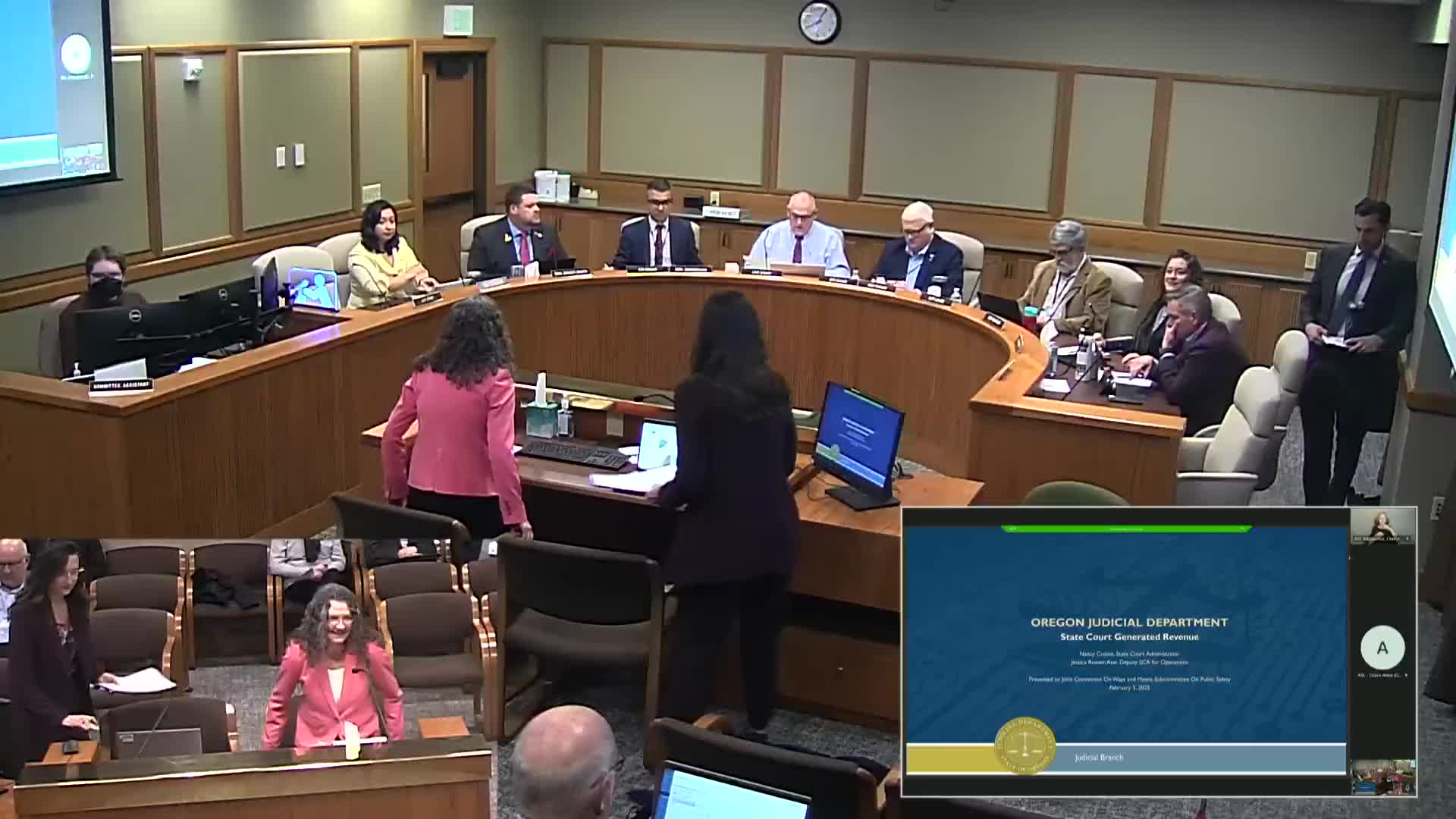
State Court Administrator Nancy Kozine and Oregon Judicial Department operations official Jessica Rozier told the Oregon House Public Safety Subcommittee on Feb. 5 that courts are collecting less money from fines and fees than in past biennia and that statutory changes and pandemic disruptions have shifted more revenue to victims and away from the Criminal Fine Account.
Kozine told Co-Chair Bridal, Co-Chair Evans and subcommittee members that courts do not retain most fines and fees and must accurately distribute funds each month to victims, the state general fund, the Criminal Fine Account and local citing agencies. Kozine quoted a national guidance paper, saying, “State courts occupy a unique place in democracy. Public trust in them is essential,” and repeated the courts’ stated principle that they are “not established to be a revenue generating arm of any branch of government.”
The subcommittee heard that total court-collected revenue has declined from prior biennia. Jessica Rozier summarized recent totals, saying the judicial department collected roughly $297 million in 2017–19, about $250 million in 2019–21 and had taken in approximately $176 million in the first 18 months of the 2023–25 biennium. She and Kozine attributed part of that decline to pandemic-era reductions in civil filings and violations, changes in enforcement (including limits on license suspensions for nonpayment) and statutory changes such as House Bill 4,075 (2022) that reprioritized restitution ahead of fines and fees.
Rozier explained practical effects: restitution judgments can take decades to collect — “often years to collect and those judgments are valid for up to 50 years,” she said — and because restitution now has priority, less money reaches the Criminal Fine Account in the short term. The department reported that most violations are paid within a year of processing and that the current collection rate for violations is about 72%, with a 64% collection rate for misdemeanors and an 82% rate on smaller parking matters. Civil filing fees are paid nearly in full at filing, at about 97% collection.
Officials described operational practices intended to improve collections and reduce long-term unpaid, “stale” debt: lowering payment-plan fees (now a nominal $25), offering year-long grace before referring unpaid judgments to collections, increased use of payment plans and automated reminders, and work to “right-size” fines so they are payable. Kozine said those changes have improved overall collection performance over the past five to six years, moving an historical overall rate from about 65% to roughly 72%.
The subcommittee also heard an accounting of outstanding court debt and collection costs. Rozier and Kozine said outstanding court debt peaked near $1.8 billion in 2019 and has since declined to roughly $1.5 billion after pandemic-era policy actions and remittance/clemency orders. Collection costs include a statutory 28% collection fee applied before Department of Revenue (DOR) referral and private collections, and judicial-department appropriations for third-party collection work. Kozine told the committee that, according to the department’s data, “for every dollar we spend on those collection efforts, we get 4 to $5,” a return she said has outstripped collection costs in recent biennia.
After the court presentation, legislative staff and agency representatives briefed the subcommittee on the Criminal Fine Account (the account is established in statute and managed by DOR). Legislative Counsel Jessica Menifee reviewed ORS 01/7300 (statute establishing the Criminal Fine Account) and explained the statutory allocation priorities the Legislature set in 2011 and has adjusted in later budget bills. Menifee noted the statute lays out a prioritized list of purposes (including DPSST training, crime victim compensation and forensic services) but is silent on what to do if account receipts are insufficient to fund the prioritized allocations.
John Borden, committee staff, and DOR representatives Exanne Culver and Katie Lawley described how receipts are collected, tracked and distributed monthly. DOR said it divides biennial allocations into 24 monthly transfers and is limited by law from transferring more than one-eighth of an allocation in any quarter. Lawley said the account’s receipts have declined and that, as of December 2024, the Criminal Fine Account showed a shortfall of a little more than $3 million relative to allocations — a point-in-time figure that may change with subsequent months’ receipts and tax-season activity.
DOR staff told the subcommittee that when quarterly receipts are insufficient, the department prioritizes the statute’s top-tier allocations and prorates remaining distributions among lower-tier recipients, and that any leftover balance at the end of a biennium is transferred to the state general fund. Menifee said earlier drafts of the statute included language directing proportional reductions when receipts were insufficient; that language was removed during the 2011 enactment, and she said the statute now is silent on the exact mechanics if allocations exceed receipts.
Committee members asked for additional information, including the fiscal impact of Multnomah County’s arrangement (circuit court acting as municipal court) and more granular breakdowns of collections costs over time. Representatives pressed for follow-up data on the number of hearings tied to collection actions, appellate caseloads related to fee disputes, and whether better front-end income-verification tools could help courts set appropriate fines. Kozine and Rozier said courts have some tools (verification staff, credit checks for specific programs) but that statewide, practices vary and additional integrations with DOR would require funding and policy work.
The hearing was informational; no action or votes were taken. Subcommittee members were told the account’s forecast will be revisited in the Office of Economic Analysis February and June revenue forecasts and that statutory or budget adjustments may be needed if the shortfall persists.
Ending: Subcommittee staff said they will pursue follow-up data requested by lawmakers, including clearer breakdowns of collection costs by year, the Multnomah County circuit/municipal arrangement, and the potential cash-flow and statutory remedies if the Criminal Fine Account continues to underperform against allocations.