Get Full Government Meeting Transcripts, Videos, & Alerts Forever!
Get email alerts on the Tax Increment Financing topic
No spam. Unsubscribe anytime.
State auditor: housing TIFs rising in Greater Minnesota; many districts decertify early
Summary
The Office of the State Auditor told the Senate Taxes Committee that housing districts have become the most common TIF district type in Greater Minnesota and that a growing share of TIF districts end earlier than their statutory duration, returning tax base sooner than planned.
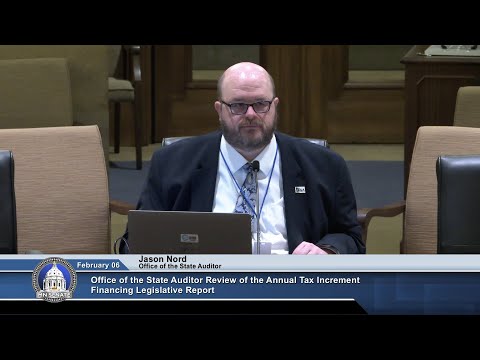
The Minnesota Senate Taxes Committee heard the Office of the State Auditor’s annual tax increment financing (TIF) report on Feb. 6, 2025. Jason Nord, division director at the Office of the State Auditor, presented the office’s 2023 data (reported to the auditor in 2024) and described recent patterns in district types, revenues and decertifications.
Nord told the committee the report shows housing districts overtook redevelopment districts in Greater Minnesota by count, though most TIF dollars remain concentrated in the Twin Cities metro. “My name is Jason Nord. I’m the Division Director at the Office of the State Auditor,” Nord said when he opened his presentation. He added the office had added new charts this year “to kind of drill into” early decertification trends.
The nut graf: the auditor’s report highlights two related trends that shape local tax revenues and redevelopment policymaking — a shift in the kinds of TIF districts cities create, and a rising share of districts that end before their statutory maximums, which returns captured tax base to counties, cities and schools sooner than previously expected.
Most important facts: Nord summarized statewide counts and dollar flows. The auditor’s presentation said roughly 382 TIF authorities exist in Minnesota, and the office received reports from 378 authorities covering 1,678 districts (four authorities did not report for six districts). By count, 61% of districts are located outside the metro area; by dollars, roughly 78% of increment was generated in the metro area, reflecting higher property values and larger projects there. The presentation reported about $2.38 billion of tax increment created in 2023 and roughly $7.4 million of increment returned to counties, cities and school districts in 2023 when districts had more increment than they were authorized to spend or when jurisdictions voluntarily returned funds.
Nord walked committee members through financing types and risk shifts. Pay-as-you-go notes are now the most common financing vehicle for TIF obligations; general obligation bonds, which place risk on taxpayers if projects underperform, have declined in use. The report lists about $1.8 billion of outstanding TIF-related debt statewide and shows an increasing reliance on pay-as-you-go arrangements that place more risk on developers and note holders than on local taxpayers.
On decertifications, Nord emphasized a marked shift: a large share of districts are ending earlier than their statutory maximums. The report finds that more than three-quarters of housing and redevelopment districts decertified before their maximum allowed life, on average nearly a decade early; many economic development districts (which have shorter maximum terms) also end several years early. Nord told members the 5-year and 6-year rules (statutory guidance about when a district should be decertified once it has sufficient increment to meet necessary costs) and recent practice both appear to be driving earlier decertifications.
Committee members asked about comparisons with other states, the rigor of the statutory “but-for” test (the local finding that a project would not occur without TIF), and how common shortfalls in increment are handled. Nord said cross-state comparisons were not part of the report and that Minnesota’s pooling provisions (which allow up to 25% of increment to be shared) are not universally available in other states. On the but-for test he said the determination is made locally — typically by the city council or authority — and that statute generally makes the local finding conclusive after a short challenge window.
Why it matters: the shift to earlier decertification changes when property value increases return to other taxing jurisdictions (counties, cities, schools), affects the size and type of projects that can be financed with TIF, and influences legislative proposals about TIF duration, blight standards and reporting.
Chair remarks and follow-up: Chair Rest told members she will bring general-law legislation to address the renewal/renovation and redevelopment distinctions and to adjust duration and but‑for standards so fewer special‑laws are needed. Committee members indicated they would use the auditor’s charts to inform upcoming legislation. The report’s author offered to supply follow-up lists and city-level details at the chair’s request.
Ending: Committee members praised the auditor’s office for the report and signaled it will inform debates this session over possible statutory changes to TIF rules and oversight.